
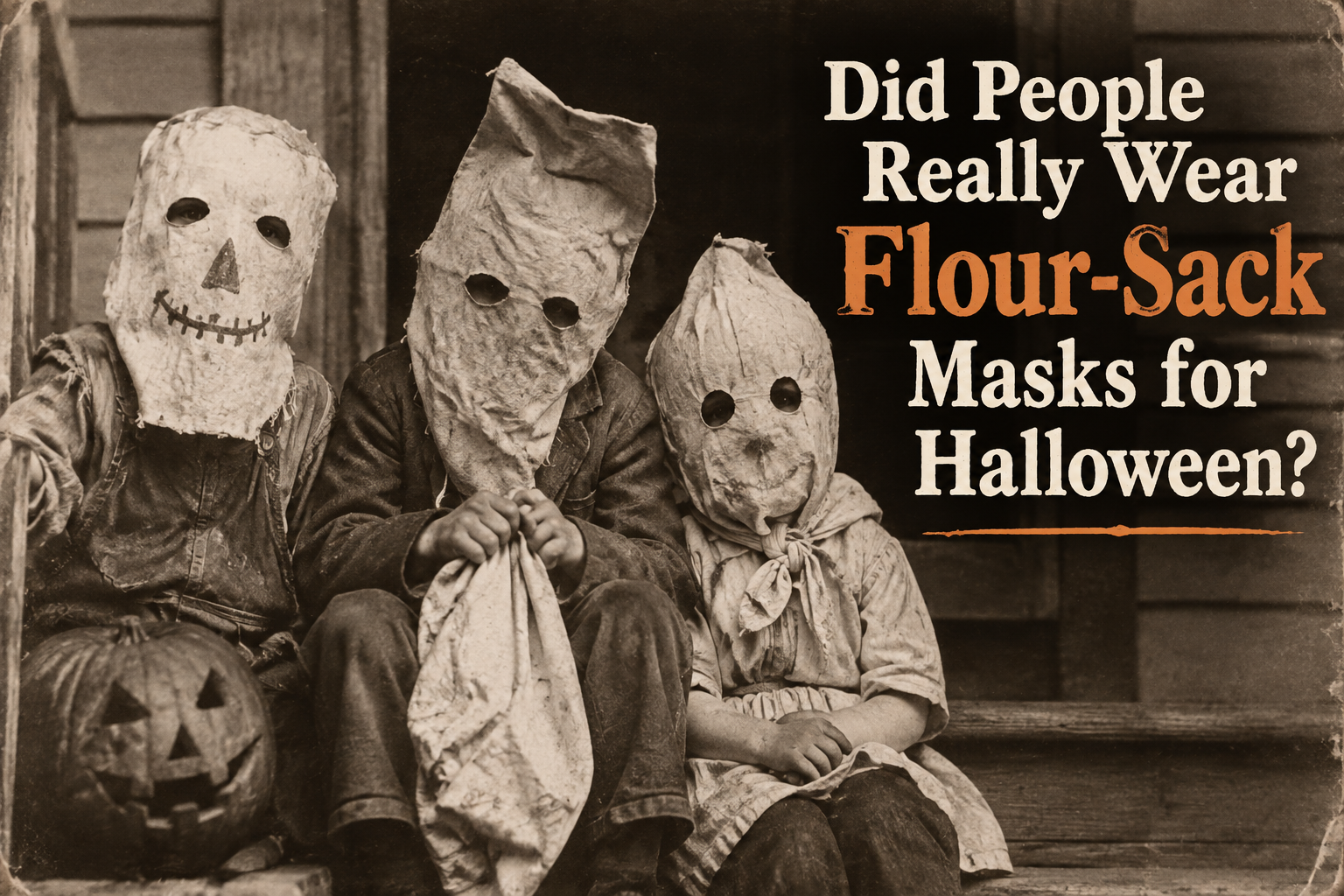
There is something uniquely unsettling about an old Halloween photograph where somebody has pulled a cloth sack over their head, cut a couple of eyeholes in it and apparently decided, Yep. Costume finished.
It looks less like trick-or-treating and more like the opening five minutes of a movie in which absolutely nobody should go into the basement.
But flour-sack masks weren’t simply invented by modern horror movies.
People really did make masks from flour sacks.
And once you understand what an empty flour sack meant to an earlier household, the idea becomes considerably less strange.
There Are Real Flour-Sack Halloween Masks in Museum Collections
One particularly good piece of evidence survives at the Horniman Museum and Gardens in London.
The museum identifies one of its objects as a Celtic Halloween mask made from a square piece of cloth from a flour bag. A Horniman Museum feature describes the mask as dating from the first half of the 20th century and says it was used to celebrate Halloween in Ireland.
It is wonderfully simple.
Cloth. A face. Openings to see through.
No molded plastic. No elastic strap. No trip to the Halloween aisle in September.
And flour-sack masks weren’t limited to one surviving Irish example.
In 1935, the American recreation magazine Recreation reviewed a mask-and-costume instruction booklet produced by the Recreation Division of Chicago’s South Park Commissioners. The booklet started with paper masks and progressed through flour-sack and cotton-stocking masks before moving on to more elaborate papier-mâché creations. Its projects included Halloween and grotesque masks.
So this wasn’t merely somebody improvising once because they couldn’t find the costume box.
A flour sack was recognized as perfectly usable mask-making material.
Why a Flour Sack?
This is the part that immediately reminded me of my own family.
My grandmother used to say that her mother used flour sacks for just about anything they could be used for.
Her reasoning was wonderfully practical: the sack had already been paid for when you bought the flour. Why would you throw away perfectly usable material?
I know she used them for drying dishes. And that wasn’t unusual.
The Smithsonian describes the thrift practiced by American farm families in the 1920s and 1930s and says women turned feed sacks and flour bags into dresses, underwear, towels, curtains, quilts and other household necessities.
There is even a surviving flour-sack dish towel in the collection of the La Crosse County Historical Society. Its maker, Winifred Mattson, remembered Depression-era families using the sacks for clothes, towels and small tablecloths.
So today we might look at an empty sack and see packaging.
They looked at it and saw fabric.
And Yes, Flour Sacks Really Did End Up in Quilts

That was another family use I remembered, and the museum record backs it up.
The Smithsonian has several Depression-era quilts containing flour- or feed-sack material. One Log Cabin quilt made between 1931 and 1934 has a back made from feed/flour sacks, with some of the old lettering still faintly visible.
Another child’s quilt from the same period was also backed with feed/flour sacks.
The Smithsonian American Art Museum even has a 1930s string quilt specifically cataloged as having a flour-sack backing.
Nothing useful went to waste if somebody could figure out another job for it.
A sack might start out carrying flour, become a dish towel, supply fabric for sewing, or wind up in a quilt.
And if Halloween arrived somewhere along the way?
Apparently it could become your face.
Why Do Those Old Sack Masks Look So Creepy Now?
This may be the funniest part.
They weren’t necessarily trying to create the nightmare fuel we see today.
We’re accustomed to Halloween masks being professionally designed. Even inexpensive ones have symmetrical eyes, molded faces, recognizable characters and factory-perfect shapes.
A homemade cloth mask doesn’t behave that way. The fabric wrinkles. The eyeholes aren’t necessarily even.
A painted face shifts when the cloth moves.
The head underneath gives it a shape that is almost — but not quite — human.
Add an old black-and-white photograph and suddenly Great-Grandpa’s inexpensive homemade costume looks like somebody we should probably report to the authorities.
The simplicity is exactly what makes many of them so effective now.
Flour Sacks Weren’t Disposable Packaging
That’s really the piece that changes the story.
Looking backward from a world full of disposable bags and packaging, making clothing or a Halloween mask out of a flour sack can sound like an odd novelty.
It wasn’t.
For many households, throwing away usable cotton fabric would have been the strange choice.
Flour and feed companies eventually understood this too. Manufacturers began producing sacks in attractive colors and prints because the fabric’s second life mattered to the people buying the product. The Smithsonian notes that companies found the popularity of sack fabrics could actually influence which brand customers chose.
That is recycling with some serious economic incentive behind it.
My great-grandmother’s attitude may sum it up better than anything else: She had paid for the sack. The flour may have been its first job. Nobody said it had to be its last.
So, Did People Really Wear Flour-Sack Masks for Halloween?
Yes.
We have surviving museum examples, and period recreation material confirms that flour sacks were intentionally used for mask making.
But the mask makes much more sense when we stop thinking of a flour sack as trash.
It was cotton fabric already in the house. The household had paid for it. People routinely found second, third and sometimes fourth uses for material like that.
A dish towel? Certainly.
A quilt? Absolutely.
A Halloween mask?
Apparently all you needed were scissors — and perhaps a willingness to terrify the neighbors.