
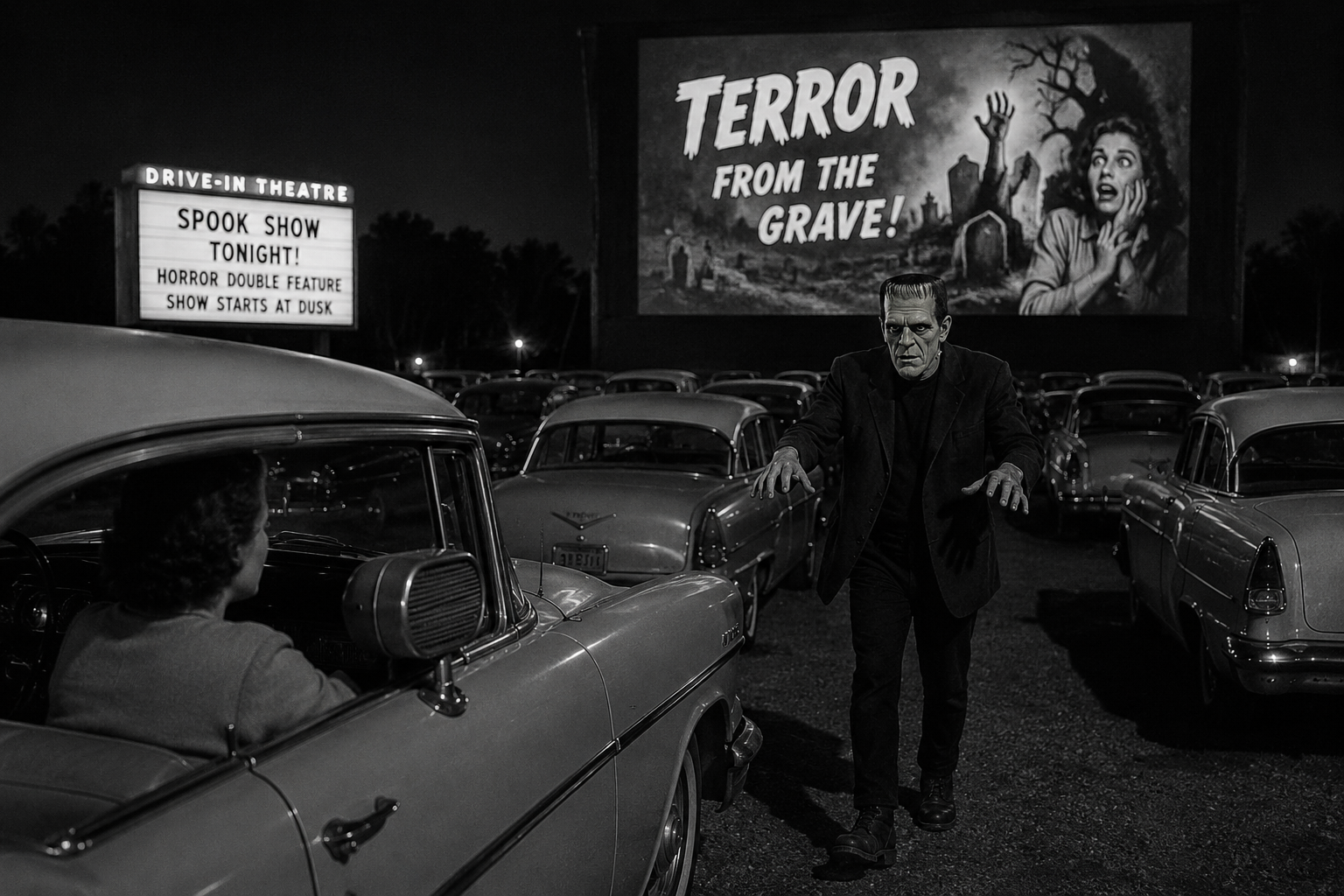
Imagine settling into your car at the drive-in.
The speaker is hanging from the window. There’s popcorn somewhere between the front seat and the kids in back. A horror movie is flickering across that enormous outdoor screen.
Then Frankenstein comes running between the cars.
Not on the screen.
In the parking lot.
Because apparently watching a monster movie from the relative safety of your Buick wasn’t exciting enough.
For a while, particularly during the 1950s and 1960s, some drive-in theaters went considerably beyond simply showing scary movies. They advertised spook shows, ghost shows, Spook-Taculars and midnight horror programs designed to turn the entire evening into an attraction.
Sometimes that meant an all-night lineup of horror movies and a theater decorated with skeletons.
Sometimes there were live performers, stunts and assorted spooky nonsense.
And sometimes somebody in a cheap rubber monster mask really did come charging through the rows of parked cars.
Drive-in movies were already a little strange after dark.
Somebody looked at that and apparently thought:
Needs monsters.
Before Drive-Ins, There Were Ghost Shows
Drive-ins didn’t invent the spook show.
They just discovered that adding several hundred cars made one even more interesting.
Long before drive-in theaters borrowed the idea, traveling performers were putting on elaborate late-night ghost shows inside regular movie theaters.
They became particularly popular during the 1930s, 1940s and 1950s, and these weren’t simply screenings of horror movies.
A traditional ghost or spook show might include stage magic, fake séances, hypnosis, comedy, gruesome illusions, horror skits and costumed monsters before or alongside a scary movie.
One of the favorite tricks was the blackout.
The theater would suddenly go completely dark.
Then glowing ghosts, skeletons or other unpleasant visitors might appear around or above the audience.
Frankenstein could lumber onto the stage.
A magician might summon the dead.
Someone might lose a head.
Presumably it was returned before the next performance.
Promoters gave themselves wonderfully dramatic names such as Dr. Evil, Dr. Silkini and assorted other supposed authorities on ghosts, monsters and things that probably should have remained wherever they had been summoned from.
It was part horror movie, part magic show, part carnival sideshow and part haunted house.
Then the drive-ins got hold of the idea.
Things were about to get interesting.
Taking the Spook Show Outside
A drive-in couldn’t reproduce every trick that worked inside a dark theater.
There was no auditorium ceiling for dangling glowing ghosts, no stage at many drive-ins and no easy way to make hundreds of automobiles disappear into a carefully controlled blackout.
But drive-ins had something indoor theaters didn’t.
Acres of darkness.
Rows and rows of parked cars.
And an audience staring straight ahead at a giant screen, not necessarily paying attention to whatever might be sneaking up behind them.
That opened up possibilities.
Some drive-in spook shows were fairly straightforward: horror double features, triple features, midnight programs or dusk-to-dawn monster marathons promoted with suitably alarming advertising.
Others added Halloween decorations and live attractions.
And then there was the wonderfully low-tech option:
Find somebody with a monster costume and turn them loose in the parking lot.
An account of a drive-in horror show during the 1960s remembers local teenagers wearing cheap monster masks and running among the cars while the movie played.
Cheap?
Certainly.
Effective?
Imagine watching a horror movie in the middle of a dark field and suddenly discovering a creature staring through the passenger-side window.
Nobody is stopping to inspect the quality of the mask.
This Wasn’t Just One Weird Theater
Period theater publications show that drive-in operators really were promoting spook shows.
In 1952, the theater trade magazine Boxoffice reported Halloween spook shows at numerous theaters and drive-ins around San Antonio, Texas, including the Alamo, Rigsby, Kelly, Mission, Fredericksburg Road and Trail drive-ins.
That same issue reported that the Diane 29 Drive-In in Gastonia, North Carolina, held another all-night Halloween program and decorated the theater with skeletons and other spooky effects.
So this wasn’t one eccentric drive-in manager who owned a Frankenstein costume and had too much free time.
It was a promotion.
And like many things in drive-in history, the point was very simple:
Get more cars through the gate.
Turns Out Monsters Were Good for Business
And apparently they were.
In July 1954, Boxoffice reported that the Governor Ritchie Drive-In in Glen Burnie, Maryland, held a special Spook Festival.
The promotion produced what the magazine described as an all-time high gross for the drive-in.
Which explains quite a bit.
Drive-in owners were constantly looking for something that would turn an ordinary night at the movies into an event.
They tried contests.
Giveaways.
Fireworks.
Playgrounds.
Live appearances.
Promotional stunts.
Anything that might convince another carload of people that they really ought to go to the drive-in tonight.
Then somebody discovered that monsters worked too.
You can almost picture the manager looking at the night’s receipts afterward.
Skeletons?
Absolutely.
Frankenstein?
Book him again.
Halloween Wasn’t Required
Naturally, Halloween was perfect for a spook show.
But theater owners weren’t about to wait an entire year when the calendar offered another perfectly good excuse.
Friday the 13th.
On March 13, 1959, the Skyway Drive-In near Texas A&M advertised a “Fantastic Friday 13 Spook Show.”
The program paired Macabre with Hell’s Five Hours.
The Skyway was no stranger to wonderfully dramatic movie titles. Its bookings also included Voodoo Woman, The Undead, Attack of the 50 Ft. Woman, The Blob and I Married a Monster from Outer Space.
Honestly, at that point a regular romantic comedy probably would have seemed suspicious.
Some Drive-Ins Kept Doing It
Other theaters apparently decided one spook show wasn’t enough.
Historical records for the Oasis Drive-In near Chicago mention a Spooktacular in October 1960, another spook show in 1961, a Spook-Tacular in 1962 and another planned spook show in 1964.
Four different years.
Whatever they were doing out there, people apparently kept showing up for it.
And that tells us something about old drive-ins that gets lost when we remember only the giant screen, the snack bar and those little metal speakers hanging from car windows.
The movie wasn’t always the entire attraction.
The drive-in itself could become part of the show.
So Did Monsters Really Roam Between the Cars?
At least sometimes, yes.
Not every newspaper advertisement or trade report tells us exactly what happened after the cars came through the gate, so we shouldn’t assume every program advertised as a “spook show” included live monsters.
Some were probably horror-movie marathons dressed up with a terrific name.
Others were much more elaborate.
Traditional ghost-show performers had long used costumed monsters and live horror acts, and later versions of those shows were adapted for drive-ins. Accounts include creatures running between parked cars and performers appearing around concession areas.
And really, you didn’t need Hollywood special effects.
You already had the perfect setup.
It’s midnight.
You’re sitting in a dark car.
The giant screen is glowing in front of you.
Everyone is watching the monster in the movie.
Nobody is watching Row 6.
Then something taps on the window.
There goes the popcorn.
Drive-Ins Were Almost Built for This
A drive-in already contained most of what a good spook-show promoter needed.
Darkness.
Isolation.
A giant glowing screen.
Plenty of places where you couldn’t quite see what was happening.
And hundreds of people conveniently sitting with their backs to a very large dark parking lot.
From a scare-the-customers standpoint, that’s practically cheating.
The audience was scattered through rows of automobiles instead of sitting together inside an auditorium.
That made the show harder to control.
It also made it wonderfully unpredictable.
A monster didn’t need to appear onstage.
It could appear beside your Buick.
The concession stand could become part of the attraction.
The parking lanes could become paths for wandering creatures.
Skeletons could decorate the grounds.
And since drive-ins already loved double features and late-night programs, stretching the whole thing into a midnight or all-night horror show wasn’t much of a leap.
Naturally, the Advertising Was Completely Reasonable
No.
No, it was not.
Spook-show advertising promised terror, screaming, supernatural forces, monsters, fainting and horrors apparently so terrible that no sensible human being should voluntarily buy a ticket.
Which, of course, was exactly why you bought a ticket.
Posters warned audiences not to come alone.
Promoters claimed attractions were too terrifying for the weak-hearted.
Ghosts were loose.
Monsters were alive.
Someone might go berserk.
Your hair might stand on end.
You would almost certainly scream.
And that was possibly before the second feature.
Subtlety was not the goal.
The goal was to make a carload of teenagers look at an advertisement and say:
We have GOT to go see this.
Where Did the Spook Shows Go?
Like the drive-in itself, the classic spook show belonged to a particular moment in entertainment.
Television brought horror hosts and monster movies directly into people’s living rooms.
The old traveling stage shows became less common.
Movie promotion changed.
Then drive-in theaters themselves began disappearing in large numbers.
But the spook show also disappeared because theaters gradually stopped selling the kind of spectacle that had once surrounded the movie.
The old drive-in didn’t always just show you a film.
It tried to give you a reason to leave the house.
Maybe there were fireworks.
Maybe there was a giveaway.
Maybe somebody appeared in person.
Maybe the kids got a playground.
Or maybe it was October, the horror movies were booked, skeletons were hanging around the property and somebody’s teenage nephew had been handed a werewolf mask.
You worked with what you had.
When the Monster Didn’t Stay on the Screen
That’s the part I love about the old drive-in spook show.
Movies normally come with an understanding.
The monster stays over there.
On the screen.
The Blob stays on the screen.
Frankenstein stays on the screen.
The werewolf definitely stays on the screen.
Everybody knows the arrangement.
Then along came the spook show and somebody decided to break the rules.
For one night, the giant outdoor screen wasn’t the only thing worth watching.
Because while everyone else was looking straight ahead…
you might have wanted to check the rearview mirror.
For More Information
Boxoffice — November 8, 1952 — period trade-magazine coverage of Halloween spook shows at multiple drive-ins, including the Diane 29 Drive-In.
Boxoffice — July 24, 1954 — reports the Governor Ritchie Drive-In’s Spook Festival setting an all-time high gross.
Texas A&M — Fantasyland/Aggieland Drive-In History — documents the Skyway Drive-In’s 1959 “Fantastic Friday 13 Spook Show.”
CrimeReads — The Lost History of America’s Traveling Ghost Shows — useful background on ghost shows and the firsthand memory of masked monsters running among cars at a drive-in.