
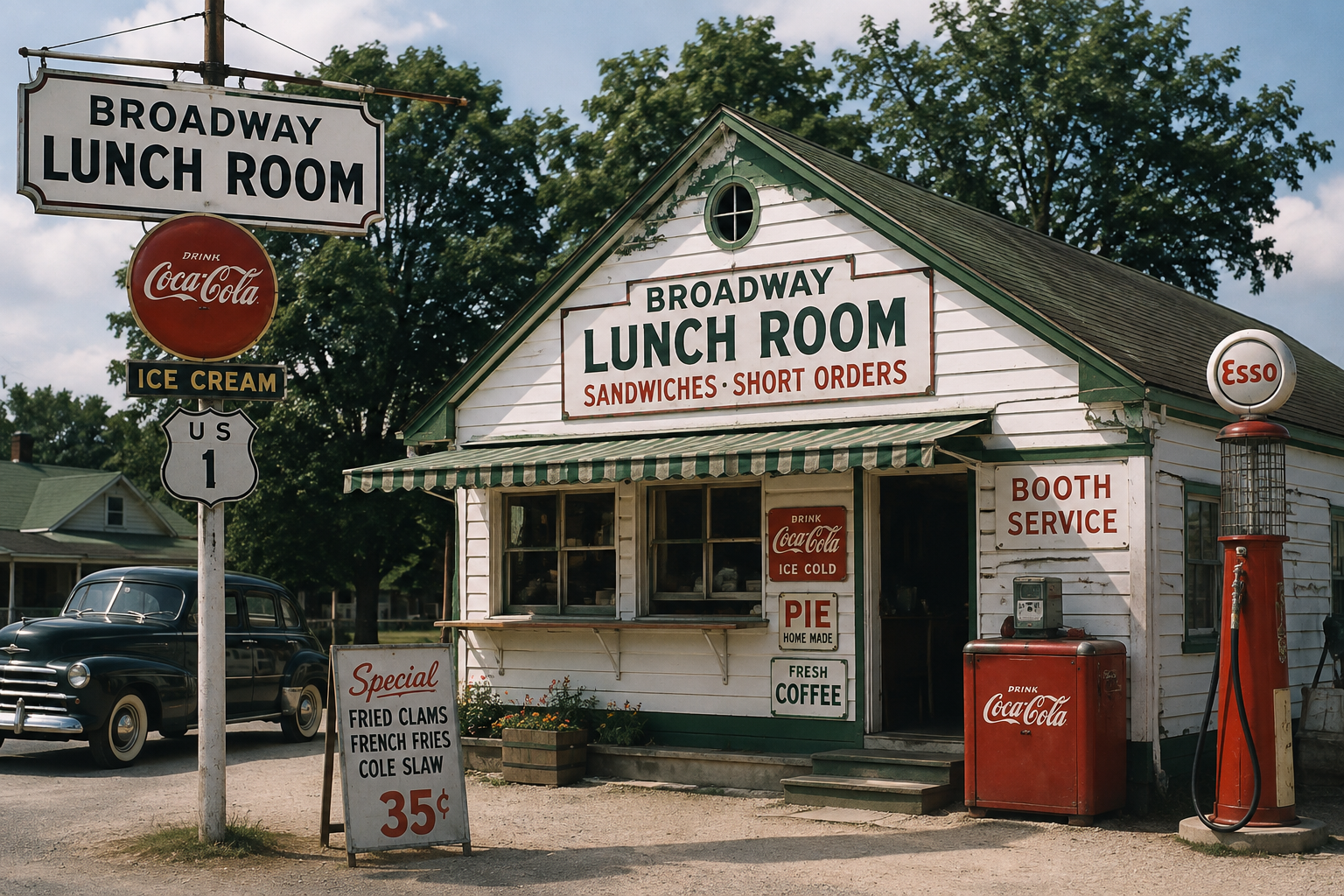
There was a time when a hungry traveler could be driving along a two-lane highway, spot a hand-painted sign that simply said LUNCH ROOM, and know exactly what it meant.
Well, more or less.
It might be a little building beside a gas station. It might have a counter and six stools. There might be a few tables, an ice cream freezer, a Coca-Cola sign and somebody’s homemade pie sitting under glass.
Nothing fancy.
That wasn’t the point.
You could get off the road, get something decent into a hungry traveler, maybe top off the gas tank, use the facilities and be moving again without turning lunch into a two-hour production.
Before fast-food exits, interstate service plazas and restaurants that looked exactly the same from Maine to California, little roadside lunch rooms did the job.
And for something that was once common enough to put on a sign without explanation, the term has almost disappeared.
So What Exactly Was a Lunch Room?
“Lunch room” wasn’t one rigid style of restaurant.
That is part of what makes the old term confusing today.
It generally meant a relatively small place where you could get a meal, sandwich, drink or snack without all the formality of a full restaurant. Some were little more than lunch counters. Others had tables. Some offered window service as well as seats inside.
And along America’s growing highway system, plenty of them became roadside lunch rooms.
We actually have a wonderful surviving example of what somebody around 1940 thought one should look like.
A catalog of farm and roadside buildings offered a plan called “Lunch Room—No. 433.”
The little rustic building was only about 16 by 14 feet in the main service area, but they managed to cram quite a bit into it.
There was a kitchen.
A counter.
An area marked for ice cream.
Another marked “pop.”
And restrooms, although the catalog cheerfully noted that those could be left out if the owner needed to save money.
Apparently even in 1940 there was a budget version.
The designers described it as offering both lunch-stand and lunch-counter service.
That little floor plan may explain the roadside lunch room better than any dictionary could.
You stopped.
You ate.
You got back on the road.
A Roadside Lunch Room Wasn’t Necessarily a Diner
This is where things get muddled today.
See an old photograph of a little roadside restaurant with a counter and stools and it is tempting to call it a diner.
But historically, diner had a more specific meaning.
The classic American diner grew out of the lunch wagon. Many traditional diners were factory-built structures manufactured somewhere else and transported to their location.
That is where those familiar long, narrow diner buildings came from.
A roadside lunch room didn’t have to be any of that.
It could simply be a little building somebody put up beside the highway.
It could be attached to another business.
It could sit beside a filling station.
It might have six stools, three tables and a screen door that slapped shut behind every customer.
So while a diner certainly served lunch, a roadside lunch room wasn’t automatically a diner.
Sometimes a lunch room was just…
a room where somebody sold you lunch.
Our ancestors could be wonderfully literal when naming things.
Gasoline, Pie and a Place to Sit Down
The automobile created an entirely new kind of hungry customer.
People weren’t just driving across town anymore.
They were taking Sunday drives. Visiting relatives. Going on vacations. Traveling between cities. Following numbered highways through places they had never seen before.
And eventually somebody in that car was going to announce that they were hungry.
Probably several miles after everyone else had suggested stopping.
All those travelers needed gasoline, bathrooms, something cold to drink and something to eat.
That created a natural marriage between the filling station and the lunch room.
Restaurant historian Jan Whitaker has documented combination gas-station/lunch-room businesses becoming commonplace during the 1920s and 1930s as recreational automobile travel grew.
One New England example was The Gables in South Deerfield, Massachusetts, where a roadside lunch business operated beside an unusual little lighthouse-shaped gas station.
And the combination wasn’t limited to New England.
Frankly, if I had been driving all day in 1934 and found gasoline, homemade pie and a bathroom in the same place, I wouldn’t have needed a billboard to convince me to stop.
What Would You Actually Eat There?
This is where roadside lunch rooms get more interesting.
There wasn’t one official American lunch-room menu.
Thank goodness.
The food depended on where you were, who owned the place, what the kitchen could handle and what people in that part of the country liked to eat.
The circa-1940 Lunch Room No. 433 plan specifically made room for ice cream and soft drinks, along with an actual kitchen and lunch counter.
Individual businesses advertised sandwiches, hamburgers, chicken dinners, tamales, homemade pies and plenty of other straightforward food.
But imagine what that could mean as you traveled.
Down South, the little place alongside the road might have somebody’s hush puppies or fried chicken coming out of the kitchen.
Get all the way up into Maine and perhaps today’s special involved seafood that hadn’t traveled very far at all.
Maybe Uncle Roy brought in the lobster that morning.
Maybe Aunt Mabel was the one making the hush puppies.
The names are imaginary, but that’s the point: a lot of these places were personal.
They belonged to somebody.
And whatever was normal where they lived could end up on the plate of somebody passing through.
The pie might be a towering apple pie with enough filling to make the top crust look slightly worried.
There might be blueberry pie where blueberries were plentiful, peach pie farther south, or whatever somebody in the kitchen happened to make particularly well.
And instead of choosing between the same national soft-drink brands everywhere, you might find a regional soda or something bottled fairly close to where you were sitting.
That meant stopping to eat could actually tell you something about where you had arrived.
Before the Roadside Tasted the Same Everywhere
That’s one of the things I find most interesting about old roadside food.
Today you can drive hundreds of miles, pull off the highway and order exactly the same hamburger you could have bought near home.
There is certainly something comforting about knowing what you’re going to get.
But we lost something too.
A roadside lunch room in Maine didn’t have to feed you the same thing as a lunch room in South Carolina.
The owners weren’t working from one national menu.
They used the ingredients available to them, cooked what local people ate and served what they thought travelers would buy.
So a road trip could change one meal at a time.
You weren’t necessarily seeking out “regional cuisine.”
You were hungry.
You stopped at the next place with a sign.
And regional cuisine sometimes found you.
They Were Built for People Who Still Had Somewhere to Go
A roadside lunch room wasn’t necessarily where you planned to spend your afternoon.
That mattered.
You had a destination.
Maybe you were trying to reach Grandma’s before dark.
Maybe there was still another hundred miles to go.
Maybe Dad had already announced three times that you were making “good time” and was not about to surrender that achievement lightly.
A small lunch room let you stop without really stopping.
Park the car.
Order at the counter.
Have a sandwich, a plate lunch, maybe a piece of that mile-high pie and something cold to drink.
Stretch your legs.
And get moving again.
No reservation.
No dress code.
No leisurely three-course meal.
Just enough of a break from the road to make the next stretch bearable.
That convenience was part of what made these little places work.
They Could Be Tiny Businesses
Not every roadside lunch room was a large operation with a glowing sign and a packed parking lot.
That 1940 building plan is a good reminder of just how small one could be.
A counter.
A handful of customers.
A compact kitchen.
Ice cream and soda tucked into whatever space remained.
For a family willing to do the cooking and serving themselves, a little roadside building could turn passing automobiles into customers without requiring a full-size restaurant.
And location was everything.
A lunch room beside a busy highway, gas station, tourist attraction or well-traveled crossroads had an endless parade of potential customers coming right past the door.
Some stopped once and were never seen again.
Others came through often enough that somebody behind the counter knew what they wanted before they sat down.
Truckers and local people could keep a place busy right alongside the vacationers.
That mix probably made some of these places considerably more interesting than the tiny building suggested.
The Term Was Once Completely Ordinary
One of the strangest things about researching roadside lunch rooms is how little explanation the old sources give.
They didn’t need to explain them.
In 1940, the New Jersey Department of Health casually referred to its work reaching everything from the State House to a “roadside lunch room a hundred miles away.”
Nobody stopped to define the term.
Everybody knew what one was.
That’s often the trouble with everyday history.
The things everybody understands at the time are exactly the things nobody bothers explaining for the people who come along eighty years later.
Nobody sitting at that counter in 1940 imagined we’d someday be staring at an old postcard wondering:
What the heck was a roadside lunch room?
So What Happened to Them?
The road changed.
The old two-lane highway world gradually gave way to bigger roads, bypasses and interstate highways.
Restaurants changed with it.
Drive-ins grew.
Fast-food chains spread.
Service plazas gathered fuel, bathrooms and food into larger operations.
And the language changed too.
Signs increasingly promised a DINER, RESTAURANT, COFFEE SHOP, SNACK BAR, DRIVE-IN or eventually the name of a chain everybody already recognized from fifty miles back.
“Lunch room” began sounding old-fashioned.
The businesses didn’t all vanish overnight.
Some grew into larger restaurants.
Some changed names.
Some survived for decades.
And some probably disappeared for the simplest reason imaginable:
The highway moved.
A bypass could be brutal.
Yesterday thousands of potential customers passed your front door.
Tomorrow they didn’t.
Another Little Piece of the Old Road
Today the words Roadside Lunch Room on an old postcard can sound almost mysterious.
They weren’t.
They described one of the simplest businesses along the American road.
A small place where somebody traveling could pull over, sit down, get something good into them and then continue on.
Maybe there was a gas pump outside.
Maybe there was homemade pie inside.
Maybe six stools at the counter constituted the entire dining room.
Maybe the soda came from a local bottler and whatever was on the plate tasted a little different from what you’d eaten two states ago.
It wasn’t quite a diner.
It wasn’t fast food.
It wasn’t necessarily a full restaurant either.
It belonged to that wonderful in-between world of old roadside travel, when stopping for lunch didn’t automatically mean eating exactly what you could have ordered back home.
Sometimes all a place needed was a sign that said:
LUNCH ROOM.
And if there was a mile-high apple pie under glass…
I would’ve stopped too.
Sources
- Brown-Blodgett Company, Modern Farm and Suburban Buildings: Farm Homes and Roadside Buildings, circa 1940 — “Lunch Room—No. 433.” https://dahp.wa.gov/sites/default/files/BrownBlodgettCoModernFarmSuburbanBuildings_c1940.pdf
- Smithsonian Magazine, “A Life Devoted to the American Diner.” https://www.smithsonianmag.com/arts-culture/a-life-devoted-to-the-american-diner-472278
- National Park Service documentation on the development of the American diner and lunch wagon. https://npgallery.nps.gov/NRHP/GetAsset/NRHP/64500250_text
- Restaurant-ing Through History, “The Gables.” https://restaurant-ingthroughhistory.com/2016/07/31/the-gables/
- New Jersey Department of Health, Report of the Director of Health, 1940. https://collections.libraries.rutgers.edu/sites/default/files/nj-health-stats/stats/NJ1940A.pdf
[…] of those. If you’re curious about the other half of that roadside meal-and-fuel world, see what a roadside lunch room was and why old gas stations rang “ding-ding” when a car […]