
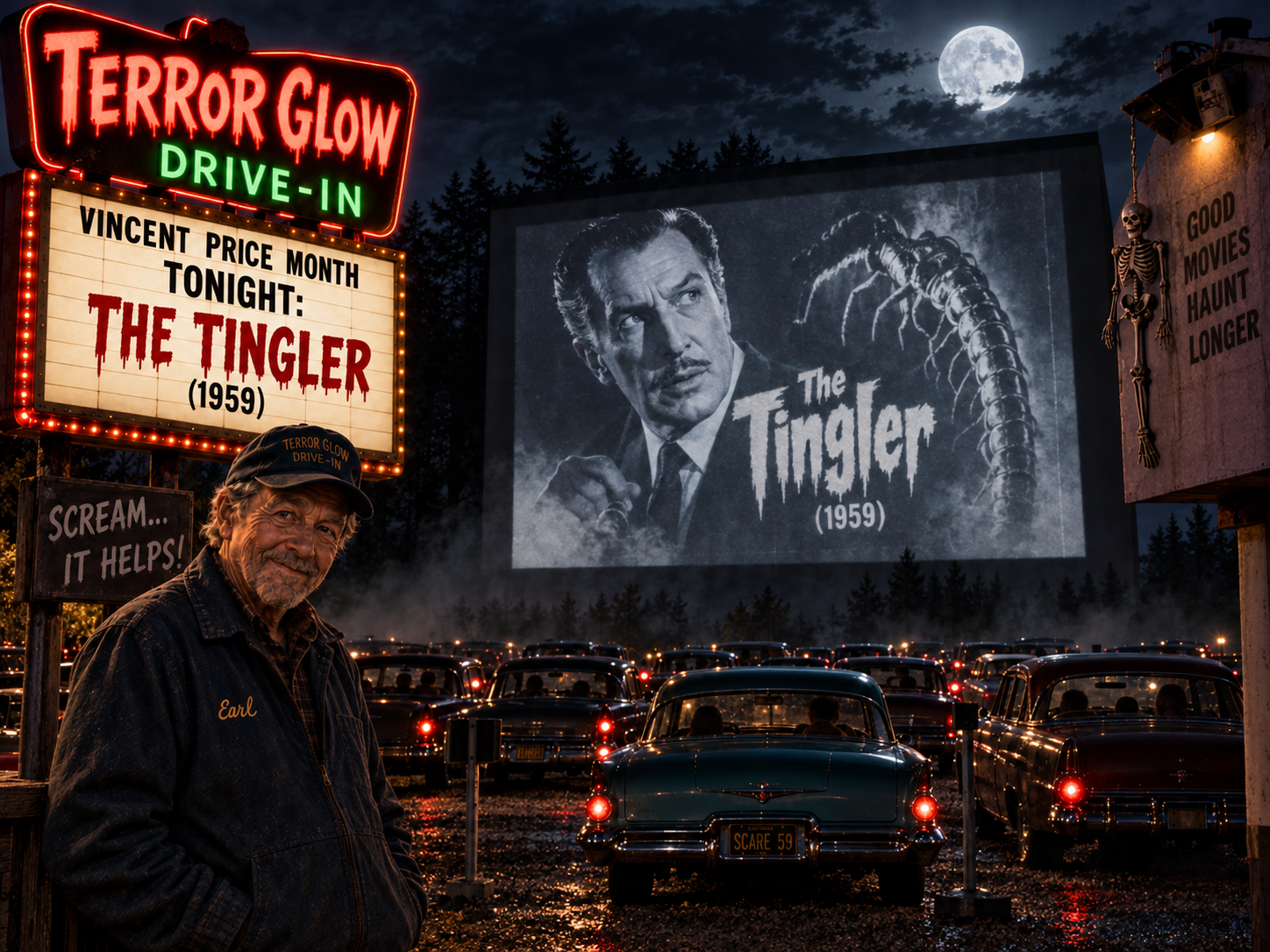
Last Friday, William Castle sent a skeleton flying over the audience.
Apparently that wasn’t enough.
This week he would like to electrify your seat.
Welcome back to the Terror Glow Drive-In, where Vincent Price Month continues with The Tingler — a movie built around the perfectly reasonable scientific theory that terror creates a creature on your spine and the only way to stop it is to scream.
Earl has already asked whether we can wire the parking lot.
The answer is no.
We have hidden the extension cords.
The Earl Rating
Feature: The Tingler
Year: 1959
Best watched: In the dark, preferably in a chair that has not been modified by Earl
Scare level: 3½ out of 5
1950s cheese: 5 out of 5
Vincent Price science: 5 out of 5
Chance William Castle had too much fun making this: Approximately 147%
So What Exactly Is a Tingler?
Dr. Warren Chapin, played by Vincent Price, is a pathologist studying fear.
Not fear in the philosophical sense.
He’s interested in what actually happens inside the human body when somebody becomes terrified.
And Chapin has a theory.
When people experience extreme fear, something physical develops along the spine.
A creature.
A parasite.
A Tingler.
Normally, screaming causes the thing to weaken and disappear.
Which means every time you’ve screamed because something moved in the basement, you were apparently practicing preventative medicine.
Things get considerably more interesting when Chapin encounters someone who cannot scream.
That allows him to study what happens when fear has nowhere to go.
And because this is a William Castle movie, the answer is not:
“Let’s publish our findings in a respectable medical journal.”
The answer is:
“Let’s unleash a giant spinal parasite.”
Sony’s official description is almost wonderfully matter-of-fact about the whole thing: Price plays an obsessed doctor who discovers that fear manifests itself as a parasitic creature growing on the spinal cords of terrified people.
Seems straightforward.
Earl would like to know whether insurance covers this.
Vincent Price, Scientist
Price is terrific here because he plays Warren Chapin surprisingly straight.
He isn’t cackling.
He isn’t wearing a cape.
He isn’t standing in a thunderstorm announcing that mankind has gone too far.
He’s curious.
Calm.
Intelligent.
And perhaps just a little too interested in discovering what terror does to the human body.
That makes the ridiculous premise work better than it has any right to.
If somebody else announced that fear produces a lobster-like creature on your spine, you might leave.
When Vincent Price says it, you start wondering whether your back has felt strange lately.
That’s his trick.
Price rarely seems embarrassed by the movie he’s in.
He commits.
And when the man with that voice calmly explains something completely insane, the insanity begins to sound almost reasonable.
Almost.
And Then He Takes LSD
Yes.
Really.
At one point Chapin decides that if he wants to understand fear properly, he needs to experience intense fear himself.
His scientific method involves taking LSD.
Remember:
This movie came out in 1959.
The psychedelic counterculture most people associate with LSD hadn’t arrived yet. The drug was still being studied experimentally, and The Tingler uses it as part of Chapin’s attempt to deliberately frighten himself.
TCM describes the sequence as the first acid-trip freak-out on American movie screens.
So there sits Vincent Price.
Alone.
Waiting to become terrified.
And when it works, Price gets to do something he rarely does:
Completely lose his composure.
For a man whose greatest weapon is usually remaining suspiciously calm while everybody around him panics, watching him unravel is enormously entertaining.
Earl has suggested adding “experimental hallucinogens” to the concession menu.
Management has declined.
Vincent Price Intermission
If you’re just joining us for Vincent Price Month, here’s something worth knowing:
Vincent Price did not spend his entire career lurking around haunted houses.
By the time The Tingler arrived in 1959, he had already spent more than two decades acting in theater and film, appearing in dramas, mysteries, historical pictures and film noir before horror became the part of his career most people remember.
The Tingler was his second and final movie with director William Castle, following House on Haunted Hill earlier that same year. TCM notes that Price’s polished voice and acting style brought a little elegance to Castle’s wonderfully disreputable horror pictures.
Which is useful when your co-star is essentially a rubber centipede living on somebody’s spinal column.
Earl considers this range.
William Castle Had Another Idea
Last week we talked about Emergo, William Castle’s gimmick for House on Haunted Hill.
A skeleton traveled along a wire over certain theater audiences during the movie.
Castle looked at that success and apparently thought:
Too subtle.
For The Tingler, he created Percepto.
Selected theater seats were fitted with small vibrating motors wired so they could be activated during a particular part of the movie.
When the Tingler escapes and crawls into a movie theater onscreen, the movie suddenly involves the audience sitting in the real theater.
The screen goes dark.
Vincent Price’s voice warns everyone that the creature is loose.
Then some unsuspecting customers discover that something underneath their seat has started buzzing.
TCM describes the devices as small motorized vibrators installed beneath selected seats and controlled from the projection booth. Sony likewise identifies Percepto as Castle’s new gimmick following the success of House on Haunted Hill.
It is ridiculous.
It is juvenile.
It is shameless.
It is also magnificent.
Imagine buying a ticket in 1959 without knowing whether your chair had been secretly altered so the movie could attack you.
This is why William Castle belongs at the Terror Glow.
Earl would have hired him immediately.
“Scream!”
The whole movie is built around one beautiful rule:
Fear feeds the Tingler. Screaming weakens it.
Castle naturally realized that this gave him permission to involve the audience.
When the Tingler gets loose inside the movie theater, Price urgently addresses moviegoers and tells them what they need to do.
Scream.
That’s not just dialogue.
That’s audience participation.
The whole theater was suddenly part of the movie.
People weren’t politely watching anymore.
They were being encouraged to yell while random seats buzzed underneath them.
Horror cinema had become a carnival attraction.
Which was exactly what Castle wanted.
He didn’t just sell movies.
He sold the story of what might happen to you while you were watching them.
And seventy years later, we’re still talking about the gimmick.
That’s pretty good marketing.
There’s a Movie Theater Inside the Movie
One of my favorite things about The Tingler is that its biggest sequence takes place inside another movie theater.
The Tingler gets loose while an audience is watching the 1921 silent film Tol’able David. AFI confirms that footage from that movie was actually incorporated into the theater sequence.
Think about the layers here.
You’re sitting in a theater.
Watching a movie.
About people sitting in a theater.
Watching another movie.
While a fictional creature crawls through their theater.
And then your actual seat starts moving.
William Castle apparently looked at the fourth wall and decided it was cluttering up the place.
Earl approves.
Wait — Wasn’t This Movie Black and White?
Mostly.
And then comes one wonderfully strange exception.
There is a nightmare sequence involving a bathtub filled with what appears to be blood.
The movie remains black and white. The blood does not.
That sudden flash of color makes the scene startling even now because your eyes have spent so long adjusting to the monochrome world of the movie.
Castle didn’t need the whole picture in color. He just needed one thing to be red.
Subtle?
Absolutely not.
Effective?
Oh yes.
This is William Castle we’re talking about.
Subtlety was presumably locked in another theater.
The Creature Itself
Eventually we get to see the Tingler.
And this is where modern viewers have to make a decision.
You can examine the special effect carefully.
Or… You can have fun.
Choose fun.
The Tingler looks like something that crawled out from underneath the biological-science display at a high school that lost its funding in 1957.
It wiggles.
It crawls.
It occasionally appears to have ambitious career plans.
It is not convincing.
And I would not change it. A sleek computer-generated monster would ruin this movie. The homemade quality is part of the experience. This isn’t a movie asking you to believe a creature really lives on your spine.
It’s asking: Wouldn’t it be fun if one did?
No, William.
No, it would not.
Please continue.
The 1950s Cheese Report
We are operating at dangerous cheese levels tonight.
We have:
A scientist investigating fear.
A creature growing on the human spine.
Fear experiments.
Hypnosis.
LSD.
A blood-filled bathtub.
A silent movie theater.
A monster loose among the seats.
Vincent Price shouting instructions at the audience.
And theater chairs secretly rigged to vibrate underneath unsuspecting customers.
This isn’t merely cheese.
This is a cheese wheel rolling downhill with no brakes.
And yet the movie works because everybody treats the nonsense seriously enough for us to enjoy it.
Especially Price.
Give that man a spinal parasite and he will deliver dialogue about it like he’s presenting important findings to the Royal Society.
Does The Tingler Hold Up?
As realistic horror? Good heavens, no.
As an experience? Absolutely.
That’s the distinction that matters with William Castle.
Some old horror movies survive because they’re still frightening.
Some survive because they’re beautifully made.
The Tingler survives because there is simply nothing else quite like it.
It’s part horror movie.
Part mad-scientist picture.
Part theater stunt.
Part marketing experiment.
And part excuse for Vincent Price to explain why everybody needs to scream.
You can sit on your couch seventy years later and still understand why audiences talked about it afterward. Although admittedly your couch probably won’t attack you.
Unless Earl has been there.
Check underneath before sitting.
Earl’s Verdict
Last week William Castle sent a skeleton flying over the audience.
This week he put motors underneath their chairs.
That is escalation.
The Tingler is strange, ridiculous and completely committed to showing you a good time. Vincent Price gives the insanity just enough dignity to hold everything together while Castle keeps finding new ways to reach beyond the movie screen and mess with the people watching it.
Would I recommend conducting fear experiments in your basement?
No.
Would I recommend spending a Friday night watching Vincent Price hunt a spinal parasite while imagining your theater seat suddenly buzzing beneath you?
Absolutely.
Park the car.
Clip the speaker onto the window.
And whatever happens tonight…
Don’t hold in the scream.
Earl has checked the wiring.
This does not make me feel better.
Next Friday, Vincent Price Month continues.
And apparently he’s bringing Edgar Allan Poe, Boris Karloff and Peter Lorre with him.
This should go smoothly.
Further Information:
Turner Classic Movies — background on The Tingler, Vincent Price, the LSD sequence, and William Castle’s “Percepto” gimmick.
Sony Pictures — official film page with the basic premise and history of “Percepto.”
AFI Catalog — production information and the use of footage from the 1921 film Tol’able David in the theater sequence.