
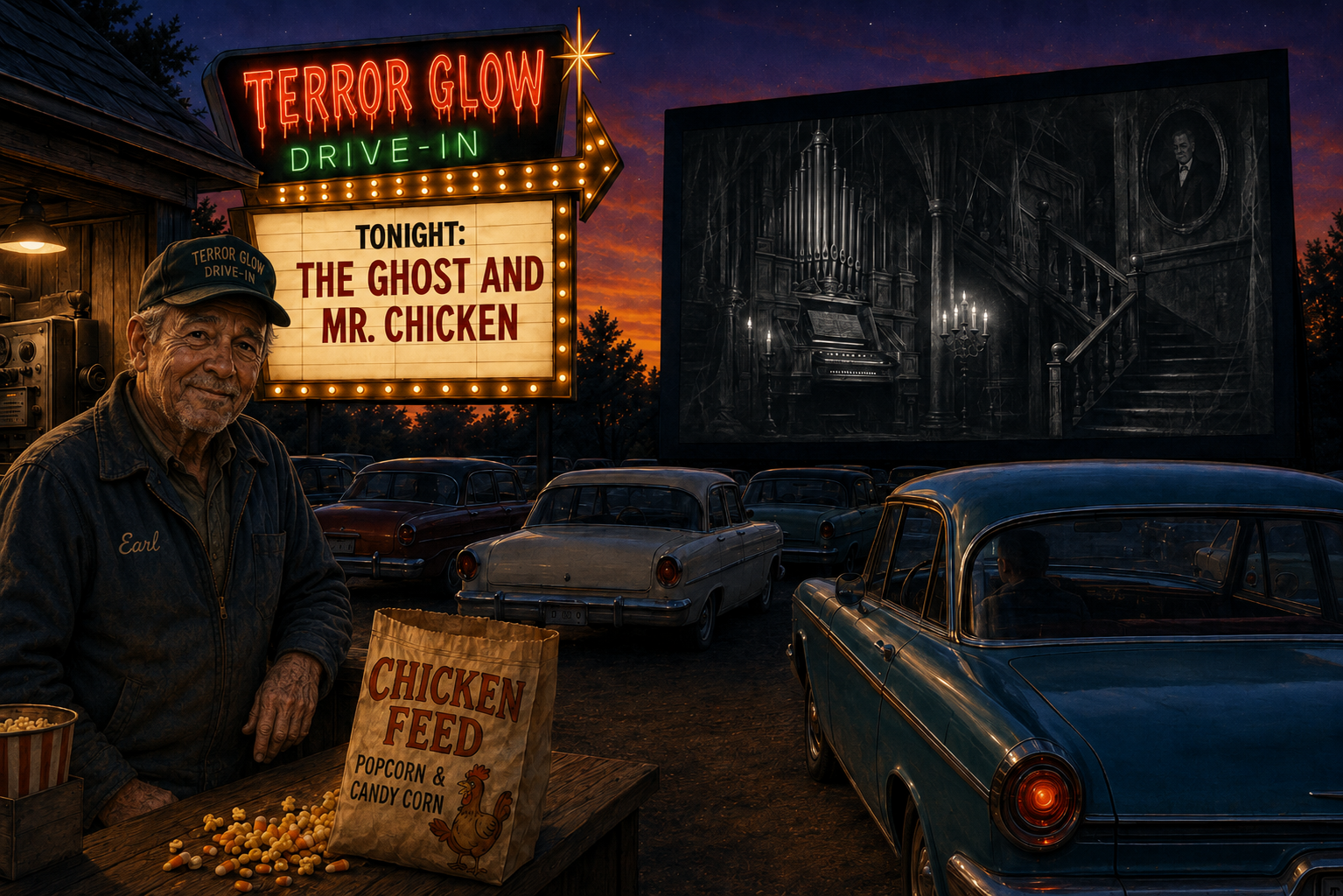
Last Friday, Earl had a Cyclops problem.
There were giant birds, a dragon, a skeleton with a sword and enough Dynamation to keep the projection booth busy all night.
This week Earl wanted something simpler.
A ghost.
One ghost.
In one house.
How difficult could that possibly be?
Unfortunately, Don Knotts is investigating it.
Tonight the Terror Glow marquee belongs to The Ghost and Mr. Chicken, the 1966 comedy-mystery starring Don Knotts as Luther Heggs — newspaper typesetter, aspiring reporter and a man whose nervous system appears to be operating approximately three minutes ahead of the rest of his body.
Earl has already turned the lights down.
Luther would prefer he turn them back on.
The Earl Rating
Feature: The Ghost and Mr. Chicken
Year: 1966
Best watched: On an early fall night when you want a haunted house without needing to sleep with the lights on
Scare level: 2 out of 5
1960s cheese: 4 out of 5
Nervous Don Knotts energy: 5 out of 5
So What Is The Ghost and Mr. Chicken About?
Luther Heggs works as a typesetter at the Rachel Courier Express in the little town of Rachel, Kansas.
What Luther really wants is to become a reporter.
Unfortunately, his natural journalistic instincts are occasionally interfered with by the fact that he panics before gathering all available information.
This becomes apparent when Luther believes he has discovered a murder.
He has not.
His coworkers find this extremely entertaining.
Then the newspaper gives him another opportunity.
The old Simmons mansion has been abandoned since a grisly murder-suicide twenty years earlier. The house is supposedly haunted, and the anniversary is approaching.
If Luther wants to prove himself as a reporter, he can spend the night inside.
Alone.
At midnight.
Luther agrees because ambition sometimes makes people do things their common sense would normally prevent.
Earl understands.
He once ordered six cases of frozen clam rolls because they were on sale.
Luther Heggs Is Not Built for Haunted Houses
There are people who walk into haunted houses saying:
“Who’s there?”
Luther Heggs walks into a haunted house already knowing perfectly well who is there.
Death.
Possibly several deaths.
Maybe a ghost.
Probably murder.
And almost certainly something behind him.
Don Knotts doesn’t need a monster chasing him to be funny. The possibility that something might be chasing him is plenty.
His eyes widen.
His shoulders tighten.
His voice climbs.
His entire body appears ready to evacuate in a different direction.
And then he tries desperately to convince everyone — including himself — that everything is under control.
It is not.
This is classic Don Knotts territory.
The comedy works because Luther genuinely wants to be brave.
He isn’t pretending to be frightened.
He is frightened.
But he goes into the house anyway.
That’s what makes Luther more likable than simply watching a coward run away for ninety minutes.
He wants the story badly enough to stay.
Mostly.
Then the Organ Starts Playing
The Simmons mansion gives Luther plenty to work with.
A portrait seems to bleed.
There are hidden passages.
There are strange noises.
And then an old pipe organ begins playing by itself.
Nobody is sitting at it.
This is not helpful.
The music is one of the reasons the haunted-house material works better than you might expect in what is essentially a Don Knotts family comedy.
Composer Vic Mizzy wrote the score. If that name sounds familiar, it should: Mizzy also wrote the themes for The Addams Family and Green Acres. TCM says he completed the score for The Ghost and Mr. Chicken in only four days, including the wonderfully creepy “Haunted Organ” music.
Four days.
Earl has taken longer than that to fix one drive-in speaker.
And apparently we now know what happens when the man who wrote The Addams Family theme is given a haunted pipe organ.
Children attending a 1966 matinee may have discovered that the answer was:
sleeping in their parents’ room.
TCM specifically notes that the portrait-and-organ sequence was surprisingly frightening material dropped into the middle of a family comedy.
There’s Still Blood on the Organ Keys
One of the movie’s best running jokes involves the supposedly bloody organ.
The town ladies keep repeating that the blood stains simply will not come off.
Not even with Bon Ami.
That joke nearly required more work behind the scenes than anyone expected.
According to Don Knotts’ recollection, Universal’s legal department was trying to get permission from Bon Ami to use the company’s name. With filming only days away and no answer, Knotts finally called the company president himself.
Permission was granted.
The joke survived.
Which means somewhere in corporate America, an executive was presented with:
“We would like to explain that your cleaning product cannot remove decades-old murder blood from a haunted pipe organ.”
And said:
Sounds good.
Earl respects efficient management.
Wait — Andy Griffith Helped Make This?
Yes.
And this is where The Ghost and Mr. Chicken starts feeling like Mayberry wandered into a haunted house.
Don Knotts was leaving The Andy Griffith Show as a regular and had signed a movie contract with Universal. For his first Universal picture, he chose a haunted-house story and brought in Jim Fritzell and Everett Greenbaum, writers who had worked extensively on The Andy Griffith Show. Alan Rafkin, another Griffith-show veteran, directed.
Then Knotts called Andy Griffith himself.
Griffith helped the writers develop the story structure, though he wasn’t officially credited as a screenwriter.
And one particular gag came directly from Andy:
“Atta boy, Luther!”
Throughout the movie, an unseen man keeps shouting encouragement to Luther at exactly the appropriate moment.
Or inappropriate moment.
It becomes funnier every time.
Andy Griffith suggested it.
So Barney Fife may have left Mayberry.
Mayberry followed him anyway.
Don Knotts Had Something to Prove
Leaving The Andy Griffith Show was a big move.
Knotts had turned Barney Fife into one of television’s most recognizable characters. Universal offered him a film contract, and The Ghost and Mr. Chicken became his first picture under that deal.
The movie didn’t receive universally enthusiastic reviews, but audiences showed up.
AFI records that the film was already performing strongly in the South months before its general release, and its success led to longer-term deals for Knotts and director Alan Rafkin.
Universal followed it with more Don Knotts comedies, including The Reluctant Astronaut, The Shakiest Gun in the West, The Love God? and How to Frame a Figg.
Luther Heggs had successfully escaped the haunted mansion.
Don Knotts had successfully escaped Barney Fife.
Mostly.
The nervous energy came with him.
Seventeen Days in a Haunted House
This wasn’t some enormous prestige production.
TCM says filming was scheduled for only 17 days, using Universal’s backlot and existing television sets that were redressed for the movie.
That may actually help the film.
Rachel, Kansas, feels like one of those slightly artificial but wonderfully comfortable television towns where everybody knows everybody else’s business before breakfast.
The Simmons mansion feels just theatrical enough.
The newspaper office feels lived in.
The courthouse feels familiar.
And the cast is filled with faces that anyone who watched 1960s television has probably seen somewhere before.
Charles Lane appears as the wonderfully sour lawyer.
Ellen Corby turns up.
Burt Mustin is there.
Hal Smith appears too — another familiar Mayberry face.
It’s less like discovering a strange town and more like realizing everybody from television moved to Kansas without telling you.
Is the House Actually Haunted?
That is the fun question.
Luther spends the night.
He sees things.
He hears things.
He writes about what happened.
And then people begin explaining why Luther couldn’t possibly have seen what Luther insists he saw.
Eventually the movie becomes as much mystery as ghost story.
There are old secrets surrounding the Simmons mansion, and somebody has a very strong interest in making sure they stay buried.
I won’t spoil how all of that untangles.
But The Ghost and Mr. Chicken does something smart: It lets you enjoy the haunted-house story and the explanation.
And then, just when everything appears neatly settled…
Well.
Earl isn’t saying anything.
He still has to lock up after the show.
Does The Ghost and Mr. Chicken Hold Up?
Yes.
Mostly because Don Knotts is very, very good at this.
His comedy is broad without feeling mean. Luther is ridiculous, but the movie actually likes him. That’s important.
Everybody jokes about him. People underestimate him.
The woman he likes doesn’t initially see him as much competition for the town’s more confident newspaper reporter.
But Luther keeps going.
He goes into the house. He writes the story. He faces the consequences. And when it matters, he finds more courage than anybody expected.
Including Luther.
The movie is also genuinely cozy in a way modern horror-comedies often aren’t.
There is danger. There are spooky moments. But you never feel like the film is waiting to become cruel.
This is a haunted house you can visit with Don Knotts and still expect to go home afterward.
Probably.
The 1960s Cheese Report
Oh, we have cheese.
Small-town newspaper rivalry.
Town picnics.
Psychic society ladies.
A haunted organ.
A bleeding portrait.
A nervous man giving speeches while visibly trying not to pass away.
And an unseen citizen yelling:
“Atta boy, Luther!”
We also have the wonderful mid-century movie belief that if something supernatural happens, the entire town should immediately hold a public meeting about it.
Nobody texts anyone.
Nobody posts a video.
Nobody starts a podcast.
They assemble folding chairs.
Civilization peaked early.
Tonight at the Terror Glow Snack Bar
Chicken Feed — Popcorn and Candy Corn
Earl says it’s seasonal.
Luther wants to know why the bag just moved.
It didn’t. Probably.
Want to Watch It?
This one takes a little more hunting than Sinbad.
As of August 2026, The Ghost and Mr. Chicken does not appear to have a free U.S. streaming option. It is available to rent or buy digitally through services including Amazon Video, Apple TV and Fandango at Home.
Earl has therefore regained some confidence in the value of his film collection.
Please don’t tell him about DVDs.
Earl’s Verdict
Earl wanted one simple ghost.
Instead he got Don Knotts, a haunted pipe organ, twenty-year-old murder blood, a psychic society and several citizens who cannot stop yelling encouragement.
Good booking.
The Ghost and Mr. Chicken is silly, warm and just spooky enough to feel right when the September evenings start getting darker.
Don Knotts does what Don Knotts does better than anybody else.
The haunted-house sequences are surprisingly effective.
Vic Mizzy’s score gives the whole thing just enough genuine creepiness.
And underneath all the nervous comedy is a very sweet story about a man who desperately wants everyone else to believe he’s capable of more.
Eventually, Luther begins believing it too.
So park the car. Clip the speaker onto the window. Chicken Feed is at the snack bar.
And if you hear organ music coming from the projection booth after closing…
Earl didn’t put an organ in there.
Next Friday, the laughing stops.
Earl has invited Dracula.
Atta boy, Earl.
Sources
American Film Institute Catalog — The Ghost and Mr. Chicken (1966)
https://catalog.afi.com/Film/19755-THE-GHOSTANDMRCHICKEN
Turner Classic Movies — The Ghost and Mr. Chicken
https://www.tcm.com/articles/345385/the-ghost-and-mr-chicken
JustWatch — The Ghost and Mr. Chicken
https://www.justwatch.com/us/movie/the-ghost-and-mr-chicken