
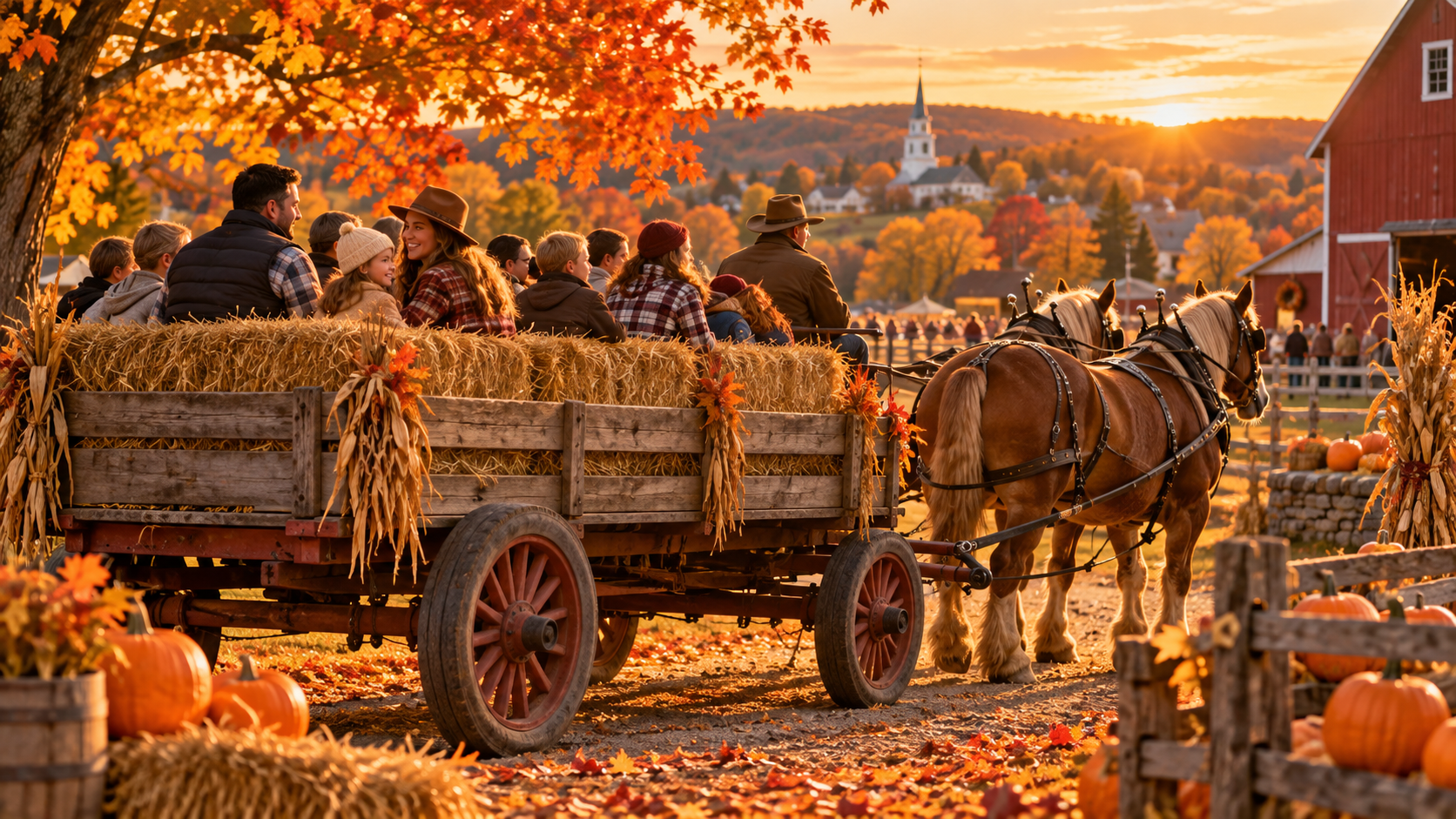
There is something wonderfully impractical about sitting on a bale of hay while a tractor pulls you around a farm.
The seat is scratchy. The wagon is slow. If you wore the wrong sweater, you’ll probably take half the field home with you.
And yet, every autumn, people line up for a ride—sometimes after paying for the privilege. How did a wagon made for hauling crops become one of our favorite ways to announce that fall has arrived?
Why are hayrides associated with fall?
Hayrides became a fall tradition because an older kind of group outing fit naturally into the season of harvest parties, pumpkins, cooler evenings and, eventually, Halloween. Farms later made the ride part of a larger autumn visit, often alongside apple picking, cider, corn mazes or pumpkin patches.
But there is a wrinkle: recreational hayrides were not always autumn outings. Period accounts put them in spring and summer, too. And hay itself was often cut in the warmer months. The wagon was useful to a farmer; the ride was useful to anyone looking for an excuse to gather a crowd.
That distinction is where the story gets interesting.
First, the wagon had a job
A hay wagon or hay rack was a practical way to move cut hay from field to storage. People certainly rode on working wagons at times. A Library of Congress photograph cataloged as Last load shows children and adults on an ox-drawn hay wagon, a reminder that the sight of passengers among the hay was real.
But a photograph of people on a working wagon does not prove that somebody immediately invented the recreational hayride. That neat origin story gets repeated a lot, yet I could not pin it to reliable evidence establishing a first place, date or moment when a farm worker’s trip became a party.
The farming calendar also complicates the usual explanation. Penn State’s haymaking guidance gives an example of grass cut in early June and ready for another cutting by mid-July. Depending on weather, region and crop, hay can be cut more than once. An October ride beside pumpkins, then, isn’t simply a celebration of hay being cut that week.
The fall connection came from what people did with the wagon after work—and from the other traditions they built around it.
By the late 1800s, a hay rack could be the party
One of the pleasures of digging through old local records is finding evidence of people being cheerfully ridiculous a century before us.
A May 1897 account from Iron Mountain, Michigan, preserved in a Dickinson County Library history presentation, describes forty young people taking a hay-rack ride to a logging camp. Their hosts had decorated the camp with lanterns and candles. The newspaper described the wagon trip as a novelty. It was an evening out, not a hay-hauling chore—and it happened in May.
There is a New England example as well. The Poland Spring Preservation Society in Maine describes a hay-rack outing recorded in a 1900 resort magazine: guests took the Sabbathday Lake drive, stopped for lunch and sang along the way. The precise day of that ride is not established by the society’s account, so it would be wrong to label it an October custom. What the account does show is a scenic, social ride in Maine at the turn of the century.
The names were still loose. Newspapers called these events hay-rack rides, hay rack parties and hay rides. The rack was the wagon platform; the hay was sometimes as much atmosphere and seating as cargo.
An August 1905 Oregon newspaper account makes that last point almost too perfectly. Two young women gave a hay-rack party, and their wagon was described as partly filled with hay and mostly filled with cheerful passengers. Four horses pulled the group through La Grande and the surrounding valley while they sang. If you were a neighbor trying to sleep, perhaps the nostalgia was less immediate.
It wasn’t confined to one sort of organizer. An Oregon paper announced a church Epworth League hay-rack outing in October 1906. An October 1913 account in a college sorority publication described a hay-rack ride into the country for supper, followed by songs. The point was the company, the journey and the destination. A roomy wagon made a shared evening possible.
So how did autumn get the wagon?
Fall had several advantages. The rural landscape was especially vivid, people were already holding harvest gatherings, and a wagonful of friends had somewhere to go: a supper, a bonfire, a party or simply a circuit of the countryside in the cool air.
This is a historical interpretation, rather than a claim that one 1890s organizer invented the modern fall hayride. The old accounts show outings in several seasons. But by the early twentieth century, the hay wagon was becoming a recognizable image in Halloween and harvest culture.
The Henry Ford holds a Halloween postcard published around 1912 showing young people on an evening hayride through harvest fields. A postcard isn’t a survey of what everyone did that year. It does tell us the pairing—young people, a wagon, a harvest setting and Halloween—was familiar enough to print and sell as a seasonal greeting.
Meanwhile, the outings themselves kept turning up in the autumn social calendar. In October 1906, guests in La Grande were to travel by hay rack to a costume-like “Hard Times” party where cards would be played. The hay rack could be part of the fun before anyone reached the front door.
Still, the ride did not surrender the rest of the calendar. In June 1969, The New Yorker reported on a commercial horse-drawn hayride from a Staten Island stable, rented by a Brooklyn church youth group. Three young couples were on dates. There were no pumpkin patches, no Halloween actors and no claim that hay had to be harvested in June for the outing to count.
What persisted through all these examples is the social idea: put people together on a slow wagon, give them a little scenery and see what happens. Singing was optional. Awkward conversation was apparently included.
Then the farm visit became a whole fall outing
The version many of us know now usually begins at a farm stand or orchard. You might buy a pumpkin, walk a corn maze, drink cider, visit animals and climb aboard a wagon for a circuit of the property. Sometimes the wagon is transportation to the pumpkin patch; sometimes the ride itself is the attraction.
That is part of agritourism: farms welcoming visitors for recreation, entertainment or hospitality as another source of income. Penn State Extension describes pumpkin farms offering hayrides to the patch and other fall activities. The U.S. Department of Agriculture reported $1.26 billion in U.S. farm and ranch agritourism income for 2022 across all seasons and kinds of experiences—not hayrides alone.
The season is especially important to visitor farms. In a USDA survey of certain agritourism operations, October 2018 had the highest share of annual visitors by month; the agency specifically noted overlap with hayrides and apple or pumpkin picking. That is a snapshot of modern farms, not a date for when autumn hayrides began.
The old ride and the new farm business fit each other remarkably well. A wagon can carry a group past fields or out to a crop. Hay or straw makes it feel rustic, even when the tractor, ticket booth and cider doughnut machine are thoroughly modern. The pumpkins are in season, the trees put on a show, and people are already in the mood to make a day of it.
New England farms have their own especially persuasive scenery: orchard roads, changing leaves, old stone walls and that particular October chill that convinces you to buy a hot drink. But the early evidence also comes from Michigan and Oregon. There is no good basis for claiming New England invented the hayride.
When did hayrides turn haunted?
Once you have a wagon moving slowly through a dark field, it isn’t a long imaginative trip to ask what might be waiting beside the road.
Halloween-themed hayride gatherings and today’s staged haunted hayride are not necessarily the same thing. The latter builds a route around scares, actors, sets and effects. I have not found a documented national “first” that settles the question of who invented it.
We can identify a solid early example. Allen’s Haunted Hayrides, a working dairy-farm family business in Pennsylvania, dates its attraction to October 1979. The family says their father had already hauled ordinary church and Scout group hayrides in the 1960s. The two sons later worked with the local Jaycees to start a haunted version; over time the route gained a forest road, bonfires, games and other attractions.
That family history is a small-scale version of the wider change: the group ride could become a ticketed autumn event, and the autumn event could become a moving ghost show. It does not establish that Allen’s invented the form or that haunted hayrides began in 1979.
Why we still climb aboard
A hayride has a wonderfully modest promise. You will move slowly, sit with other people and look at the season. The boards may creak. Someone will probably complain about the hay and then take a picture anyway.
Its history is less tidy than the usual tale of farmers giving their children a lift from the hayfield. The evidence shows social rides by the late nineteenth century; an early twentieth-century connection to harvest and Halloween imagery; later group outings in other seasons; and a modern farm attraction that made October the ride’s busiest stage.
Perhaps that is why it lasted. The wagon was never only about getting somewhere. For a little while, it gave everyone a reason to go together.
Were hayrides always held in fall?
No. A documented 1897 Michigan hay-rack party took place in May, an Oregon outing made the local paper in August 1905, and The New Yorker described a paid ride in June 1969. Fall eventually became the season most closely associated with the activity, but it never had a monopoly on it.
Is a hay-rack ride the same as a hayride?
In the old social accounts used here, hay rack referred to the wagon or platform carrying the group. A hay-rack ride was a closely related name for what many people now call a hayride. Some modern rides use trailers or wagons with bales for seats rather than a wagon carrying a full load of hay.
Further Reading & Sources
- Dickinson County Library, “Wheels: The Horse and Buggy Era” (PDF) — reproduces an Iron Mountain Range-Tribune item dated May 15, 1897, about forty young people on a hay-rack outing to a logging camp. The PDF is large; search indexing exposed the relevant excerpt.
- Poland Spring Preservation Society, “A Brief Resume of the Hill-Top” — describes a 1900 Maine resort-magazine account of a scenic hay-rack ride to Sabbathday Lake with lunch and singing; it does not give a ride date.
- La Grande Evening Observer, October 22, 1906 — primary account of party guests traveling by hay rack in October.
- The Key, December 1913 issue (PDF) — first-person sorority account of an October 18 hay-rack ride, supper and singing.
- The Henry Ford, “Halloween Postcards” — collection note on a circa-1912 Halloween postcard showing an evening hayride.
- Library of Congress, “Last load” — catalog description of children and adults on an ox-drawn hay wagon; evidence of riding on a work wagon, not an origin for recreation.
- Penn State Extension, “Timing Second Cutting Grass Hay” — modern agricultural guidance showing June and July hay cutting in an example, with later cuts dependent on growing conditions.
- Susan Sheehan, “Hayride,” The New Yorker, June 21, 1969 — original reporting on a paid June ride for a church youth group, including teenage dates.
- Penn State Extension, “Pumpkin Production in the United States” — explains today’s pumpkin-farm agritourism offerings, including hayrides.