
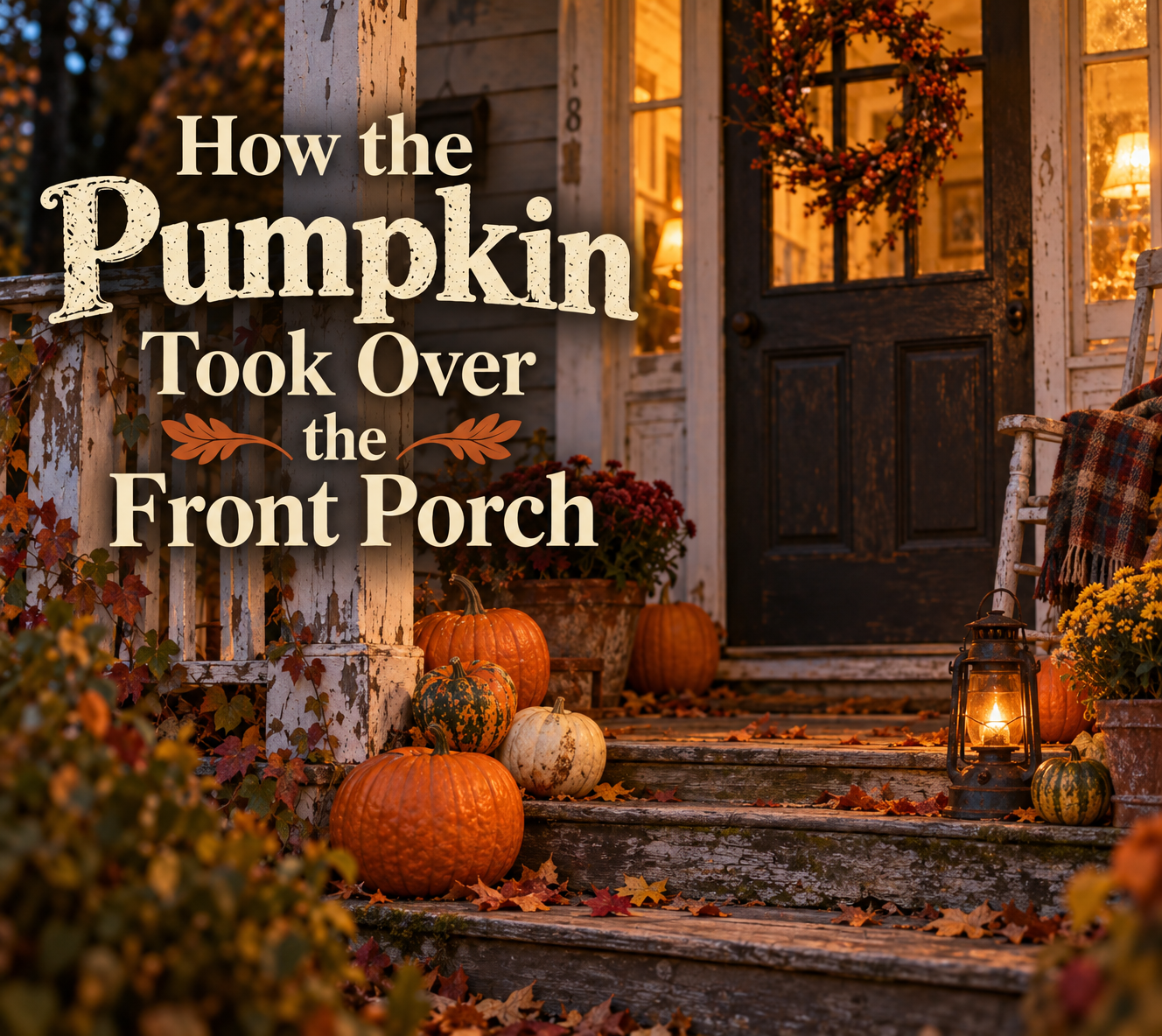
Every fall, it happens. You buy one pumpkin.
Then somehow there are three.
One goes beside the front door. Another lands on a step. A little one gets tucked next to the mums because apparently the mums looked lonely.
And suddenly your house has officially announced that fall has arrived.
Some houses had porches. Some had stoops. Some had two crooked steps and a door that stuck in October. The pumpkin didn’t seem to care.
But why did we start putting pumpkins by the front door in the first place?
The answer is a little more interesting than “because Halloween.”
The pumpkin earned its place there through two different American traditions: it became a symbol of the old-fashioned fall harvest, and it became the perfect material for the glowing jack-o’-lanterns people placed near doors and entrances on Halloween.
Eventually, the two ideas blended together.
And the pumpkin never really left the porch.
Pumpkins Weren’t Always Decorations
Long before anyone was arranging pumpkins beside a welcome mat, people were growing them for food.
Pumpkins and other squash are native to the Americas and have been cultivated for thousands of years. Indigenous peoples grew squash long before European settlers arrived, and pumpkins later became an ordinary part of colonial and farm life.
They were useful. They could be baked, stewed, made into pies and stored for colder months. In other words, nobody originally looked at a pumpkin and thought, You know what this needs? A decorative basket and a bale of hay.
That came later.
By the 1800s, something interesting began happening.
As more Americans moved away from farms and into towns and cities, pumpkins started to represent something besides dinner.
They became nostalgic. The big orange pumpkin began calling up images of harvest time, family farms, Thanksgiving, country life and an older America people were already beginning to romanticize.
The pumpkin was turning into a symbol.
Then Halloween Got Involved
The other half of the story came from the jack-o’-lantern.
The tradition of carving frightening faces into vegetables came to America largely through Irish and other European customs. Turnips and similar root vegetables had been hollowed out and carved overseas.
Then immigrants arrived in a country where pumpkins were everywhere. Compared with a turnip, a pumpkin was practically asking for the job.
It was bigger. It was hollow. And you could carve a face into it without declaring war on a root vegetable.
By the second half of the 1800s, carved pumpkin jack-o’-lanterns were already appearing in American Halloween culture.
And once you put a candle inside a carved pumpkin, where do you put it?
Near the entrance.
Where people can see it.
We Know Pumpkins Were Sitting on Porches More Than 100 Years Ago
This is where things get especially fun.
We don’t have to guess that people once put jack-o’-lanterns on their front porches. They actually wrote about doing it.
A children’s book published in 1914 included instructions for making a pumpkin jack-o’-lantern and then told the children to set it “on the front porch for Hallowe’en.”
There it is.
More than a century ago, somebody was already putting the pumpkin right where many of us still put it now.
Newspaper accounts from the same general period also describe jack-o’-lanterns glowing on porches and lighting entrances during Halloween gatherings.
So the pumpkin wasn’t merely a Halloween object.
It had become part of the front-door experience.
You saw it before you went inside.
The Harvest Pumpkin and the Halloween Pumpkin Became the Same Pumpkin
Meanwhile, the pumpkin was becoming more deeply connected with fall itself.
Pumpkin patches, farm stands, county fairs, Thanksgiving images and autumn displays helped turn the pumpkin into a shorthand symbol for harvest season.
That meant the pumpkin now had two jobs.
One pumpkin said: Halloween.
The other said: Harvest. Autumn. Country life. Thanksgiving.
Eventually there wasn’t much reason to separate them.
A whole pumpkin could sit outside in September and October as a fall decoration. Then somebody could carve it for Halloween. Or leave it alone and keep it through Thanksgiving.
That flexible little vegetable had managed to claim nearly the entire season.
The Modern Fall Porch Came Later
There is one thing worth clearing up.
The giant modern fall display — stacked pumpkins, white pumpkins, gourds, mums, cornstalks, lanterns and perhaps enough decorative hay to feed a small pony — does not appear to be some unchanged tradition handed down from the 1800s.
The older evidence is much clearer for individual pumpkins and jack-o’-lanterns placed near entrances.
The elaborate “fall porch” developed later as decorative pumpkins became more popular, farmers grew more varieties for appearance, roadside farm stands expanded and magazines, stores and eventually social media turned autumn decorating into a category of its own.
Which explains why today you can find pumpkins that are white, green, blue-gray, striped, flat, bumpy, tiny, enormous and shaped like something that escaped from a fairy tale.
Many of them were never destined for pie.
Their job is to sit there and look autumnal.
Why the Front Door?
There’s probably a simpler reason underneath all the history too.
The front door is where private life meets public life. It is the part of the house your neighbors see. It is where visitors arrive. It is where trick-or-treaters knock.
Long before anybody talked about “curb appeal,” the entrance to the house was a natural place to display something meant to be seen.
A glowing jack-o’-lantern made perfect sense there. So did a harvest pumpkin.
Once those traditions took hold, putting a pumpkin near the door became one of those little seasonal habits that hardly needs explaining anymore.
We just do it.
So Why Do We Put Pumpkins on the Porch?
Because the pumpkin managed to become two American symbols at once.
It represented the harvest, the farm and the arrival of autumn, and as a jack-o’-lantern, it became one of Halloween’s most recognizable decorations — often placed right beside the door.
Over time, those traditions merged.
The carved pumpkin became the uncarved pumpkin. The Halloween decoration became a fall decoration. Somewhere along the way, the pumpkin claimed the porch.
Or the stoop.
Or those two crooked steps out front.
It really never was picky.
Further Reading & Sources
Smithsonian — “How Ancient Humans Helped Bring Pumpkins to Your Thanksgiving Table” — for pumpkin/squash domestication and their American origins. Smithsonian pumpkin history
Smithsonian — “How the Formerly Ubiquitous Pumpkin Became a Thanksgiving Treat” — useful for the pumpkin’s shift from everyday food into a cultural and seasonal symbol; it draws on historian Cindy Ott’s work. Smithsonian cultural history of the pumpkin
University of Notre Dame, Rare Books & Special Collections — “An Irish Story Produces a Halloween Icon” — for Irish jack-o’-lantern traditions and the 1867 Harper’s Weekly pumpkin imagery. Notre Dame jack-o’-lantern history
Project Gutenberg — Daddy Takes Us to the Garden by Howard R. Garis — this is our fabulous 1914 front-porch evidence, including the instruction to place the lighted pumpkin on the front porch for Halloween. Read the 1914 book
University of Oregon — Historic Oregon Newspapers — period newspaper evidence from 1916 describing pumpkin jack-o’-lanterns associated with porches and Halloween entrances. Oregon Halloween newspaper history
Discover more from A Little Off the Ordinary
Subscribe to get the latest posts sent to your email.