
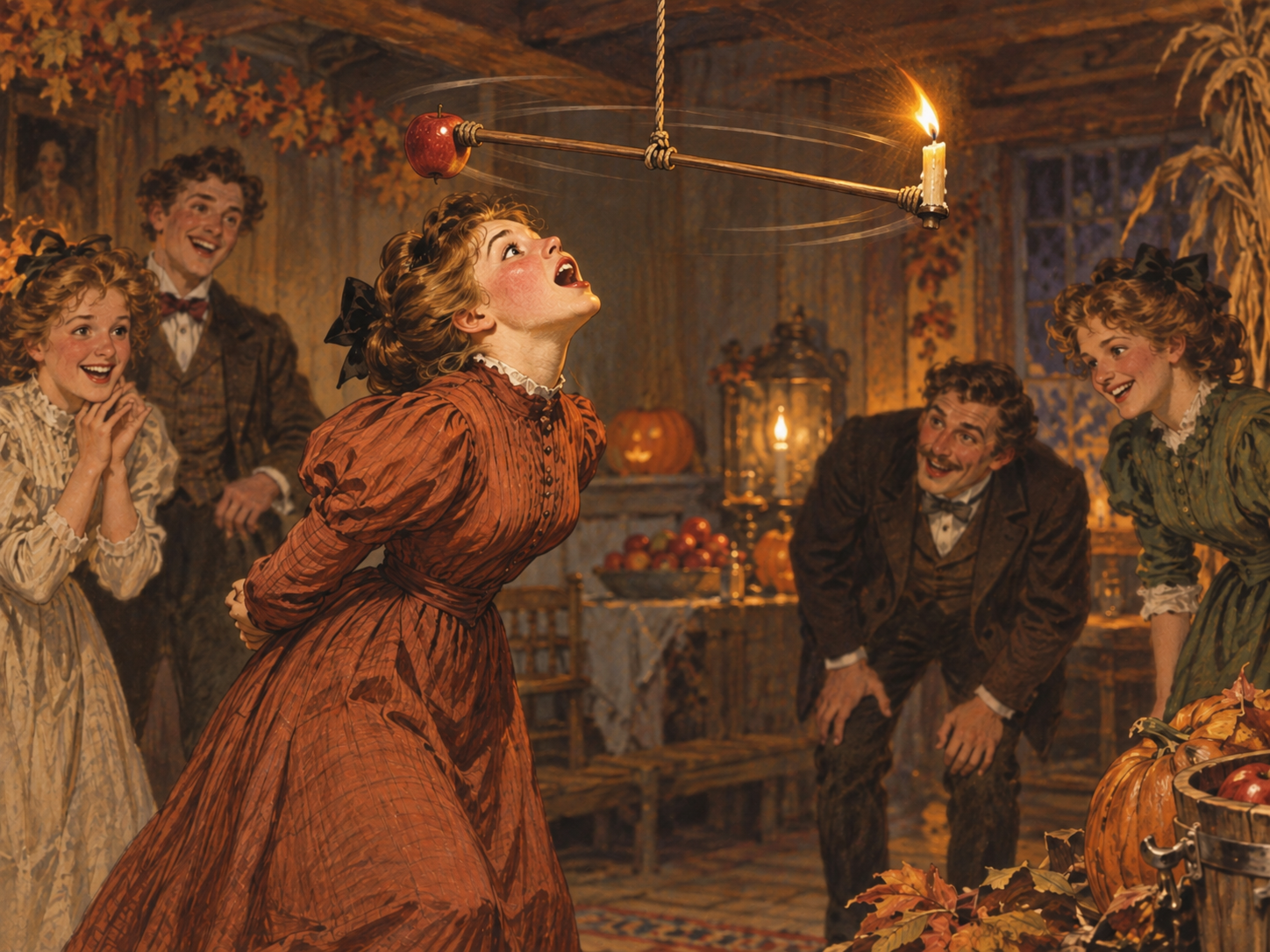
Apparently, there was a time when planning a Halloween party involved looking at an apple, a lit candle and a spinning stick and thinking:
Yes. Let’s put people’s faces near this.
I assumed this had to be one of those old traditions that became more ridiculous every time somebody retold it.
Nope.
They really played it.
And not just once, in one strange town where nobody had anything better to do.
Descriptions and actual directions for the apple-and-candle Halloween game turn up repeatedly in nineteenth- and early-twentieth-century books.
The basic idea was simple.
Perhaps a little too simple.
You attached an apple to one end of a stick.
You attached a lighted candle to the other.
Then you hung the stick from the ceiling and set the whole contraption moving.
Your job?
Catch the apple with your teeth.
Your hands were not allowed.
And if the candle happened to reach you first?
Well, apparently everyone else laughed.
What Was the Apple-and-Candle Halloween Game?
Robert Chambers described the game in his 1864 Book of Days.
A stick was hung horizontally from the ceiling by a string. An apple went on one end and a candle on the other.
Then the stick was set twirling.
One by one, players jumped up and tried to grab the apple with their teeth before the candle came around.
No hands.
Chambers also tells us what happened when things didn’t go according to plan.
Sometimes the candle reached the player first, scorching a face or smearing it with candle grease.
The resulting mishaps, he said, caused plenty of laughter.
Of course they did.
There is apparently nothing funnier at an old Halloween party than watching your friend discover that he has chosen candle instead of apple.
Yes, the Candle Was Actually Lit
I checked this more than once because surely there had to be an important detail missing.
Maybe the candle wasn’t lit.
Maybe it was supposed to represent a candle.
Maybe everyone stood a perfectly sensible distance away.
No.
Lighted candle. Moving stick. Face nearby.
And decades later, people were still printing instructions for it.
An 1893 edition of Lina and Adelia Beard’s The American Girl’s Handy Book includes “The Apple and Candle Game” as a Halloween activity.
Their version used a stick about a foot and a half long, suspended from a cord at its center.
Apple on one end.
Lighted candle on the other.
The stick swung back and forth while contestants tried to catch the apple in their teeth.
The authors admitted that sometimes the contestant caught the candle instead.
That apparently sent the spectators into fits of laughter.
Then they conceded that catching a lighted candle in your teeth was “a little dangerous.”
You don’t say.
Even They Eventually Thought: Maybe Lose the Fire
This may be my favorite part.
After explaining the game — including the possibility of somebody catching the lighted candle — the Beard sisters actually suggested a safer alternative.
Replace the candle with a small cloth bag filled with flour.
So even in 1893 somebody finally looked at the situation and thought:
Perhaps the spinning flame beside everyone’s face is the problem.
It also means there was already a way to play a version of the game without the candle.
Hit the apple and you win.
Hit the flour bag and…
well, you’re probably wearing the flour.
Honestly, that still sounds pretty entertaining.
But the Lighted Version Didn’t Disappear
You might think that once someone came up with the flour bag, the candle version would quietly die out.
It did not.
Mary E. Blain’s 1912 book Games for Hallow-e’en included a game called “Candle and Apple.”
The directions called for an 18-inch stick.
Fasten an apple to one end.
Fasten a short piece of lighted candle to the other.
Suspend the stick from its middle so that it balances.
Set it revolving.
Then try to catch the apple with your teeth.
That’s it.
No helmet instructions.
No fire extinguisher.
Just apple, candle, spin.
Good luck.
Sometimes They Added MORE Candles
Because apparently one candle wasn’t always enough.
Other old Halloween games followed the same general philosophy: suspend food, make it move, take away the use of everyone’s hands and add something that makes missing considerably more interesting.
Blain’s 1912 collection includes a revolving barrel hoop with apples, cakes, candies and candle ends attached around it.
Players tried to bite one of the edible prizes as the hoop turned.
Grab a candle instead?
You paid a forfeit.
At some point this stops sounding like a party game and starts sounding like a very small carnival attraction designed by someone who had recently discovered fire.
Was This the Same as Snap-Apple?
Sort of.
This is where the names get messy.
Old Halloween apple games came in several forms, and snap-apple could refer to different versions of the basic idea.
Sometimes an apple simply hung from a string and players tried to bite it without using their hands.
Sometimes a stick or other device revolved.
Some versions involved candles or other prizes.
Ruth Edna Kelley described the apple-and-lighted-candle version in her 1919 Book of Hallowe’en. She called it one of the rougher Halloween games, more suited to energetic play than the fortune-telling customs that filled so much of the holiday.
That seems fair.
Predicting your future husband with an apple peel is one thing.
Dodging an airborne candle with your face is another.
Why Were There So Many Apples at Halloween?
Once you start reading old Halloween books, apples are everywhere.
People bobbed for them.
Hung them from strings.
Peeled them to supposedly reveal the initials of future sweethearts.
Used the seeds for fortune-telling.
Ate apples while looking into mirrors hoping to glimpse a future partner.
And, apparently, attached them to spinning candle contraptions.
Apples made sense as autumn entertainment because they were readily available at harvest time, but over generations they also became wrapped up in Halloween games and fortune-telling traditions.
Still, I don’t think the apple-and-candle game needs a particularly mystical explanation.
Its purpose seems to have been roughly:
Can you get the apple before the candle gets you?
Sometimes entertainment really doesn’t need a deeper meaning.
It Wasn’t Even the Most Questionable Halloween Game
And this is where my research became a problem.
Because once I found the apple and candle, I started noticing the other games.
Blain’s 1912 book suggests putting a lighted candle on the floor and jumping over it.
Clear the candle and you were supposedly promised a happy year.
Knock it over and you were facing twelve months of trouble.
And yes, while reading that one I immediately thought of:
Jack be nimble,
Jack be quick,
Jack jump over the candlestick.
Whether the rhyme and the Halloween game are actually historically connected is another rabbit hole, so I’m not going to pretend they are.
But apparently humans have spent quite a bit of time thinking jumping over candles sounded entertaining.
There were also walnut-shell boats carrying tiny candles, games with mirrors, flour, nuts and apples, and so many methods of predicting future husbands and wives that I am beginning to think Halloween once doubled as an annual dating service.
I went looking for one ridiculous game.
I appear to have found an entire category.
Maybe We Weren’t That Far Removed

Reading all of this made me realize that some of these old games don’t feel quite as distant as I first thought.
I remember doughnuts hanging from strings while kids tried to eat them without using their hands.
Whoever managed to finish first got a prize.
Then there was bobbing for apples.
We had a bucket of water with apples floating around, and one of the apples would be marked. Get the marked apple and you won.
Sometimes it took three or four dunks before you finally managed to grab one.
You came back up wet. Very wet. Nobody cared. We thought it was fun.
So maybe the spinning candle deserves to stay firmly in the nineteenth century, but the basic formula survived:
Put food somewhere inconvenient.
Take away the use of your hands.
Make everybody look ridiculous trying to get it.
Offer a prize.
Apparently we kept the good part.
We just eventually got smarter about the fire.
Want More Old-School Halloween Fun?
Please Don’t Recreate the Original Version
I feel like this shouldn’t need saying.
Then again, instructions for the lighted version kept appearing for decades.
So:
Please don’t hang a lit candle from a moving stick and try to catch an apple beside it with your mouth.
The original books themselves eventually acknowledged the danger, and there are very easy ways to turn the idea into a safe game without putting open flame anywhere near someone’s hair.
Actually, the 1893 flour-bag substitute gives us a pretty good starting point.
And that got me thinking.
If this strange old game can be made safe…
what other forgotten Halloween games could we bring back?
So Did People Really Play Halloween With an Apple and a Lit Candle?
They did.
The game appears in sources spanning decades.
In 1864, Chambers described a spinning apple-and-candle game in which unsuccessful players could end up scorched or covered with candle grease.
The Beard sisters included an apple-and-lighted-candle version in The American Girl’s Handy Book and admitted it could be dangerous enough that they suggested substituting a bag of flour.
In 1912, Games for Hallow-e’en was still providing directions for the lighted version.
And Ruth Edna Kelley was describing the custom again in 1919.
An apple went on one end.
A candle went on the other.
The candle really was lit.
And people voluntarily put their faces near it.
I began this rabbit hole assuming somebody had exaggerated an old Halloween game.
Instead, I discovered that the old descriptions were surprisingly consistent.
Which means I now have another question.
If this was considered Halloween fun…
what else were they doing?
I probably shouldn’t look.
Obviously, I’m going to.
Sources & Further Reading
Robert Chambers, The Book of Days (1864) — includes a description of the Halloween apple-and-candle game, along with traditional apple bobbing and other Halloween customs.
Lina Beard and Adelia B. Beard, The American Girl’s Handy Book — includes “The Apple and Candle Game,” acknowledges the danger of catching the candle and suggests replacing it with a cloth bag filled with flour.
Mary E. Blain, Games for Hallow-e’en (1912) — includes “Candle and Apple,” along with the barrel-hoop game, jumping over a lighted candle and numerous other Halloween activities.
Ruth Edna Kelley, The Book of Hallowe’en (1919) — discusses the apple-and-lighted-candle custom among the rougher traditional Halloween games.