
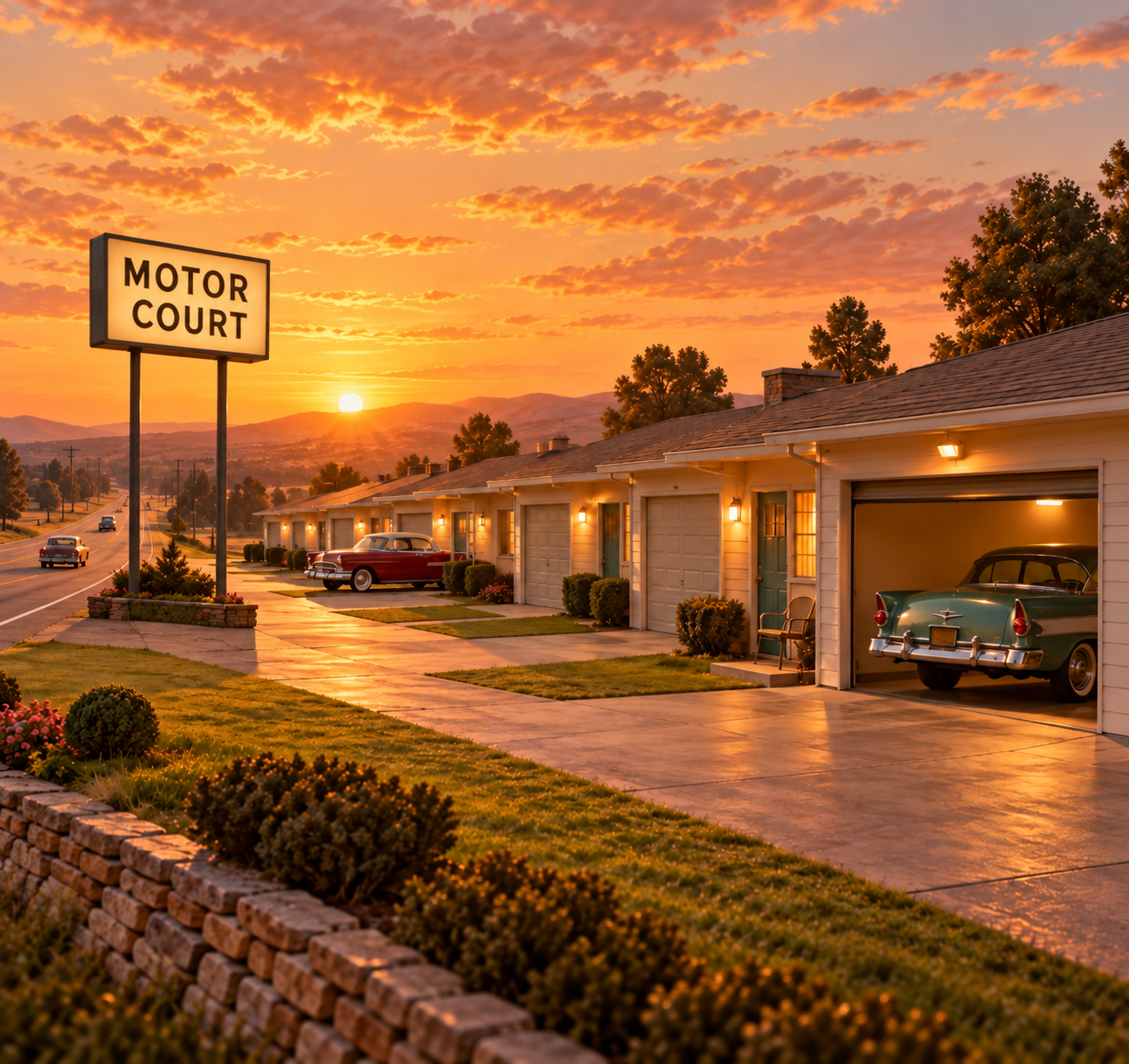
Look closely at an old photograph of a roadside tourist court. There are the little rooms, a courtyard, perhaps a neon sign—and between the rooms, what look suspiciously like garage doors.
They probably are garage doors.
At some early tourist courts, you could pull off the highway, drive into a garage beside your room, and settle in for the night with your automobile under the same roof. At others, the space between cabins was an open carport. It makes an old postcard look as if every guest arrived with a very small house for the car.
Why did travelers need that?
The short answer: These places were built for people arriving by automobile. A room-side garage or carport gave them sheltered parking and immediate access to their car and its contents. It also made a court feel more private and convenient than a downtown hotel with a separate place to park. But it was an amenity, not a universal feature, and no surviving evidence points to one single reason every owner installed it.
Before the Motel, You Might Have Slept in a Tent
The first long-distance motorists couldn’t count on finding a familiar motel sign at the edge of town. They might stay at a downtown hotel, seek a room in a private home, or camp with their car. Towns set up tourist camps with varying degrees of water, cooking space, and bathing facilities. In Amarillo, Texas, for example, the city opened a tourist camp in 1924, according to the National Park Service’s history of the Ranchotel.
The private roadside trade grew alongside those camps. Some operators added cabins to camping grounds; others built groups of cabins from the start. A cabin promised a proper roof and a measure of separation from the next traveler. Later cottages offered more comforts, including plumbing, heat, and furnishings. Group the units around a drive or courtyard, and you had a tourist court or cottage court.
The names were flexible. Tourist camp, cabin camp, tourist court, motor court, and motel overlapped as businesses improved, renamed themselves, or advertised to different travelers. There was no inspector traveling the highways to make every proprietor use the same label. The name motel, formed from motor hotel, existed by the 1920s but became much more familiar after World War II. The important change was in the design: lodging was increasingly arranged around the guest’s car.
A Room for You, a Space for the Car
Imagine arriving after dark in a road-weary Chevrolet. A downtown hotel might mean negotiating town streets, finding parking, and carrying your things through a lobby. At a motor court, you turned directly off the highway and stopped beside the door where you would sleep.
With a garage, you could pull the car into an enclosed bay. With a carport, the roof still covered the vehicle and often bridged the space between cabins. Your bags, picnic supplies, and whatever else was riding along were only a few steps away. Even when a court offered nothing fancier than an open parking spot, that room-to-car connection remained its defining convenience.
The buildings show several versions of the idea. A Texas Historical Commission survey documents carports between stone cabins dating to about 1930 in Eastland, Texas. It also describes garage openings between units at a court built in 1939 in Sierra Blanca. The 1940 Ranchotel in Amarillo had 16 rooms linked by alternating garage spaces. In Albuquerque, the 1937 El Vado had covered carports between some of its 32 units.
That distinction matters. Some guests drove into a genuine enclosed garage with doors. Some pulled under an open-sided roof. Some simply parked in the court. The old buildings did not all follow one blueprint.
What Did Owners Actually Advertise?
The garages weren’t just a decorative touch that later historians discovered. They were something proprietors thought might persuade a driver to stop.
A classified advertisement indexed in the July 5, 1927, Pampa Daily News offered furnished cottages at the Pampa Tourist Court and mentioned private garages. It is an unusually early lead, although the digitized newspaper page should be checked visually before anyone reproduces its wording.
There is firmer, wonderfully specific evidence from the Wagon Wheel Cabins in Cuba, Missouri. A 1939 AAA travel directory entry, preserved in the National Park Service’s account, lists nine stone cottages, private baths, gas heat, summer fans, enclosed garages, a café, laundry, and a service station. Two people paid $2.50 to $3 a day. The garage appears right among the creature comforts and useful services.
Notice what those listings do not tell us. They advertise a private or enclosed place for the automobile; they do not prove that most owners built garages chiefly because theft was rampant, or that every driver feared someone stealing the picnic basket. Protection from rain or snow is an obvious use of a roof. Privacy and the ability to keep the car close were real attractions of the layout. Assigning one motive to every court would be a guess.
There was another selling point in the whole roadside package. A court could put a room, parking, perhaps gasoline, and sometimes a café in one easy stop. The Wagon Wheel supplied all of those. If you’re curious about the other half of that roadside meal-and-fuel world, see what a roadside lunch room was and why old gas stations rang “ding-ding” when a car arrived.
How Common Were These Garages?
Common enough to leave a trail of surviving buildings, photographs, advertisements, and historic-register records—especially among cottage and motor courts of the 1930s and 1940s. But there is no sound national figure showing that most rooms came with an enclosed garage. A carport and an actual lockable garage are different things, and many early cabins had neither.
The form also changed by place and proprietor. Texas surveys show rustic stone cabins, Southwestern-style courts, and later buildings with parking directly in front. The Ranchotel’s design borrowed regional imagery, while its garage spaces served the same practical automobile trade. In Missouri, the stone Wagon Wheel Cabins offered enclosed parking. These examples establish variety; they do not support a tidy map where one region used garages and another never did.
For travelers, the point was simple: this place understood that you had arrived in a car. Early cars could demand attention on a trip, too—as the site’s story about old highway radiator water stops shows. The court’s garage wasn’t necessarily a repair shop. It was a place to keep the vehicle close while the people inside got some sleep.
Where Did All Those Garage Doors Go?
They didn’t vanish on one particular year or with the invention of one new kind of car. The change was uneven, and some surviving courts kept their old bays long after new motels stopped building them.
The economics of the building mattered. A continuous row of guest rooms could share walls and make plumbing and electrical runs easier. A garage between every pair of rooms occupied space that might otherwise earn room revenue. A National Register study of roadside architecture in Montana describes operators moving toward connected room rows without garages as construction costs rose. Parking remained near the room, often immediately outside its door; the individual covered bay was the part increasingly omitted.
You can see the shift within the same highway landscape. By the mid-1940s, some of the Wagon Wheel’s garages had been converted into lodging units. At the Ranchotel, garages were later enclosed to create more space after the court became apartments. A Texas survey also identifies a 1948 court with parking in front of its cabins. Yet another documented Texas property built around 1970 still had carports between its cabins. History rarely bothers to change all its motel signs at once.
Postwar motel building brought larger properties, integrated blocks of rooms, more amenities, and eventually chains. Roads changed, too. The 1956 Interstate Highway program redirected traffic away from many old two-lane business strips, leaving some independent courts stranded off the main route. The guest still arrived by car, but the standard bargain became a room near your parking space, not a separate roof and door for the automobile.
The Little Garage in the Postcard
The next time an old tourist-court postcard turns up, look between the rooms. An archway may be an open carport. A pair of big doors may mark a proper garage. A filled-in wall may hide a former parking bay that was made into another room years ago.
Today, those garages can look like an odd little feature tacked onto an old motel room. But once, they made perfect sense. They belonged to an age of two-lane highways, roadside courts, heavy suitcases, and automobiles that were every bit as much a part of the journey as the destination. The next time you spot one in an old photograph or along a forgotten road, you’ll know what it was doing there—and what kind of traveler once pulled inside.
Take the Road After Dark
If old motel signs, empty highways, and a light burning in the last room put you in the mood for a darker trip, listen to our fictional bedtime tale, Mile Marker 113: Midnight Motel, on A Little Off the Ordinary.
Sources & Further Reading
Source ledger and fact-check notes
- National Park Service, Wagon Wheel Motel, Cafe and Station: the 1936 complex had nine cabins in three stone buildings with garages. The NPS transcribes a 1939 AAA directory entry advertising enclosed garages and $2.50–$3 rates for two; some garages were made into lodging units by the mid-1940s. The AAA text is quoted through NPS, not directly inspected here.
- National Park Service, Ranchotel: 1940 Amarillo court with 16 units and alternating garage spaces; documents the municipal camp and downtown-hotel competition locally, then the garages’ later enclosure for apartment space.
- National Park Service, El Vado Auto Court Motel: 1937 Albuquerque court with 32 units, some separated by covered carports. A useful check against saying every room at every court had enclosed parking.
- National Register nomination, Log Cabin Motel Historic District, PDF: historical context traces auto camping, cabin camps, cottage and motor courts, and later integrated room rows; says attached garages became popular in the 1930s. Its terminology is a broad pattern, not a rigid naming law.
- Texas Historical Commission, Historic-Age Motels in Texas, PDF: synthesizes the progression and says garages became popular after 1930, while room-adjacent parking shaped site design. Also describes variation among courts and inns.
- The Henry Ford, “The Rise and Fall: The Golden Age of Motels”: museum account and postcard collection covering the shift from camps to cabins, courts and integrated motels.
- Library of Congress, Black and Orange “Garage Camp” photograph and Westward Ho Motel photograph: catalog descriptions of a 1930s Wyoming garage camp and a 1948 Route 66 unit with a two-car garage. These are modern photographs of historic buildings, not period advertisements. Check image rights separately before reuse.
Period advertisements and guides worth inspecting
- Pampa Daily News, July 5, 1927, p. 4: digitized page. The searchable scan indexes a Pampa Tourist Court classified for furnished cottages with private garages. The page PDF did not render reliably in this research session; visually inspect the ad before quoting its exact words or claiming the layout. It establishes an early, promising lead rather than a settled national “first.”
- 1939 AAA travel directory entry for Wagon Wheel Cabins: transcribed on the NPS page. It explicitly sells “enclosed garages,” along with baths, heating, a café and service station. The underlying AAA page was not independently located here.
- Blue Bird Tourist Court display ad: a Library of Congress digitized telephone directory is indexed with “PRIVATE GARAGES – STEAM HEAT – HOT WATER” on the Birmingham–Bessemer highway. The PDF did not render here and its directory year has not been confirmed, so do not date or quote it in the article until its title page and advertisement are visually checked.