
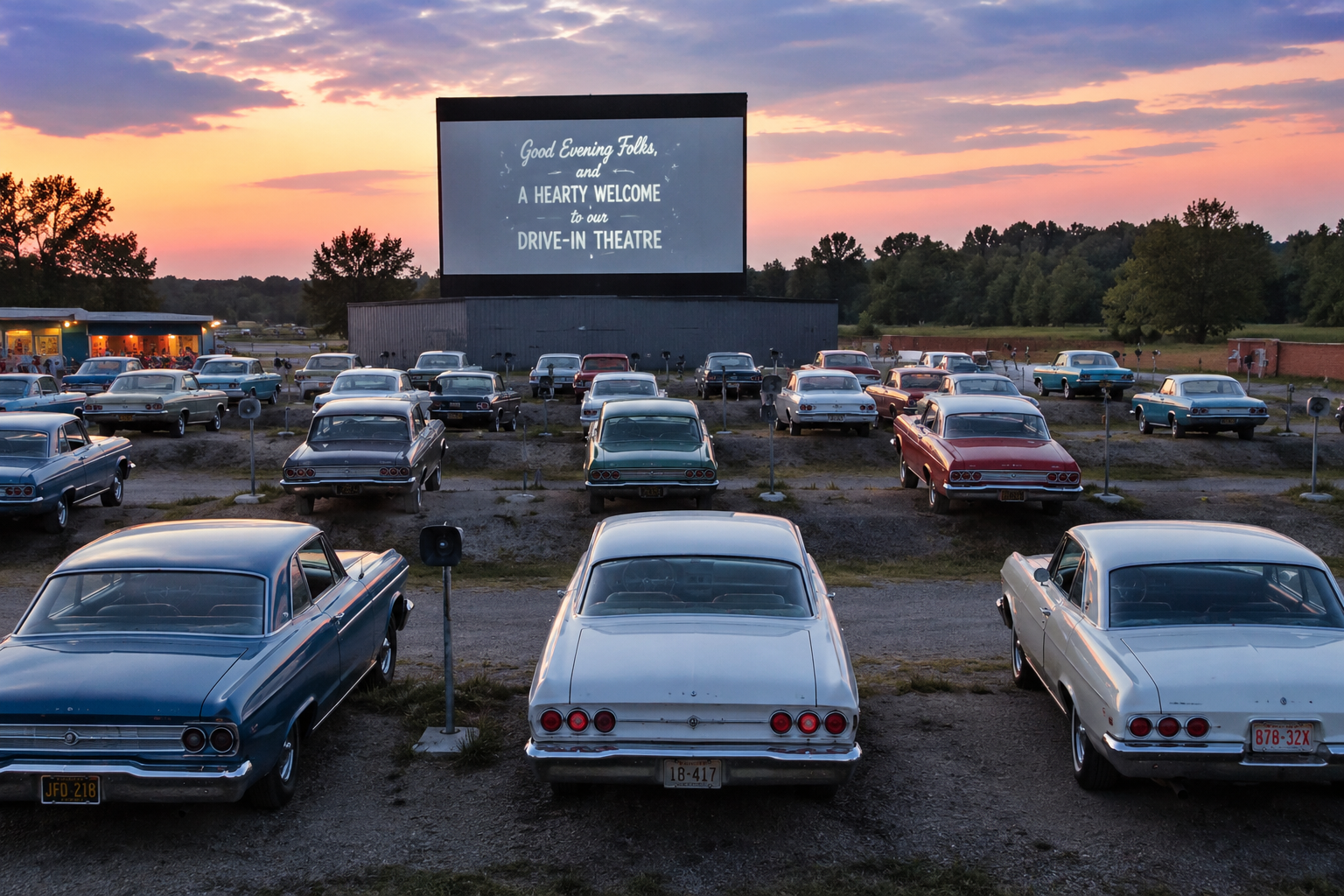
Think about a packed drive-in theater for a minute.
Rows and rows of cars. Big sedans. Station wagons. Somebody’s enormous Buick parked directly in front of you because of course it is.
And somehow everybody was supposed to watch the same movie through a windshield.
So how did that actually work?
The answer was underneath the cars.
Those odd little humps and sloping parking rows at old drive-in theaters were not random piles of dirt or badly graded parking lots. They were part of a carefully planned system designed to tilt cars toward the screen and help everyone see over the vehicles in front of them.
The drive-in parking lot was doing a lot more work than it looked like.
A Giant Movie Screen Didn’t Solve Everything
Putting a huge screen at the end of a field sounds like the easy part.
Then you start parking automobiles in front of it.
Unlike seats inside a movie theater, cars were not all the same height. A low sedan might have a perfectly good view while the people behind a taller car spent half the movie looking at somebody else’s roof.
Richard Hollingshead Jr., who developed the first commercially successful patented drive-in theater system in the early 1930s, figured out pretty quickly that this was going to be a problem.
Before opening his theater, Hollingshead reportedly experimented in his own yard. He parked one car behind another and put blocks beneath the wheels until he found an angle that let the people in the second car see over the one ahead.
It was a wonderfully simple solution to a surprisingly annoying problem.
And it became part of the drive-in itself.
Those Parking Lots Were Built in Rows and Ramps
Instead of simply paving a flat field and telling everybody to point toward the screen, drive-ins used carefully graded rows.
Hollingshead’s 1933 patent showed automobiles arranged on inclined parking areas so the cars ahead would interfere as little as possible with the view from those behind them.
The raised parking mounds tilted the front of the car slightly upward.
That meant your windshield was aimed more directly toward the screen, while the difference in height between rows helped you look over the cars ahead.
Not every theater had exactly the same arrangement, and the ramps were not always dramatic. Sometimes they were little more than long, gentle mounds running across the parking rows.
You drove up, stopped in the right spot and probably never gave the dirt underneath you another thought.
But without it, the movie might have consisted of two hours of the back of a Chevrolet.
Pulling Into a Drive-In Was Part of the System
There was a rhythm to arriving at a drive-in.
You came through the entrance, moved along the lanes, found the right row and settled the car onto its parking mound facing the screen.
Then came the speaker.
At older theaters, you would take the little metal speaker from its post and hang it on the window, hoping nobody drove away with the thing still attached later.
The whole setup worked together: screen, projection booth, parking rows, ramps, speaker posts and traffic lanes.
None of it was especially glamorous when taken apart.
Put it all together on a warm night with a few hundred cars, concession-stand smells drifting across the lot and kids wandering around before the movie started, and suddenly you had a drive-in theater.
That is part of what I try to recreate with Friday Night at Terror Glow Drive-In — not just the movie, but the strange little pieces that made the whole night work.
The Ramps Had Another Problem to Solve: Getting Everybody Back Out
Seeing the movie was only half the battle.
Eventually the credits rolled.
Now hundreds of automobiles all wanted to leave.
At once.
Some early parking-ramp designs had a rather unfortunate feature: an abrupt drop on the front side. That could mean drivers had to back their cars off the mound before they could head toward the exit.
Imagine an entire drive-in trying to do that at the same time.
This was exactly the sort of situation where the lot boys — sometimes called runner boys — earned their keep.
They helped direct cars, opened up blocked rows, guided drivers toward exits and kept traffic moving when everybody decided they needed to be home five minutes ago.
The design of the parking rows eventually improved so cars could move through the lot more smoothly instead of performing a little reverse maneuver off the ramp.
That made life easier for the drivers.
It probably made life considerably easier for the boys running around the lot too.
Drive-In Parking Lots Were Surprisingly Engineered
From a distance, an old drive-in can look like a giant screen sitting beside a field.
It wasn’t.
The parking area had to be shaped around sight lines.
Cars had to enter without creating a traffic jam.
They had to park at the correct angle.
People needed access to speaker posts.
Drivers had to get back out again after the movie.
And somehow all of this had to work in the dark while children wandered around, people headed to the snack bar and several hundred automobiles were packed together in rows.
There was a lot of engineering hiding underneath what looked like a very casual night at the movies.
So How Did Everybody See the Screen?
Drive-in theaters used graded parking rows and raised ramps to position cars at better viewing angles.
The ramps lifted and tilted vehicles slightly toward the screen while the arrangement of the rows helped people see over the cars parked ahead.
Those humps were not leftover dirt.
They weren’t just drainage.
And they weren’t simply there to mark the parking spaces.
They were part of the theater.
So the next time you see an old photograph of a drive-in and notice all those cars sitting at slightly funny angles, now you know why.
Somebody had already figured out that without those little hills, the fellow in the Buick ahead of you might end up being the main attraction.
Sources
Richard M. Hollingshead Jr., U.S. Patent 1,909,537, “Drive-In Theater,” granted May 16, 1933. https://patents.google.com/patent/US1909537A/en
Smithsonian Magazine, “The Origins of the Drive-In Theater.” https://www.smithsonianmag.com/arts-culture/the-origins-of-the-drive-in-theater-1-180949222
United Drive-In Theatre Owners Association, information on traditional drive-in lot design. https://uditoa.wildapricot.org/About-Us
Historical documentation on American drive-in theater design and parking-ramp development. https://www.thc.texas.gov/public/upload/Section%20III.1%20NRHP%20and%20III.2%20Prop%20Types%20%26%20Reg.%20Reqs.pdf