
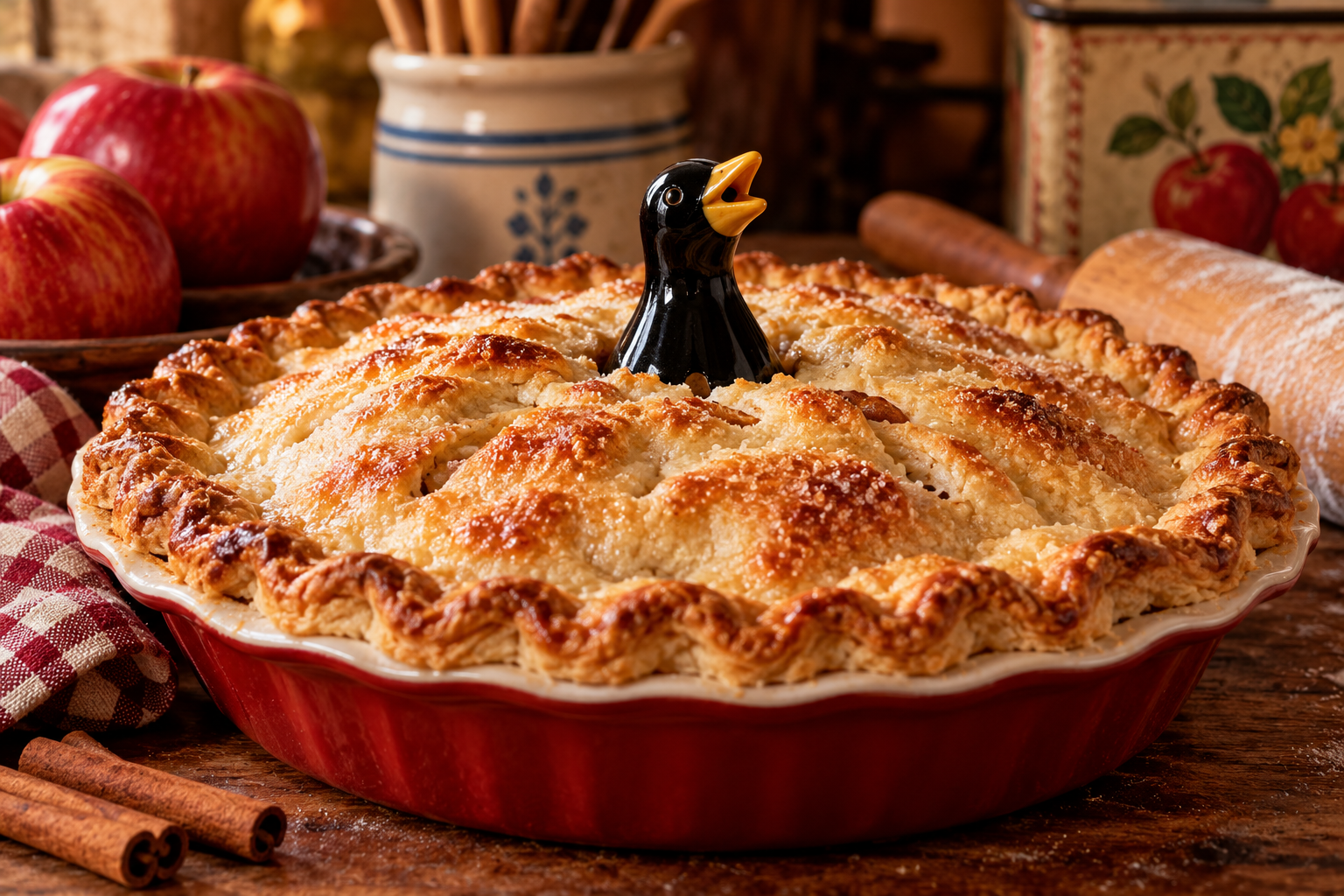
That little ceramic bird peeking out of Grandma’s apple pie wasn’t just there to look cute. It actually had a job to do—and it might still be useful in your kitchen today.
Imagine Thanksgiving dinner sometime in the 1940s.
The turkey has been carved, the dishes are being cleared, and someone carries a beautiful homemade apple pie to the table.
But there’s something peculiar sticking out of the golden crust.
A little black bird.
Not a real one, thankfully. This one is made of ceramic, with a bright yellow beak and a rather satisfied expression.
And while everyone else is thinking about dessert, that little bird has been quietly working away in the oven.
It’s called a pie bird, and this charming old-fashioned kitchen gadget is considerably more useful than you might think.
Especially if your pastry-decorating abilities don’t quite match those magnificent holiday pies we see all over Pinterest.
What Exactly Is a Pie Bird?
A pie bird is a small, hollow ceramic funnel designed to sit inside a pie while it bakes.
Most resemble little blackbirds with open beaks, although manufacturers have produced everything from chickens and ducks to other animals and rather peculiar little characters.
The traditional version has openings near the bottom and a hollow passage leading upward through the bird’s body to its beak.
As the pie bakes, steam from the hot filling travels through the little chimney and escapes through the bird’s mouth.
It’s a simple idea, but a surprisingly clever one.
Because one of the biggest problems with a homemade fruit pie isn’t the fruit.
It’s the moisture.
Why Grandma Put a Bird in Her Pie
If you’ve ever baked a double-crust apple, cherry, or blueberry pie, you know what can happen when the fruit begins to cook.
The filling heats up, moisture turns into steam, and those beautiful fruit juices start bubbling.
Without enough ventilation, steam can become trapped beneath the pastry, causing the top crust to puff up or separate from the filling as the fruit cooks down.
And sometimes, all those bubbling juices make a break for freedom around the edges of the pie.
That’s where a pie bird earns its keep.
First, it provides an escape route for steam.
The hollow bird acts like a miniature chimney, giving steam a way to leave the pie through the center.
Second, it helps support the top crust.
Because the bird stands upright inside the pie, it can help hold the pastry up as the filling cooks and settles.
That’s particularly helpful with deeper pies.
Third, it may help reduce messy boil-overs.
By providing additional ventilation, a pie bird can help manage some of the moisture building up beneath the crust.
It’s not a guarantee against an overflowing pie, especially if you’ve packed in enough filling to feed half the neighborhood.
But it can help.
And unlike a decorative ceramic figurine sitting on a kitchen shelf, this little fellow is actually doing something.
Before There Were Birds, There Were Funnels
The pie bird wasn’t originally a bird at all.
In Victorian Britain, bakers used small ceramic devices known as pie funnels or pie chimneys.
These were practical kitchen tools, often shaped like simple tubes or little hourglasses.
They stood in the center of covered pies, allowing steam to escape while helping hold up the pastry.
By the early twentieth century, potteries were producing increasingly decorative versions.
Around the 1930s, bird-shaped pie funnels became more familiar, eventually finding their way into kitchens in Britain and America.
The classic blackbird design is often linked to the old nursery rhyme Sing a Song of Sixpence, with its famous reference to four-and-twenty blackbirds baked in a pie.
Whether the rhyme inspired every early bird design is less certain, but the connection certainly seems appropriate.
Soon these hardworking kitchen helpers were becoming collectible little characters in their own right.
Some were blackbirds, others were brightly colored, and eventually the designs became almost as interesting as the pies they were intended to bake.
The humble pie funnel had developed a personality.
Do Pie Birds Really Work?
Here’s where things get interesting.
Yes, pie birds have a genuine purpose.
But no, you don’t absolutely need one to bake a wonderful pie.
Cutting several generous slits into a top crust also allows steam to escape. A lattice crust provides even more openings.
Modern baking experts, including King Arthur Baking, emphasize the importance of proper ventilation in double-crust fruit pies.
So why bother with a pie bird?
For one thing, its hollow opening provides a dedicated steam passage while also offering some support to the center of the pastry.
And there’s evidence that it can make a difference.
Baking author Dede Wilson reported testing two pies side by side, one with a pie bird and one without. Her test kitchen found that the crust baked with the bird was noticeably crispier.
That’s an interesting result, although it doesn’t mean a pie bird will improve every recipe.
A good crust still depends on properly prepared pastry, the filling, oven temperature, and adequate baking time.
The bird is a helper, not a miracle worker.
Although considering what some of us have done to perfectly innocent pie crusts, a miracle worker wouldn’t be entirely unwelcome.
Not Everyone Is a Pie Crust Artist
Take a look at some of today’s holiday baking photographs and you’d almost think a homemade pie required an art degree.
There are perfectly woven lattice tops, delicate pastry leaves, braided borders, and intricate cutouts arranged with surgical precision.
Beautiful? Absolutely.
Necessary for a delicious pie? Not remotely.
I still have a photograph in my kitchen of my mother and me, flour on our faces, taken by my grandmother during one of our pie-making adventures.
I remember struggling with lumpy pastry dough until a more experienced pair of hands took over.
“Not sure why your dough is lumpy. Give it here.”
And seemingly two seconds later, there were two perfect circles of pastry.
Some people just understand pie dough.
The rest of us occasionally need a little assistance.
And that’s another reason our ceramic friend still deserves some attention.
A pie bird allows a baker to use a simple, traditional top crust while adding a charming decoration that actually performs a useful job.
There’s no complicated weaving, no collection of tiny pastry cutters, and no need to master a dozen decorative techniques.
Just a little opening in the middle of the pastry, a bird peeking through, and suddenly you’ve got a pie with personality.
Of course, those fancy lattice tops and decorative cutouts do serve a purpose beyond looking pretty. Their openings allow steam to escape.
The pie bird accomplishes that job through its hollow body while also helping support the pastry.
Neither method is automatically better for every pie.
But if your pastry-decorating skills are somewhere between reasonably competent and please don’t look too closely, the little bird makes a delightful assistant.
And unlike those painstakingly arranged pastry leaves, nobody expects the bird to look any different when it comes out of the oven.
Can You Use a Pie Bird With Store-Bought Pie Crust?
Absolutely! And this might be one of the best reasons for today’s occasional holiday baker to try one.
Plenty of people enjoy preparing their own apple or cherry filling but would rather leave the pastry preparation to somebody else.
There’s nothing wrong with that.
Particularly when you’ve got a turkey in the oven, potatoes waiting to be mashed, and relatives arriving considerably earlier than expected.
The easiest prepared pastry to use with a pie bird is refrigerated, ready-to-unroll pie dough.
Line your pie plate with the bottom crust, place the bird upright in the center, and add your prepared filling around it.
Make a small opening in the second crust and gently lower it over the filling, allowing the bird’s head to poke through.
Seal the edges, add any additional vents your recipe requires, and bake according to your recipe.
You now have a traditional-looking holiday pie without making pastry from scratch.
But what about those frozen pie shells already sitting in aluminum pans?
Ah, now there’s a different adventure.
Some frozen pie crusts, including Pillsbury’s two-pack deep-dish shells, are designed so that one shell can be removed from its pan, turned upside down, and used as the upper crust.
It sounds simple.
And sometimes it is.
But frozen pastry can be rather uncooperative when you’re trying to fit it neatly around a filling.
Pillsbury’s directions call for removing the crimped edge and inverting the second shell while still frozen, then allowing it to thaw briefly before sealing and venting.
Adding a pie bird to that process is possible in principle, but it isn’t the method described on the package, and the rigid top shell makes it more awkward.
Trying to force a ceramic bird through brittle frozen pastry is a fine way to turn dessert into a jigsaw puzzle.
A flexible, ready-to-roll upper crust is generally the more convenient partner for a pie bird.
And here’s the important thing to remember:
A pie bird cannot fix poor-quality dough.
It won’t magically turn tough pastry into a flaky masterpiece, and it won’t solve a soggy bottom crust simply by sitting in the middle of the pie.
But it can help a properly prepared top crust release steam, provide a little support, and give an otherwise ordinary pie a charming finishing touch.
Sometimes that’s quite enough.
After all, the guests came for apple pie, not an examination of your pastry qualifications.
How to Use a Pie Bird

If you happen to discover one in Grandma’s baking cupboard—or decide to give a modern one a try—using it is fairly simple.
- Prepare the bottom crust. Line your pie plate with pastry as usual.
- Position the bird. Stand the clean, oven-safe pie bird upright in the center of the bottom crust.
- Add the filling. Spoon your prepared fruit or savory filling around the bird, keeping its steam openings clear.
- Prepare the top crust. Cut a small opening in the center of the pastry, large enough for the bird’s head to pass through.
- Cover the pie. Carefully lower the pastry over the filling, allowing the bird to poke through. Seal and crimp the edges, adding any additional vents your recipe calls for.
- Bake as directed. Follow your recipe’s temperature and baking instructions.
- Cool before serving. Allow the pie to cool appropriately, cut the first slice, and carefully remove the bird before serving the remaining pieces.
Remember that the ceramic bird will become extremely hot during baking.
And even when using a pie bird, placing the pie on a rimmed baking sheet is still a good precaution.
An especially enthusiastic cherry pie can overcome nearly any attempt at containment.
Which Holiday Pies Benefit Most?
Pie birds are particularly suited to deep, double-crust pies with moist fillings.
A classic apple pie is an excellent candidate, as are cherry, blueberry, and mixed berry pies.
Traditional savory meat pies and some covered chicken or turkey pot pies can also benefit from a pie chimney, depending on the recipe.
But a pumpkin pie?
Not so much.
Pumpkin and other open-top custard pies don’t have an upper pastry crust trapping steam.
And a lattice-topped fruit pie already has plenty of ventilation.
That means the pie bird isn’t necessary for every dessert on the holiday table.
For a generously filled, double-crust apple pie, however, it’s a charming and potentially useful little companion.
Can You Still Buy Pie Birds?
Absolutely.
Modern cookware manufacturers still produce them, including Le Creuset, which makes a colorful stoneware version designed for oven use.
You can also find vintage examples at antique shops, estate sales, and flea markets.
Collectors particularly enjoy the unusual shapes, colors, and designs produced by different potteries over the years.
One word of caution, though.
An unidentified antique pie bird shouldn’t automatically go into the oven. Older decorative glazes may not meet modern food-safety standards, and cracks or damage can make an old ceramic piece unsuitable for baking.
For actual use, choose one clearly identified as food-safe and oven-safe.
The old collectible can always sit on the shelf and supervise.
A Little Bird Worth Keeping
There’s something rather wonderful about an old kitchen tool that manages to be practical and charming at the same time.
The pie bird doesn’t need batteries, electricity, or a complicated set of instructions.
It simply stands in the middle of your pie and does the job it was designed to do.
And perhaps that’s why these little ceramic birds are still finding their way into kitchens generations after they first became popular.
They’re reminders of a time when everyday kitchen objects could be useful, durable, and just a little whimsical.
So the next time you’re making a holiday apple pie, consider giving one a perch in the middle.
Even if you decide ordinary pastry vents work just as well, you’ve got to admit:
A pie with a little blackbird peeking through the crust has considerably more personality.
And if your pastry turns out beautifully flaky, all the better.
Just don’t expect the bird to tell you when you’ve added too much water to the dough.
That’s what Grandma was for.
Sources and Further Reading
- Ceramics Monthly — Sing a Song of Pie Birds — Historical development of ceramic pie funnels and bird-shaped designs.
- Bakepedia — How to Use a Pie Bird — Baking author Dede Wilson’s instructions and side-by-side test.
- King Arthur Baking — How to Prevent Runny Apple Pie — Why ventilation matters for fruit pie filling and pastry.
- Pillsbury — Frozen Deep-Dish Pie Crusts — Manufacturer directions for one- and two-crust pies.
- Le Creuset — Stoneware Pie Bird — Example of a modern pie bird and its intended use.