
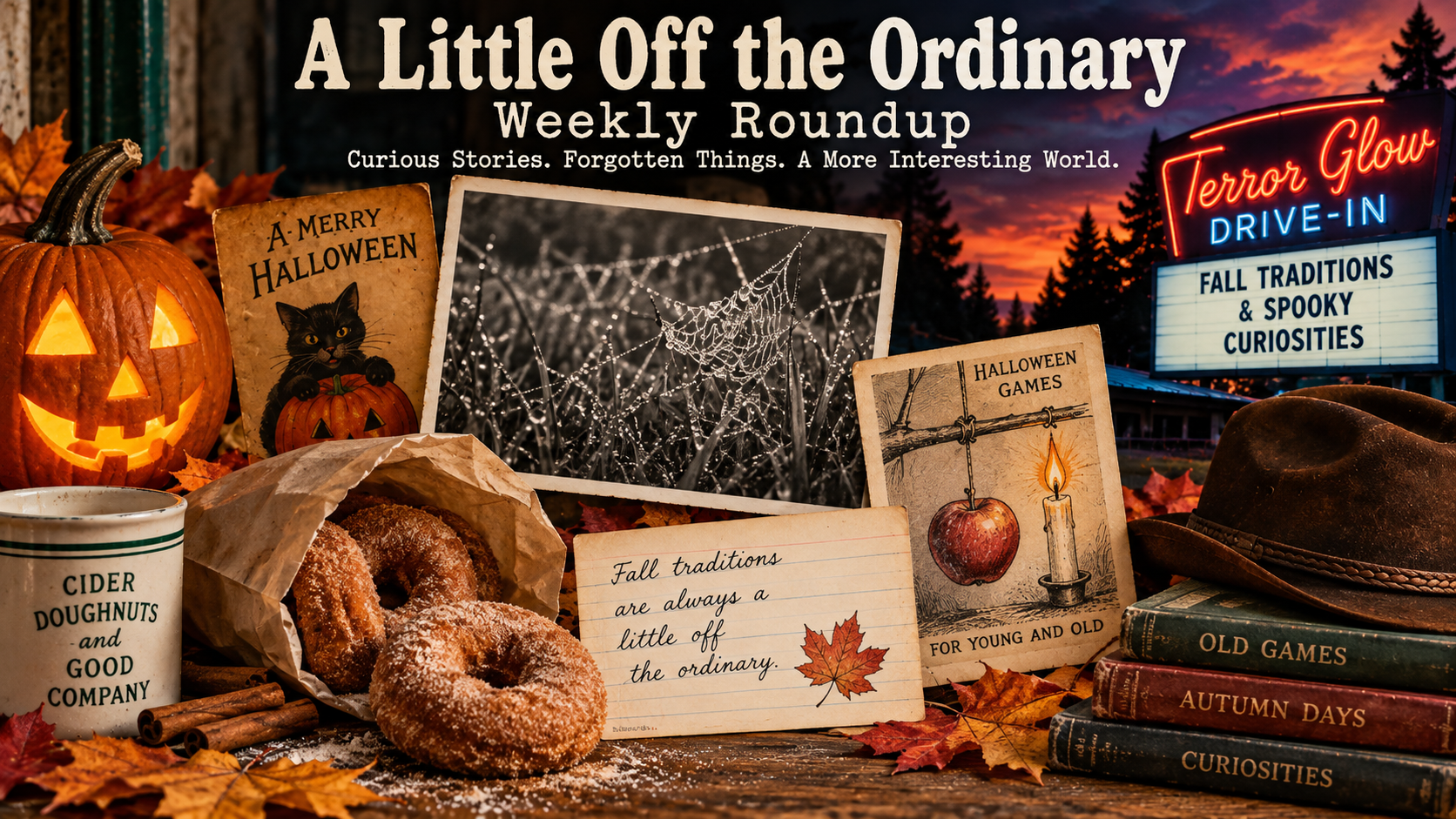
Pip: Welcome to A Little Off the Ordinary, where the lawn is full of spiders, the Halloween party involves open flame, and the doughnuts have a surprisingly complicated origin story — just another calm autumn week.
Mara: Tess Blackwood has been covering a lot of ground this episode — from backyard natural history to vintage Halloween folklore to the surprisingly modern roots of a fall food tradition. Let’s start with the season’s more unsettling decorations: the ones nature puts out without asking.
Spiders, Dew, and the Halloween Atmosphere
Pip: There’s a particular kind of early-morning panic that hits when you step outside in late summer and your lawn appears to have been gift-wrapped overnight. The question this post is really answering is: did something move in, or was it always there?
Mara: The answer is almost certainly the latter. As the post puts it, “The morning dew simply gave them away.” Grass spiders build flat sheet webs close to the ground all season — the dew just outlines what was already invisible.
Pip: So the spiders didn’t arrive. The lighting changed. Which is either reassuring or the opposite, depending on how you feel about learning your lawn has been populated this whole time.
Mara: The post walks through exactly how the hunting system works. The sheet web isn’t sticky — it doesn’t trap prey. It transmits vibrations. When something walks across it, the spider races out of the funnel. The post describes them as fast, and that speed is the whole mechanism.
Pip: And then the sun comes up, the dew evaporates, and the neighborhood vanishes. The post has a nice line for that: “You just lost the lighting.”
Mara: Right, and the post is careful to point out that this is mostly good news for the yard. Grass spiders are predators eating other small insects — not pests damaging the lawn itself. The post also flags one important distinction: if what you’re seeing looks more like fuzz than a structured sheet with a funnel, it might be lawn fungus rather than spider silk, and the two call for very different responses.
Pip: A spider builds over the grass. A fungus grows on it. Genuinely useful. The post even addresses what happens after you mow — the spider can repair and rebuild, so fresh-looking webs a day later are probably renovations, not new arrivals.
Mara: The post closes on something almost affectionate: those webs can be one of the first quiet signs the season is turning. Long before the leaves change, the spiders’ webs start catching the dew and giving the whole thing away.
Pip: Which brings us, naturally, to Halloween — and to a party game that makes a dewy lawn full of spiders look like the safe option.
Mara: The apple-and-candle game. A spinning stick, an apple on one end, a lit candle on the other, and your face in the middle. The post on that one traces it through sources spanning decades, and the answer to “did people really do this” is an unambiguous yes.
Pip: Robert Chambers described it in his 1864 Book of Days — a stick hung horizontally, set twirling, apple on one end, candle on the other, and players jumping up to grab the apple with their teeth. No hands.
Mara: And the post quotes directly what happened when it went wrong: players could end up scorched or smeared with candle grease, and Chambers noted that the resulting mishaps “caused plenty of laughter.” The spectators, at least, were having a wonderful time.
Pip: The Beard sisters included it in their 1893 American Girl’s Handy Book, acknowledged it was “a little dangerous,” and suggested replacing the candle with a bag of flour. Progress. Slow, flour-covered progress.
Mara: But the lighted version didn’t disappear. Mary E. Blain’s 1912 Games for Hallow-e’en was still printing full instructions — apple, candle, spin, no helmet mentioned. And Ruth Edna Kelley was describing it again in 1919, calling it one of the rougher Halloween games. The post also notes that Blain’s collection included a revolving barrel hoop hung with apples, cakes, candies, and candle ends, where grabbing a candle cost you a forfeit.
Pip: At some point the party planning committee had clearly stopped asking questions and started just adding candles.
Mara: The post puts apples at the center of all of this — bobbing, peeling for fortune-telling, seeds used for divination, mirrors. Apples were everywhere at Halloween because they were abundant at harvest time and had accumulated layers of tradition around them. The candle game was just the version with the most exciting failure condition.
Pip: The post ends with a note that the underlying formula survived — food placed somewhere inconvenient, hands not allowed, everyone looks ridiculous — we just eventually got smarter about the fire.
Mara: From spinning candles to autumn orchards, apples really do carry a lot of seasonal weight.
The Surprisingly Recent History of Cider Doughnuts
Pip: Apple cider doughnuts feel ancient — the kind of thing someone’s great-great-grandmother made after the harvest. The post’s argument is that the tradition is real, but its origins are more recent and more deliberate than the smell of cinnamon sugar suggests.
Mara: The post traces it to a specific moment: “In August 1951, the Doughnut Corporation of America announced that it would introduce a new product during its annual fall sales campaign: the Sweet Cider Doughnut.” A New York Times report called it a spicy cake doughnut with a “natural fall appeal.” Someone looked at a cider doughnut and decided to sell fall with it.
Pip: And the conditions were already in place — doughnut machines from the 1920s, Americans taking Sunday drives to farm stands, orchards that already had apples and cider. The post quotes food historian Michael Krondl describing it as a meeting of automobiles, automation, and advertising. The warm doughnut at the end of a fall drive did the rest.
Mara: The post is clear that the cider actually does something in the batter — moisture, acidity, that tender texture — but notes that the warm spices and cinnamon sugar coating carry most of the familiar flavor. A tradition doesn’t have to be ancient to be real. It just needs enough years for families to start making the trip back to the same orchard every October.
Pip: Spiders that were always there, party games that were always a little dangerous, and a doughnut tradition younger than it smells — autumn is apparently full of things hiding in plain sight.
Mara: Next time, Earl thinks he’s found a ghost. We’ll see what’s actually there.