
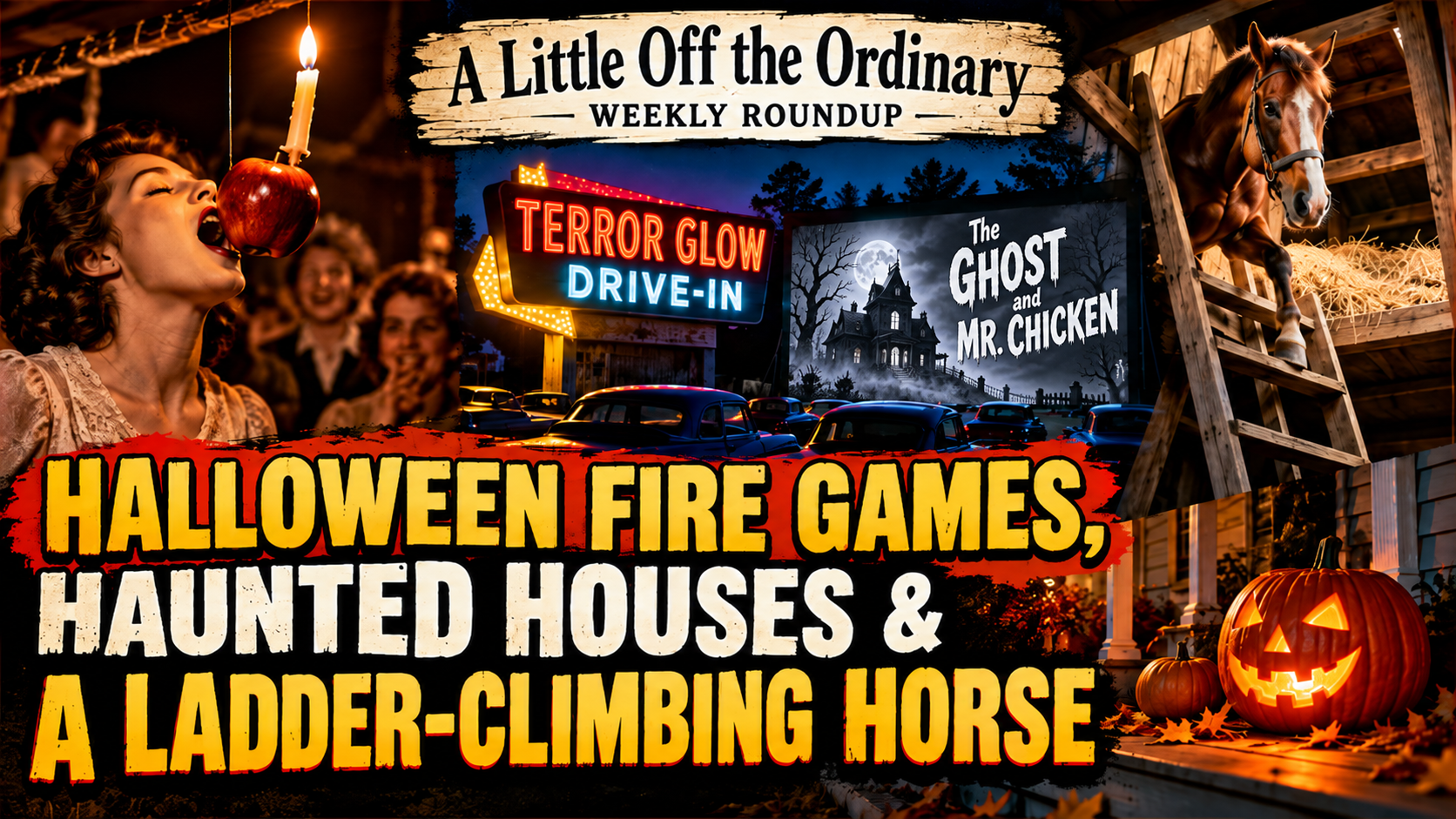
Pip: Welcome to A Little Off the Ordinary, where the questions are things like: did people voluntarily put their faces next to spinning open flames, and also, did a horse climb a ladder.
Mara: Both of those are real questions Tess Blackwood goes after this week, alongside a stop at a fictional drive-in for a 1966 haunted-house comedy. Let's start with Halloween traditions — and some genuinely alarming party games.
Halloween Traditions And Party Oddities
Pip: The question at the center here is how Halloween parties used to work — and the short answer is that they involved significantly more fire than modern liability insurance would allow.
Mara: The apple-and-candle game is the anchor. Here is how Robert Chambers described it in his 1864 Book of Days: "Sometimes the candle reached the player first, scorching a face or smearing it with candle grease. The resulting mishaps, he said, caused plenty of laughter."
Pip: So the entertainment was not just catching the apple. The entertainment was also watching someone catch the candle instead.
Mara: That is accurate. A stick hung from the ceiling, apple on one end, lit candle on the other, set spinning. Players tried to bite the apple with no hands. The game appears in sources across decades — Chambers in 1864, the Beard sisters in 1893, Mary Blain's Games for Hallow-e'en in 1912, and Ruth Edna Kelley's Book of Hallowe'en in 1919.
Pip: Decades of printing instructions for this. Someone kept deciding the world needed to know.
Mara: The Beard sisters did eventually suggest replacing the candle with a small flour bag — acknowledging the danger while keeping the game. But the lighted version kept appearing in print anyway. Blain's 1912 collection even describes a revolving barrel hoop with apples, cakes, candies, and candle ends attached, where grabbing a candle cost you a forfeit.
Pip: More candles. The logical escalation.
Mara: The piece also traces why apples dominated Halloween at all — harvest availability, fortune-telling traditions, bobbing, peel-reading for future sweethearts. The candle game fit into a broader category of suspended-food, no-hands party entertainment. And the second post, on how the pumpkin claimed the front porch, fills in the other half of that seasonal picture.
Mara: The pumpkin started as food, became a harvest symbol as Americans moved away from farms, and then the jack-o'-lantern tradition — carved faces placed near entrances where visitors could see them — pulled it permanently to the front door. A 1914 children's book already told readers to set their jack-o'-lantern on the front porch for Halloween. The elaborate modern fall display came later, but the pumpkin at the door is genuinely old.
Pip: Apple games, pumpkin porches — Halloween has always been very committed to its props. Speaking of commitment to atmosphere, there is a drive-in to visit.
Vintage Movie Night Frights
Pip: The Terror Glow Drive-In this week is screening The Ghost and Mr. Chicken, the 1966 Don Knotts comedy-mystery, framed through the voice of Earl, the drive-in's fictional proprietor.
Mara: The post describes Luther Heggs — newspaper typesetter, aspiring reporter — agreeing to spend the night alone in a supposedly haunted mansion. The score is by Vic Mizzy, who also wrote the Addams Family theme, and TCM noted he completed it in four days, including what the post calls the "wonderfully creepy Haunted Organ music."
Pip: The film is warm, cozy, and apparently just spooky enough — Earl rates it five out of five on nervous Don Knotts energy, which feels like the right metric.
Mara: From historical Halloween games to a horse with arguably better judgment than most party guests.
Historical Animal Oddities
Pip: The question is whether a horse in 1897 actually climbed a ladder into a hayloft to steal hay — and whether that question deserves a straight answer or just admiration.
Mara: The New York Journal and Advertiser reported it on December 11, 1897. Michael Carrigan's horse vanished, and hours later turned up in the hay mow. The paper noted the ladder was the only apparent route up, and that the story was "supported by several local citizens who had never been known to stray from the path of truth."
Pip: Nineteenth-century newspapers doing their best.
Mara: The horse turned out to have been a former circus trick horse, which the piece takes seriously. Ringling Bros.' 1897 route book describes trained horses that waltzed, bowed, danced quadrille figures, and one named Mizpah that retrieved objects like a dog. An 1839 European circus horse had been trained to ascend stairs. The New Hampshire SPCA has documented modern horses attempting to climb into haylofts and becoming trapped. So the behavior is not impossible — just unverified in this specific case.
Pip: Nobody watched it happen. The horse was simply there, eating hay, having apparently solved the problem.
Mara: The conclusion is honest: we cannot confirm it, but the circus-horse background makes it harder to dismiss than it first appears.
Pip: Spinning candles, porch pumpkins, nervous reporters, ladder-climbing horses — the throughline is people discovering that history was stranger and more committed than expected.
Mara: And that the strange parts usually have a real paper trail. More from A Little Off the Ordinary next time.