
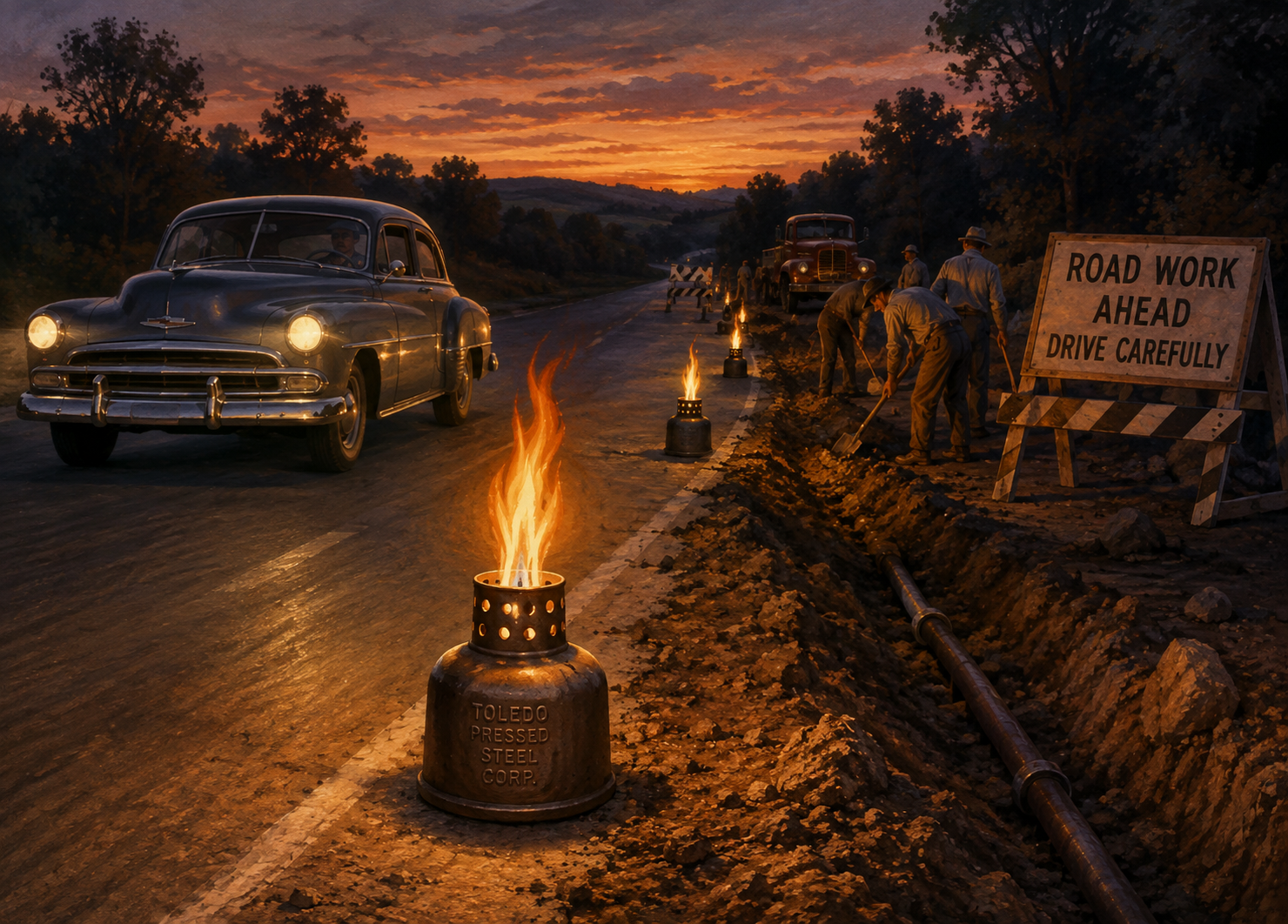
If you remember road construction from decades ago, you may remember something that would look downright peculiar beside a road today.
Little black metal pots.
With fire coming out of them.
They sat beside trenches, barricades, torn-up pavement and other places somebody apparently decided needed a warning. At night, a row of those small flames could mark the edge of a work zone.
And yes, the basic idea really was:
There is a dangerous hole in the road. Let’s put a container of burning kerosene beside it so people notice.
Different time.
Those little burners were generally known as road torches, construction torches or highway warning torches. One particularly well-known version was the Toledo Torch, and people also commonly remember the smaller road versions as smudge pots.
That last name, though, can make things confusing.
Were They Really Smudge Pots?
Sort of.
People absolutely used the term smudge pot for small flaming road markers, and if you ask someone who remembers them, that may be exactly what they call them.
But historically, smudge pot also refers to something quite different: large oil-burning heaters used in orchards to help protect fruit trees from frost.
Those could be substantial pieces of equipment.
The little black thing sitting beside a freshly dug ditch was another animal entirely.
For the road version, construction torch or road warning torch is the clearer description.
And if the one you remember looked suspiciously like a cartoon bomb—a round black body with a flame sticking out of the top—you may very well be remembering a Toledo Torch.
What Was a Toledo Torch?

The Toledo Torch was a type of kerosene-burning warning light manufactured for use around road and street construction.
By the 1920s, the Toledo Pressed Steel Company was advertising spherical warning torches specifically for marking road obstructions.
The shape was not just somebody in the factory having fun.
Some versions were built with a heavy weight low in the body, helping the torch remain upright or right itself if it was knocked over.
That is probably useful when the object you have placed beside traffic contains both fuel and fire.
A 1929 United States patent for improvements to this kind of equipment described them as street torches or construction torches used to illuminate road obstructions.
So these weren’t improvised buckets somebody filled with fuel.
They were manufactured pieces of road-safety equipment.
What Did They Burn?
Usually kerosene.
Inside was a fuel reservoir feeding a wick or burner at the top.
Manufacturers also had to deal with the obvious problem of leaving a flame outside beside a road all night:
weather.
Wind could blow it out. Rain could put it out. Snow wasn’t particularly helpful either.
Patents and advertisements for road torches therefore talk about burner designs and protective hoods intended to keep the flame going in poor weather.
A road warning isn’t much use if the warning goes dark halfway through the night.
That also explains why these weren’t simply open cans with rags burning in them. The better designs were made specifically to keep a visible flame burning for hours outdoors.
Why Use Fire at All?
Because dependable little electric warning lights were not always the easy option they are today.
Road crews needed something that was:
- portable
- visible at night
- fairly cheap
- simple to put in place
- able to operate without an electrical connection
A kerosene torch checked all of those boxes.
Set out several around an excavation or barricade and motorists could see the line of danger ahead of them.
No power cord.
No charging station.
No LED.
Just fuel, a wick and fire.
Which sounds primitive now, but for its time it was practical.
Did Road Crews Just Leave Them Burning Overnight?
Yes.
That was the point.
Road departments and municipal crews could place the torches around construction hazards and leave them burning through the dark hours.
Period advertisements even boasted about how long particular torches could operate on a supply of kerosene.
The flames might mark a trench, blocked lane, pile of construction material, barricade or another obstruction motorists needed to see.
By 1961, the national Manual on Uniform Traffic Control Devices still discussed the use of torches and lanterns at road construction sites.
So these weren’t something that vanished immediately after the Model T.
They lasted surprisingly far into the automobile age.
And Nobody Thought Open Flames Beside the Road Were a Problem?
Eventually, yes.
Even the 1961 traffic-control manual warned that open-flame torches could create hazards in places where pedestrians or children might get close to them.
Electric warning devices were already being discussed as alternatives.
And there were other obvious drawbacks.
A kerosene torch could:
- be knocked over
- leak fuel
- go out
- create a fire hazard
- require somebody to refill and light it
- become a tempting object for curious children
Modern work-zone lights don’t have quite the same dramatic charm, but a flashing battery-powered lamp has certain advantages over small unattended fire beside traffic.
They Were Still Around Later Than You Might Think
One of the more surprising things about these torches is how long they remained in use.
A Mississippi court case concerning a 1970 accident described city workers using a Toledo Torch filled with kerosene beside a street excavation in Biloxi.
So if you remember seeing these along roads in the 1950s or 1960s—or even later—you are not imagining it.
They were still part of ordinary road construction in some places long after newer warning equipment had begun appearing.
As with a lot of roadside equipment, the change didn’t happen everywhere at once.
One town might have switched to electric barricade lights while another was still getting another season out of perfectly serviceable kerosene torches sitting in the public works shed.
Why Were They Round?
This may be my favorite part.
Because the round ones really do look like something Wile E. Coyote should have ordered from Acme.
But that peculiar shape served a purpose.
At least some Toledo Torch designs put substantial weight at the bottom of the body. If the torch was bumped or tipped, the low center of gravity helped it come back upright.
A spherical metal body was also sturdy and relatively easy to move around a job site.
So the strange little road bomb was actually fairly clever.
Still looked like a bomb.
But a clever one.
Were They Always Black?
Black is how many people remember them, particularly the round Toledo-style torches, but road-warning equipment varied by maker and era.
There were different body shapes, burner designs and warning lamps over the years.
Some resemble a kettle.
Some look more like cans.
Some later versions begin looking much more like the familiar construction lantern.
So if the thing you remember wasn’t perfectly round, that doesn’t mean you’re remembering the wrong object.
The important clues are the portable fuel reservoir, exposed or hooded flame, and use around roadway hazards or construction.
What Replaced Them?
There wasn’t one morning when every highway department in America gathered up its torches and threw them away.
The change was gradual.
Reflective barricades improved.
Electric warning lamps became easier to use.
Battery-powered flashing lights became common.
Traffic cones, drums and other highly visible channelizing devices became increasingly standardized.
Eventually there wasn’t much reason to keep sending somebody out to fill and light little kerosene burners when a flashing lamp could do the job without an open flame.
The old torches moved from road crews to garages, barns, antique shops and collector shelves.
Which created another problem.
People forgot what they were.
Why Are They So Often Confused With Orchard Smudge Pots?
Because both things involved oil, smoke, flame and the word “pot.”
But their jobs were quite different.
An orchard smudge pot was essentially a heater. Growers placed them among fruit trees and burned fuel to help fight damaging frost.
A construction torch was a warning device.
It wasn’t supposed to heat the road.
It was there to make you see the road.
Or more importantly, see the part of the road that suddenly wasn’t there.
So What Were Those Little Flaming Pots Beside Old Roads?
They were an early form of nighttime traffic warning.
Road crews used kerosene-burning construction torches, road torches and warning torches, including the well-known Toledo Torch, to mark excavations, barricades and other hazards after dark.
They were simple, portable and didn’t need electricity.
Some were even designed to right themselves if knocked over.
And for decades, drivers approaching roadwork after dark saw something completely ordinary:
A line of little flames along the highway.
Today we’d probably slow down just to figure out why the road department had apparently set the construction site on fire.
Back then, that meant the warning system was working.
Sources & Further Reading
- 1929 U.S. Patent 1,732,708 — Toledo Pressed Steel Company —
U.S. Patent 1,732,708 — Google Patents - Colorado Highways, 1927 — “Spherical Warning Torch” —
https://www.codot.gov/programs/environmental/archaeology-and-history/assets/colorado-highways_1927.pdf/ - 1961 Manual on Uniform Traffic Control Devices — Highway Construction and Maintenance —
1961 MUTCD — Construction and Maintenance Traffic Controls - Jackson v. City of Biloxi, 1973 —
Jackson v. City of Biloxi — Justia - Smithsonian National Museum of American History — Orchard Heater —
Smithsonian — Orchard Heater / Smudge Pot