
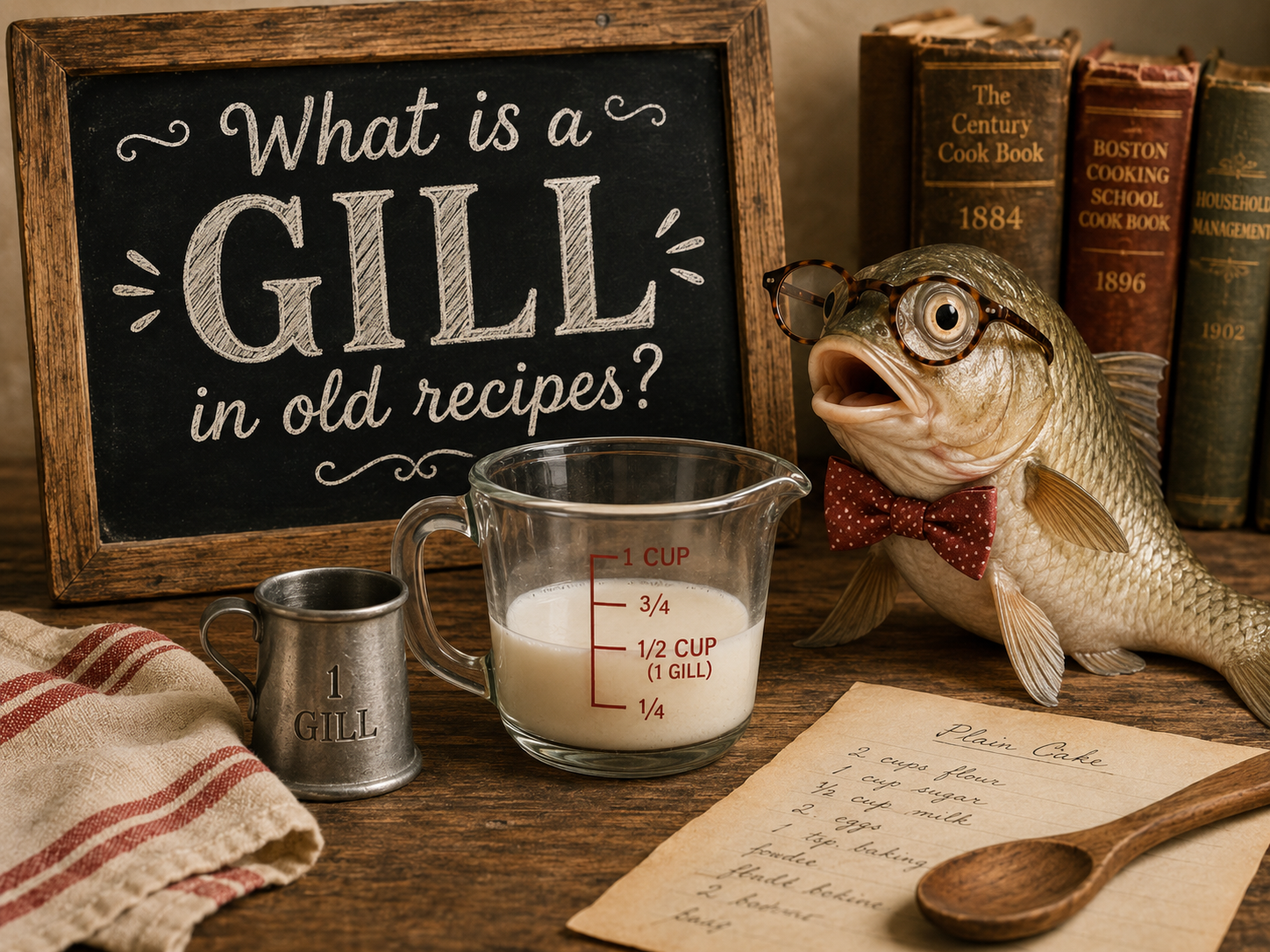
You’re happily reading an old recipe when suddenly it asks for one gill of milk.
A gill?
Did a fish somehow become involved? Is this another one of those old measurements that requires a scale, a conversion chart, and the patience of a saint?
Fortunately, no.
In an old American recipe, 1 gill equals ½ cup, or 4 fluid ounces — about 118 milliliters. The National Institute of Standards and Technology still lists the gill as the equivalent of a half-cup measure.
That answers the immediate question.
It does not, however, answer the more irritating one:
If a gill is just half a cup, why didn’t they say half a cup?
Excellent question.
Apparently, they could have.
First, What Exactly Is a Gill?
A gill — pronounced “jill” — is an old unit for measuring liquids.
In the American system:
| Old Measurement | Modern U.S. Measurement |
|---|---|
| ½ gill | ¼ cup / 2 fluid ounces |
| 1 gill | ½ cup / 4 fluid ounces |
| 1½ gills | ¾ cup / 6 fluid ounces |
| 2 gills | 1 cup / 8 fluid ounces |
| 4 gills | 1 pint / 16 fluid ounces |
So despite sounding wonderfully mysterious, a gill fits neatly into the familiar pint-and-cup system.
One pint contains four gills.
One cup contains two.
There is nothing especially complicated about it once you know what it is.
The word itself is much older than the recipes most of us are trying to decipher. The liquid-measure meaning goes back to medieval usage and was associated with a small measure for wine.
So the mighty gill had been around for a very long time before somebody’s great-grandmother decided to put one into a cake.
But Seriously. Why Not Just Say Half a Cup?
Here is where things get interesting.
They did know what half a cup was.
The White House Cook Book, published in 1887, contains a table titled “Measures and Weights in Ordinary Use Among Housekeepers.”
And there it is:
“one gill or half a cup.”
Case closed.
The people of 1887 were fully aware that a gill was half a cup.
Then, elsewhere in the very same book, a recipe for sauce for boiled cod begins by calling for one gill of boiling water.
They could have written half a cup.
They chose gill.
I have questions.
In Their Defense, the Gill Was Actually the More Official-Sounding Measurement
Before we judge them too harshly, there is a reason the gill made sense at the time.
Today, when a recipe says 1 cup, we reach for a standardized measuring cup holding 8 U.S. fluid ounces.
But “cup” was not always quite that simple.
Older cookbooks can refer to a cupful, coffeecupful, teacupful, tumblerful, wineglass and other conveniently available objects that were not necessarily the identical size from one household to another.
That is precisely why old cookbooks sometimes included pages explaining what their measurements meant.
Mary Ronald’s The Century Cook Book, first published in 1895, went so far as to tell readers that exact measurements were important and that a proper tin measuring cup holding one-half pint should be part of the kitchen equipment. Its measurement table also states plainly:
½ kitchen cupful = 1 gill.
In other words, cooks were living through a period when several measurement languages overlapped.
A gill wasn’t a quaint approximation like “a lump of butter the size of an egg.”
It was an actual unit of liquid capacity tied directly to the pint.
That made it useful.
Rather annoyingly, this means our ancestors have a legitimate defense.
The Measuring Cup Eventually Won
By the end of the 19th century, American cookbook writers were pushing cooking toward more standardized measurements.
Fannie Merritt Farmer’s enormously influential Boston Cooking-School Cook Book, published in 1896, became particularly associated with the use of standardized measurements in American recipes.
Once a “cup” reliably meant a defined measuring cup rather than whatever drinking vessel happened to be nearby, ½ cup was simply easier for a home cook than maintaining a separate word for the same amount.
The gill gradually disappeared from everyday American recipe language.
Mostly.
Technically, it never completely died.
NIST still includes the gill in its tables of U.S. capacity measurements, where one gill is exactly 4 fluid ounces and approximately 118 milliliters.
The gill is therefore not imaginary, obsolete nonsense.
It is merely lurking.
Waiting inside an old cookbook for you to find it.
One Important Warning: American and British Gills Are Not the Same
Here is the part worth knowing if you collect old cookbooks or find historical recipes online.
A U.S. gill and a British Imperial gill are different sizes.
An American gill is:
4 U.S. fluid ounces — ½ U.S. cup — about 118 mL
A British Imperial gill is:
5 Imperial fluid ounces — about 142 mL
Both are one-quarter of their respective pints, but an Imperial pint is larger than an American pint.
That means you should check where the recipe came from before automatically reaching for your half-cup measure.
For an old American cookbook, half a U.S. cup is the conversion you want.
For an old British cookbook, it isn’t.
Yet another small historical trap hiding between the flour and the eggs.
How Do I Measure a Gill Today?
For an American recipe, this part is beautifully easy.
If the recipe says:
½ gill — use ¼ cup
1 gill — use ½ cup
1½ gills — use ¾ cup
2 gills — use 1 cup
No antique measuring vessel required.
No mathematical heroics.
And absolutely no fish.
So Were They Crazy for Using Gills?
Not really.
Which is mildly disappointing.
The gill belonged to a perfectly logical system: four gills made a pint, and the gill gave cooks a recognized measurement for a fairly small quantity of liquid.
At the same time, cooks were also using cups, coffeecups, teacups, wineglasses and assorted other vessels. As standardized kitchen measuring cups became normal, saying half a cup simply became more useful than saying one gill.
So when an old American recipe tells you to add a gill of milk, cream, water or stock, you don’t need to rewrite the recipe or start rummaging through an antique shop for a mysterious little measuring cup.
Just grab the half-cup measure.
Our ancestors knew it was sitting there, too.
For reasons of their own, they simply preferred to make us look it up 140 years later.