
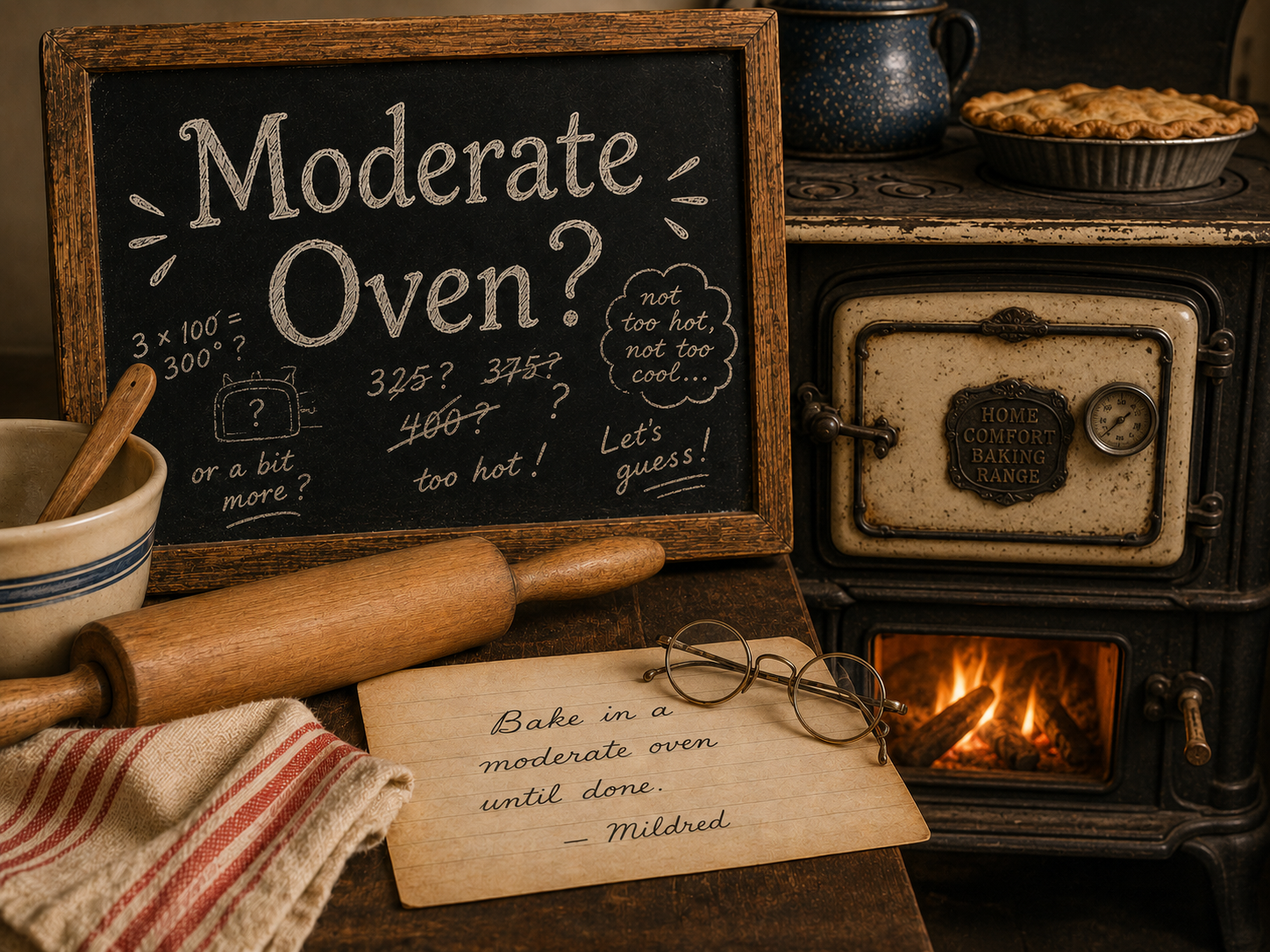
You find an old recipe that sounds wonderful.
You gather the ingredients. You translate a measurement or two. Everything is going surprisingly well.
Then you reach the instructions:
“Bake in a moderate oven until done.”
Thanks, Mildred.
Very helpful.
For anyone standing in front of a modern oven with an actual temperature dial, here is the answer you came for: In an old American recipe, a moderate oven usually means about 350°F to 375°F, or roughly 175°C to 190°C.
If the recipe gives you absolutely no other clue, 350°F is generally a sensible place to start.
But unlike a gill, which we can neatly translate into half a cup, “moderate oven” is not an exact measurement.
And there is a very good reason for that.
My Grandma Explained This Better Than Any Conversion Chart
My grandma taught me that many of the old ovens these recipes were written for were heated with wood or coal. Once you understand that, instructions like “slow oven,” “moderate oven” and “hot oven” suddenly make a lot more sense.
You weren’t turning a knob to 350 degrees.
You were managing a fire.
So “moderate” wasn’t necessarily vague to the person using the recipe. An experienced cook knew her stove. She knew the fire. She knew what happened when she opened a damper, added another piece of wood, moved the coals or let the fire settle.
Moderate was something she knew how to make.
Which is considerably more impressive than pushing three buttons and then wandering away until the oven beeps at us.
So How Did They Know How Hot the Oven Was?

Before oven dials, cooks managed the fire, dampers, and airflow themselves. “Moderate” was a skill, not a setting.
Experience. Lots and lots of experience.
Before oven dials, cooks managed the fire, dampers, and airflow themselves. “Moderate” was a skill, not a setting.
Earlier bakers learned to judge the heat produced by their particular oven and fire. The heat could be changed by the amount and type of fuel, airflow, dampers and how long the oven had been heating.
In even earlier wood-fired ovens, cooks could judge heat directly and allow an overheated oven to cool before baking. The Smithsonian notes that cooks regulated wood-fired ovens by managing the fire and testing whether the oven seemed to have reached the proper heat.
In other words, Grandma wasn’t helpless because her stove didn’t have a digital thermometer.
Grandma was the thermostat.
And she had probably baked the same cake enough times to know exactly what her oven needed. That little bit of knowledge is missing when we inherit only the recipe card.
Is a Moderate Oven 350°F or 375°F?
Yes.
Helpful, I know.
Later cookbooks are wonderful evidence of why we should treat “moderate” as a range rather than an exact temperature. Once recipes began printing actual oven temperatures alongside the old terminology, moderate oven appears at different temperatures.
The Calumet Book of Oven Triumphs, for example, describes recipes baked in a moderate oven at 325°F, 350°F and 375°F, depending on the recipe. Other published recipes even pushed “moderate” up to 400°F.
So there was never a meeting at which everyone agreed:
Moderate shall henceforth mean precisely 350 degrees Fahrenheit, and Mildred from Ohio will be responsible for enforcement.
It was a category of heat. Not a sacred number.
For most old American recipes, this is a useful modern guide:
| Old Recipe Says | Modern Oven Starting Point |
|---|---|
| Very slow oven | about 250–275°F / 120–135°C |
| Slow oven | about 300–325°F / 150–165°C |
| Moderate oven | about 350–375°F / 175–190°C |
| Hot or quick oven | about 400–425°F / 205–220°C |
| Very hot oven | about 450°F and above / 230°C+ |
Think of those as translation ranges, not universal laws. The recipe itself still gets a vote.
What Temperature Should I Actually Use?
If an old American recipe simply says “moderate oven” and gives you no temperature at all, I would usually begin at 350°F.
Then look at what you’re baking. A cake, loaf, pudding or casserole that needs a longer baking time will often be happier toward the lower end of the moderate range.
Something small that needs to bake and brown more quickly — such as certain biscuits, muffins or cookies — may make more sense at 375°F.
And if the recipe gives a baking time, compare it with a similar modern recipe.
If Mildred says her little cakes should be finished in twelve minutes, 325°F probably isn’t going to get us there. Use the old instructions as clues rather than treating any conversion chart as gospel.
What About “Bake Until Done”?
Ah yes.
Mildred’s second gift to us.
Old recipes frequently assume the cook already knows what “done” looks, smells and feels like. And once again, that wasn’t necessarily unreasonable at the time. Recipes were often written for cooks who already understood basic techniques. They were reminders as much as instruction manuals.
Today we expect recipes to tell us: Bake at 350°F for 32 to 35 minutes, rotating the pan halfway through, until a toothpick inserted 1½ inches from the center emerges with three emotionally well-adjusted crumbs attached.
Older recipes might give us: Bake until done.
Good luck.
When working with one, use the clues the food itself gives you: browning, firmness, texture, whether the center is set, and the normal doneness tests for whatever you’re making.
Modern knowledge is allowed. Mildred will never know.
Why Did Recipes Keep Saying “Moderate Oven” After Better Ovens Appeared?
Kitchen technology did not change everywhere at once.
Gas cooking existed in the 19th century, electric ranges began appearing around the turn of the 20th century, and wood- and coal-burning ranges continued in use alongside them. Cookbook language carried over from one generation of equipment to another. That happens all the time.
We still “dial” a phone number when there hasn’t been a dial on most phones for decades.
Early 20th-century cooks likewise continued talking about slow, moderate and hot ovens even as ovens became easier to regulate and actual temperatures increasingly appeared in recipes. Eventually the number won.
Thank goodness.
So What Is a Moderate Oven in an Old Recipe?
For an old American recipe: Start around 350°F.
If the recipe or type of food suggests it needs slightly more heat, 375°F may be appropriate.
In Celsius, you’re looking at roughly 175°C to 190°C.
But the real translation isn’t simply: moderate oven = 350°F.
It’s: moderate oven = the middle range of heat an experienced cook once knew how to create and maintain by managing her stove.
And that changes how I read those old instructions.
Mildred wasn’t standing in front of an oven with a digital display and refusing to tell us the temperature just to be difficult. She was tending a fire, adjusting dampers, watching the food, and working with an oven she knew well enough that moderate actually meant something.
She probably didn’t need a timer to tell her when the cake was done, either. She knew what it should smell like, how it should look, and what her particular oven was likely to do on a cold morning compared with a warm afternoon. The recipe wasn’t necessarily incomplete.
It was written for a cook who already knew things we’ve largely stopped needing to know.
So maybe we’ve been a little hard on Mildred.
She left us maddening instructions, yes. But she could probably take a pile of wood, a handful of ingredients, and an oven without a thermostat and turn out supper without consulting Google once.
We’ll give her that.
Thanks, Mildred.
This time, I mean it.