
If you spend enough time with old cookbooks and handwritten recipe cards, eventually you run into an instruction that sounds perfectly reasonable until you actually try to cook from it:
Add a piece of butter the size of an egg.
All right, Mildred. Which egg?
Modern recipes give us tablespoons, cups, ounces, or grams. Older cooks were often working with familiar visual measurements instead. A lump of butter the size of an egg was something a cook could picture without reaching for a measuring spoon.
But if you want to make that recipe today, you still need to know how much butter to use.
The short answer is: About 2 ounces, or roughly 55–57 grams of butter, is a good modern starting point.
But I wanted to see how close that really was.
What Does “Butter the Size of an Egg” Actually Look Like?

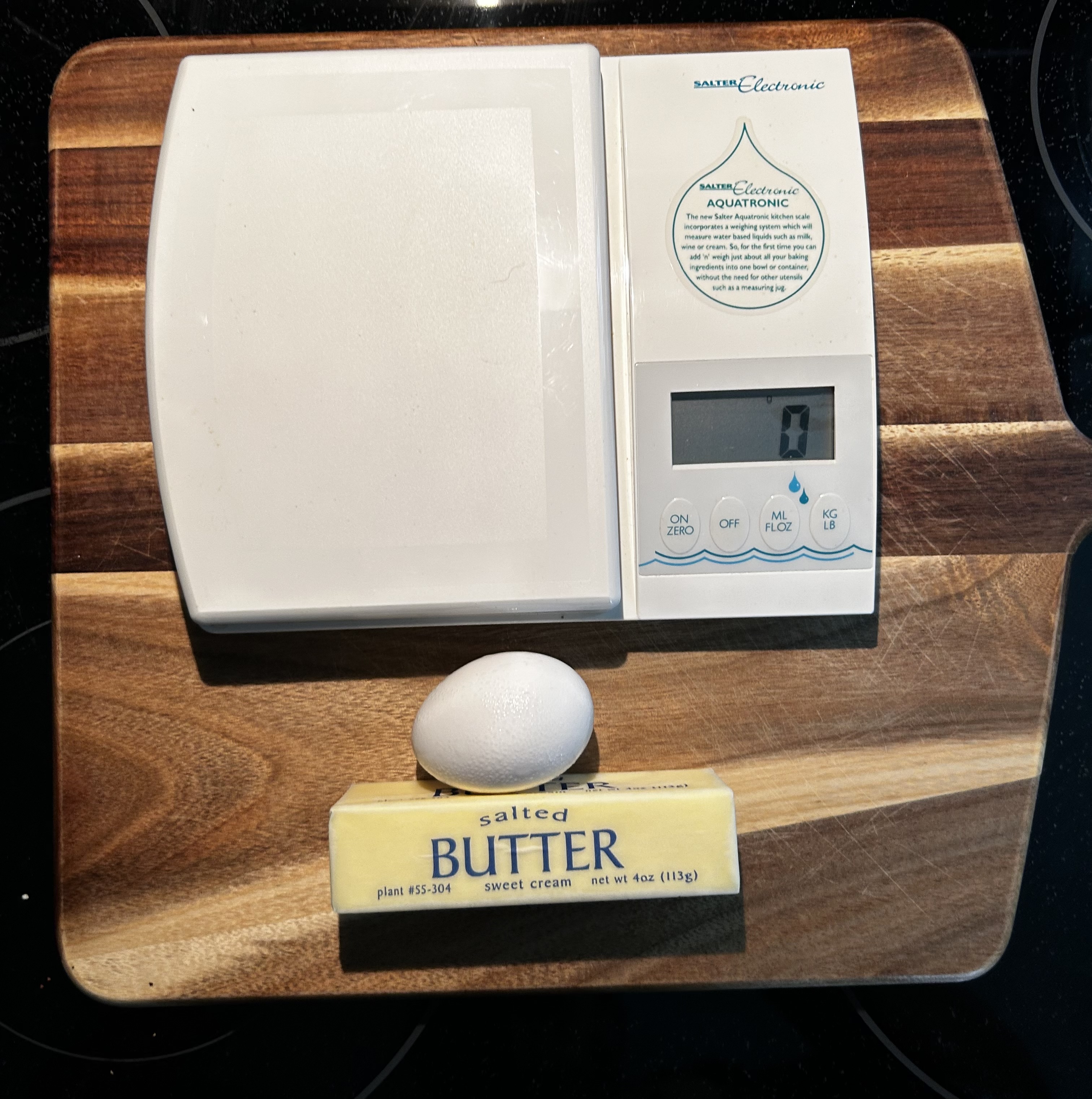
I started with something wonderfully scientific: One egg. One stick of butter. One kitchen scale.
No antique measuring devices. No complicated formulas. Just the same basic instruction an old recipe gives us — look at the egg and cut off a piece of butter that appears to be about the same size.
The tricky part becomes obvious as soon as you try it.
An egg isn’t a cube.
It’s longer through the middle, tapered at one end and rounded at the other. Butter, meanwhile, starts as a nice rectangular stick. So “the size of an egg” can only ever be an approximation.
Still, I cut a piece that looked reasonably close.
Then I put it on the scale.
My Egg-Sized Piece of Butter Weighed 50 Grams

My piece came in at 50 grams, or about 1.75 ounces.
That is pretty darn close to the commonly useful modern estimate of about 2 ounces or 57 grams.
Was my cut perfect? Absolutely not.
It was a little crooked, because apparently cutting butter into the shape of an imaginary egg is not one of my hidden talents.
But even a perfectly straight cut wouldn’t necessarily have landed exactly at 57 grams. The result depends on the egg you’re using and exactly which part of its shape you’re trying to match.
That’s the important part.
“Egg-sized” was never meant to be laboratory precision.
Why the Measurement Can Vary

The wrapper markings show my egg-sized piece of butter came out just under 4 tablespoons.
Eggs are not all the same size, and they certainly weren’t always sorted and labeled as neatly as the cartons in today’s grocery store.
A cook following an old recipe may have been looking at whatever eggs happened to come from the henhouse that morning.
One could be a little longer. Another could be rounder. Another could simply be smaller.
And two people looking at the same egg might cut two slightly different pieces of butter.
So if one person ends up with 50 grams and another gets 57 grams, neither necessarily did anything wrong.
That’s simply the nature of this kind of old-fashioned measurement.
So How Much Butter Should You Use?
If an old recipe calls for:
“a piece of butter the size of an egg”
I would use approximately:
- 4 tablespoons butter
- ¼ cup butter
- 2 ounces
- 55–57 grams
You do not need to panic if you’re a few grams one way or the other.
My real-life attempt produced 50 grams, and visually it looked very much like the amount the instruction was describing.
For most old cakes, puddings, biscuits, sauces, and similar recipes, we’re dealing with a practical kitchen estimate rather than a measurement that was ever intended to be exact to the gram.
The Verdict
So does “butter the size of an egg” actually work as a measurement?
Surprisingly, yes.
I cut a piece by eye and ended up only about 7 grams short of 57 grams.
That’s close enough to show why the instruction made sense to generations of cooks who didn’t need every ingredient measured down to the last gram.
Would I write a modern recipe this way?
Probably not.
But if a vintage recipe card tells you to add a piece of butter the size of an egg, you don’t have to stand in the kitchen holding an egg in one hand and a stick of butter in the other wondering what is expected from you.
Start with about ¼ cup, or 55–57 grams of butter.
And if your egg-sized chunk lands somewhere around 50 grams?
I’d call that pretty darn close.
Sources
Land O’Lakes — Butter Measurements
Confirms that ¼ cup butter = 4 tablespoons, and its butter label lists 1 tablespoon as 14 g, which puts 4 tablespoons at about 56 g.
https://www.landolakes.com/faqs/butter-spreads/butter/how-do-i-measure-butter/
USDA — Egg Size Classes
Useful for the point that modern eggs are standardized into weight classes such as Jumbo, Extra Large, Large, Medium, and Small.
https://www.ams.usda.gov/sites/default/files/EggGradingManual.pdf