
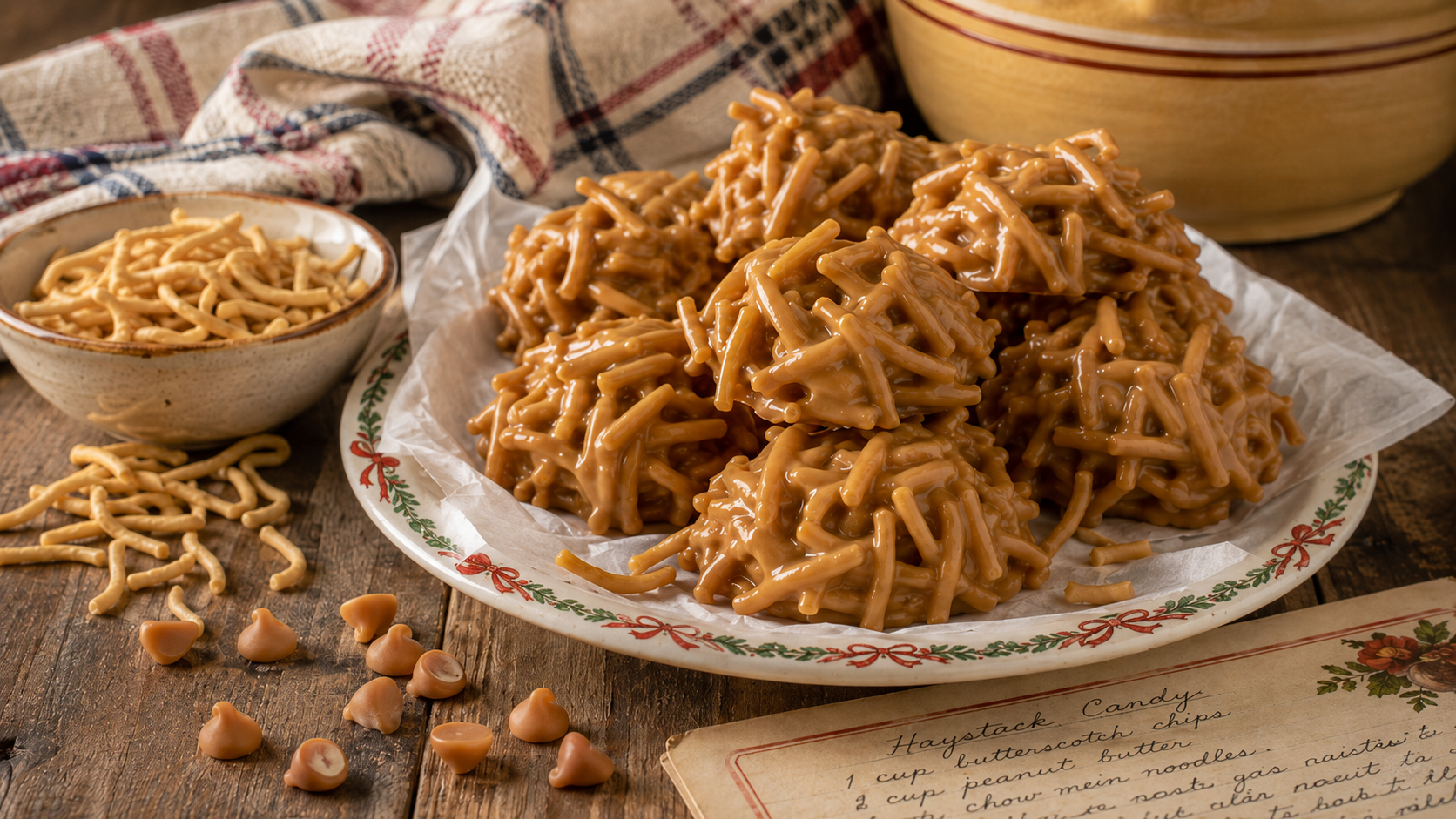
There are ingredients you expect to find in Christmas candy.
Chocolate.
Peanut butter.
Butterscotch.
Nuts.
And then someone reaches into the cupboard and pulls out a can of chow mein noodles. Excuse me?
If you’ve never encountered old-fashioned haystacks, the recipe can look like somebody accidentally combined the candy ingredients with dinner.
But those crispy noodles weren’t an accident.
They were exactly what made this strange little no-bake candy work.
What Is Haystack Candy?
Haystacks are little no-bake clusters usually made by coating crispy chow mein noodles with some combination of melted butterscotch chips, chocolate, peanut butter, and nuts.
The mixture is dropped by spoonfuls onto waxed paper and left to firm up.
That’s basically it.
No flour.
No eggs.
No rolling pin.
No oven.
And despite being frequently called haystack cookies, they’re arguably closer to candy than cookies. The melted chocolate or butterscotch holds everything together while the noodles provide the crunch and structure.
The messy little piles look vaguely like miniature haystacks. Hence the name.
At least that part of the recipe isn’t mysterious.
But Why Chow Mein Noodles?
Because the chow mein noodles used in these recipes aren’t soft cooked noodles.
They’re the dry, crispy fried noodles that were sold in cans or packages as part of the Americanized Chinese-food boom of the mid-20th century.
Companies such as La Choy mass-produced and nationally distributed crispy chow mein noodles, turning them into something ordinary American shoppers could keep in the pantry.
And once those noodles were sitting in cupboards across the country, cooks found uses for them well beyond chow mein.
Functionally, the noodles do much the same job that cereal, pretzels, nuts, or crispy rice do in other no-bake treats. They give the melted candy mixture something light and crunchy to grab onto. They also hold their shape instead of turning the whole thing into one solid lump.
Suddenly the chow mein noodles don’t seem quite as crazy.
Still a little crazy. But there was a method.
Make Your Own Old-Fashioned Haystack Candy

After all that talk about putting chow mein noodles in candy, it seems unfair not to actually make some.
This simple butterscotch-and-peanut-butter version is based on the kind of haystack candy recipes that were circulating by the early 1960s. No oven, no candy thermometer, and no complicated technique required.
If you’d like to compare another vintage version, I’ve also linked a classic Yankee Noodle Dandies recipe in the sources at the bottom of the page.
Old-Fashioned Butterscotch Haystacks
Ingredients
- 1 cup butterscotch chips
- 1/2 cup creamy peanut butter
- 2 cups crispy chow mein noodles
- 2 cups miniature marshmallows
Instructions
- Line a baking sheet or large tray with waxed or parchment paper.
- Melt the butterscotch chips gently, stirring until smooth.
- Stir in the peanut butter until completely combined.
- Place the chow mein noodles and miniature marshmallows in a large bowl.
- Pour the warm butterscotch mixture over them and gently stir until everything is coated.
- Working fairly quickly, drop small spoonfuls of the mixture onto the prepared paper.
- Let the haystacks cool until firm. You can refrigerate them for about 30 minutes if you want them to set faster.
Depending on how large you make them, this should give you roughly 2 to 3 dozen little haystacks.
Make Them Your Own
Haystacks have never been a particularly strict recipe. Some versions use chocolate, some leave out the marshmallows, and others add peanuts, cashews, or different combinations of chocolate and butterscotch.
For Halloween, their messy little twig-pile appearance works surprisingly well on a spooky treat tray without doing anything fancy to them at all.
And yes, they still look like somebody accidentally dropped dinner into the candy bowl.
That is part of the charm.
These Things Were Around Before the Famous 1963 Betty Crocker Recipe
Haystack history gets a little messy.
You’ll often see the candy traced to the 1963 Betty Crocker Cooky Book.
That book is real, and Betty Crocker did publish a recipe called Noodle Clusters using chow mein noodles. The same section included a related chocolate-and-cereal confection called Ting-A-Lings.
But the noodle idea was already out there.
Archived vintage recipes show a similar candy called P-Nutty Butterscotch Crunchies in 1961.
Then, on May 16, 1962, the Oakland Tribune published Hopscotch Cookies, made with butterscotch baking pieces, peanut butter, miniature marshmallows, and canned chow mein noodles. The newspaper promoted them as a quick no-bake confection.
So Betty Crocker certainly helped spread the idea, but the evidence doesn’t support saying Betty Crocker invented haystack candy.
In Fact, Nobody Could Agree on What to Call Them
This may be my favorite part.
The basic combination traveled around under a ridiculous collection of names.
Versions have been called:
- Haystacks
- Hopscotch Cookies
- Noodle Clusters
- Butterscotch Crunchies
- Butterscotch Spoonoodles
- Chow Mein Chews
- Yankee Noodle Dandies
- Yankee Doodlers
- Brush Piles
By 1981, a food writer for The Charlotte Observer reported receiving 27 different names from readers for versions of the same basic combination of crispy noodles, butterscotch, and nuts.
Apparently America agreed that we should put chow mein noodles in candy.
We just couldn’t agree on what the resulting object was called.
Food Companies Helped Keep the Idea Going
This kind of recipe was perfect for the era of food-company recipe cards, package recipes, magazine advertisements, and test kitchens constantly looking for another way to use a packaged ingredient.
La Choy eventually advertised a version called Yankee Noodle Dandies, combining its chow mein noodles with chocolate, butterscotch, and chopped nuts.
That wasn’t unusual marketing for the time.
If a company sold cereal, canned noodles, marshmallows, peanut butter, or baking chips, giving home cooks another reason to buy the product was good business.
And no-bake sweets were particularly easy to sell as something quick and uncomplicated.
They Weren’t Originally Just Christmas Candy
Here’s another surprise.
Today haystacks often turn up on Christmas candy trays and in collections of old-fashioned holiday sweets.
But that 1962 Hopscotch recipe wasn’t being pitched for Christmas at all.
It was promoted as something cooks could make through the summer, specifically because it was a quick treat that didn’t require baking.
That makes perfect sense.
Nobody particularly wants to turn on an oven in July just to make cookies.
Over time, however, haystacks fit easily into Christmas candy making too.
They’re fast. They can be made in batches. They don’t occupy the oven while cookies, pies, and everything else are baking. And the irregular little clusters look perfectly at home on a crowded candy tray.
So a recipe that worked because it was convenient in hot weather also happened to be convenient during one of the busiest baking seasons of the year.
Chocolate, Butterscotch, Peanut Butter — Pick Your Version
There isn’t one sacred haystack recipe.
Some old versions use mostly chocolate.
Some lean heavily into butterscotch.
Others add peanut butter, peanuts, cashews, marshmallows, or combinations of chocolate and butterscotch. That’s probably part of why so many families remember slightly different versions.
The chow mein noodles are the strange ingredient everyone notices, but the rest of the recipe has been changing for decades.
So Why Did Mid-Century Cooks Put Chow Mein Noodles in Candy?
Because by the 1960s, crispy chow mein noodles were a convenient packaged pantry food.
They were dry. They were crunchy. They didn’t need to be cooked again.
And they were sturdy enough to hold melted butterscotch or chocolate without immediately turning soggy.
What looks today like one of the stranger ingredients on an old recipe card was really a practical shortcut.
Strange? A little.
Useful? Absolutely.
And apparently useful enough that the recipe survived long after the novelty wore off.
For More Information
Click Americana — vintage butterscotch haystacks / Hopscotch Cookies
https://clickamericana.com/recipes/dessert-recipes/butterscotch-haystacks-with-peanut-butter
TASTE — history of La Choy and crispy chow mein noodles
https://tastecooking.com/the-korean-immigrant-and-michigan-farm-boy-who-taught-americans-how-to-cook-chow-mein/
Vintage Recipes — Yankee Noodle Dandies
https://vintage.recipes/yankee-noodle-dandies/