
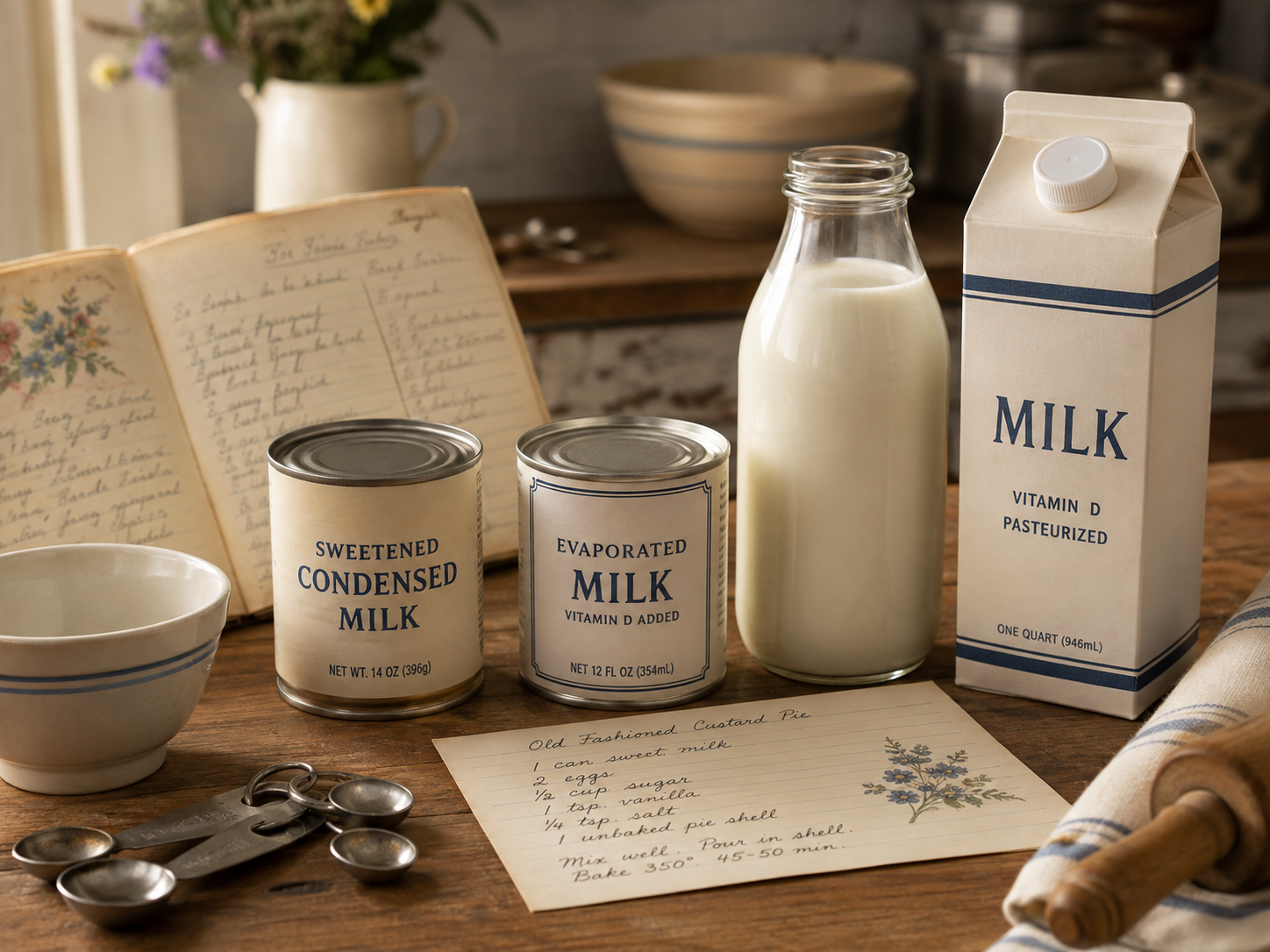
You pull out an old family recipe, start reading through the ingredients, and there it is:
1 cup sweet milk.
Sweet milk?
Milk with sugar in it? Sweetened condensed milk? Something they stopped making sometime around 1947?
Fortunately, this particular old cookbook mystery is much easier than it sounds.
The Short Answer
Sweet milk in an old recipe means fresh, regular milk.
If you want the closest modern choice, use whole milk. If you normally keep 2% in the refrigerator, that will work just fine in most recipes too.
No sugar needs to be added, and it is not sweetened condensed milk.
So if you were already reaching for the can opener, you can put it back.
Is Sweet Milk the Same as Whole Milk?
Not exactly. In old recipes, “sweet milk” simply meant fresh milk that had not soured. It wasn’t describing a specific fat percentage the way we use terms like whole milk, 2%, or skim milk today.
For most old recipes, whole milk is a good modern substitute because it has enough fat to give baked goods, puddings, sauces, and other dishes the richness those older recipes expected. If all you have is 2% milk, it will usually work just fine, but whole milk is the closest easy choice when an old recipe simply calls for “sweet milk.”
Why Did They Call Regular Milk “Sweet Milk”?
Today, milk is just… milk.
We buy a carton, stick it in the refrigerator, and generally don’t feel the need to describe its current condition.
Cooks a hundred years ago had a little more to consider.
Before dependable modern refrigeration, milk didn’t stay fresh nearly as long as we’re accustomed to. Fresh milk could be described as sweet milk to distinguish it from milk that had soured or clabbered.
And sour milk wasn’t necessarily headed straight for the drain. It had its own uses in baking.
Calling for “sweet milk” simply told the cook which kind the recipe needed.
You can see the distinction in old cookbooks. The 1910 edition of Fannie Merritt Farmer’s The Boston Cooking-School Cook Book, for example, includes separate recipes for Sour Milk Griddle-cakes and Sweet Milk Griddle-cakes.
The sour-milk version uses sour milk with baking soda. The sweet-milk version uses ordinary milk with baking powder.
So the word sweet wasn’t telling the cook to add anything.
It was basically saying:
Use the fresh stuff.
Is Sweet Milk the Same as Sweetened Condensed Milk?
No.
And considering the name, I don’t blame anyone for wondering.
Sweetened condensed milk is thick, concentrated milk with a considerable amount of added sugar. Sweet milk is simply fresh milk.
Those two things behave very differently in a recipe.
If Great-Aunt Mabel’s cake calls for a cup of sweet milk and you pour in a cup of sweetened condensed milk, Great-Aunt Mabel is not responsible for what comes out of the oven.
Use regular milk.
What Kind of Milk Should I Use Today?
For an old recipe calling for sweet milk, I’d reach for whole milk first.
Whole milk gives you a good combination of fat and moisture for vintage baking and is a sensible modern stand-in for the fresh milk many older recipes expected.
But don’t abandon the recipe because there’s only 2% in the refrigerator.
For most cakes, muffins, pancakes, quick breads, and similar recipes, 2% milk should work perfectly well.
I’d consider 1% usable in a pinch, although the finished recipe may be slightly less rich. Skim milk would be my last choice if you’re trying to reproduce an older recipe as closely as possible.
Quick Old-Recipe Milk Translation Chart

Can I Substitute Buttermilk for Sweet Milk?
Not automatically.
This is where the distinction between sweet and sour milk actually mattered to the recipe, not just to the person standing beside the cow.
Sour milk and buttermilk are acidic. Sweet milk isn’t.
That acidity affects how baking soda works, which means changing one kind of milk for another can also change how a cake, biscuit, pancake, or quick bread rises.
Those old Fannie Farmer griddle-cake recipes demonstrate it nicely: the sour-milk version uses baking soda, while the sweet-milk recipe uses baking powder.
So if an old recipe specifically says sweet milk, I wouldn’t get clever with it.
Use milk.
Sometimes the old cookbook really does mean exactly what it says. We just don’t speak quite the same kitchen language anymore.
Why Don’t Recipes Say “Sweet Milk” Anymore?
Because today there isn’t much reason to.
Modern refrigeration, pasteurization, commercial dairies, and grocery stores changed how we buy and store milk. Fresh milk became the thing everyone assumed you meant when you wrote milk.
The word sweet gradually became unnecessary.
But old cooking terms have a way of hanging around.
They survive in handwritten recipe cards, family cookbooks, church and community cookbooks, newspaper clippings, and recipes copied by one generation from another.
And those handwritten notes can be some of the best clues we have to how people really cooked.
They can tell us what someone substituted, how long something actually baked, which ingredient they doubled, or what worked well enough to make again.
Right up until they casually write down something like sweet milk and assume we’ll know exactly what they mean.
The Bottom Line
If an old recipe calls for sweet milk, use whole milk. If you’ve got 2%, use it and carry on.
Don’t add sugar.
Don’t grab the condensed milk.
There isn’t a mysterious lost dairy product you need to track down.
Sweet milk is just milk.

Old handwritten recipes are wonderful little time capsules. They can tell us how someone really cooked — right up until they casually write down something like sweet milk and assume we’ll know exactly what they mean.
This Sweet Milk Griddle-Cakes recipe comes from Fannie Merritt Farmer’s 1910 The Boston Cooking-School Cook Book. The handwritten card is our version of how a recipe like this might have found its way into a family recipe box.
At least that’s one old cookbook mystery we can cross off the list.
.