
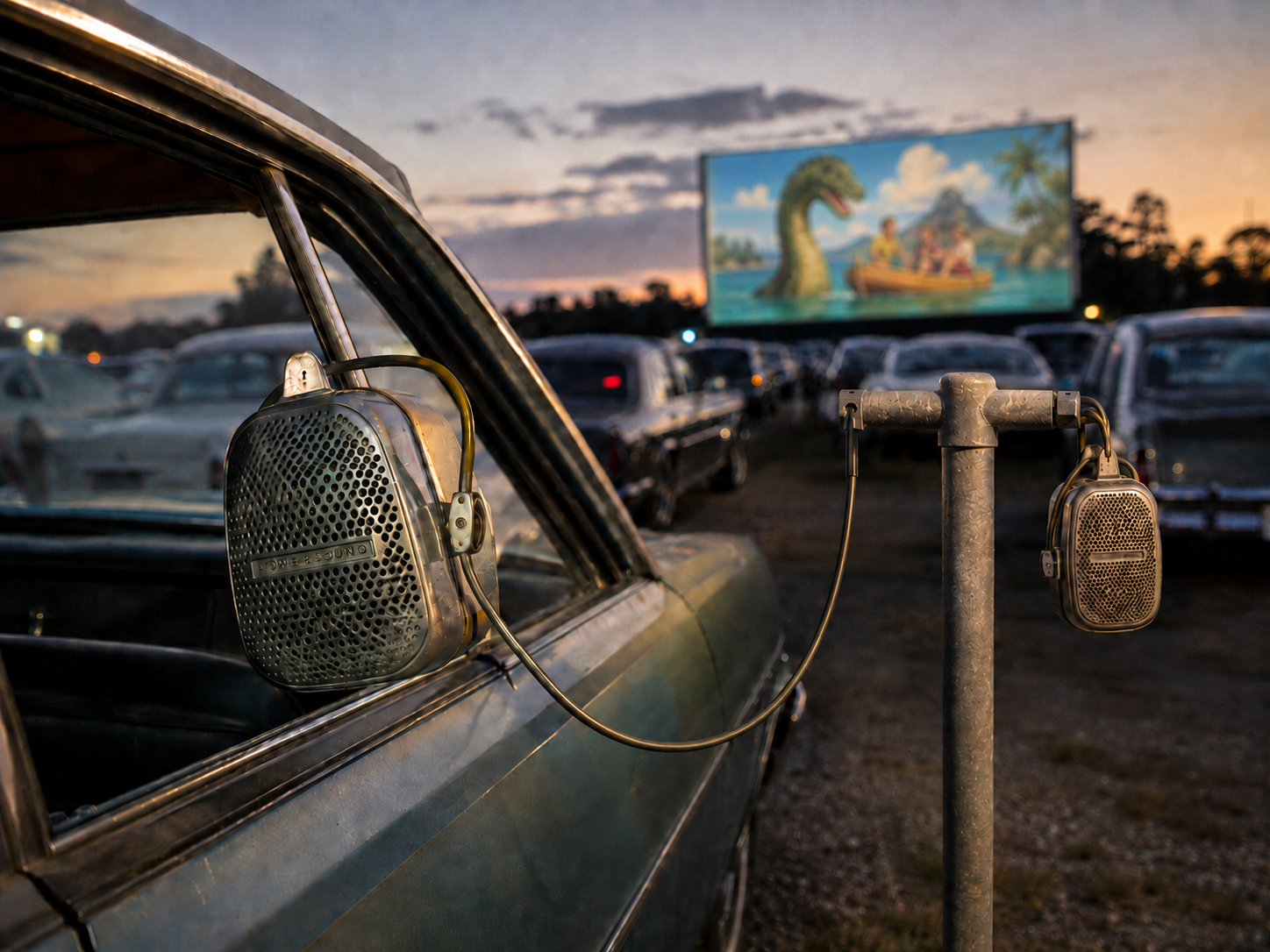
Before drive-in movie sound came through your car radio, there was a little metal speaker hanging from the window.
You pulled into your parking spot, reached out the window, lifted the speaker from its post and hooked it onto the edge of the partially lowered car window.
Then you turned the knob.
And, if everything was working properly, the movie suddenly had sound.
So how did those old drive-in movie speakers actually work?
The short answer: the movie soundtrack was converted into an electrical audio signal in the projection booth and sent through wiring across the drive-in lot. That wiring fed speaker posts located between parking spaces. A flexible cord connected each little speaker to the post, and the speaker itself had a volume control so the people in the car could adjust the sound.
It was basically a giant wired sound system spread across an entire parking lot.
Where Did the Sound Come From?
The sound started with the movie itself.
An RCA drive-in sound-system patent filed in 1945 describes the source as the soundtrack on the motion-picture film. The sound was converted into an electrical signal, amplified and sent into a main transmission line running through the theater.
From there, the signal traveled outward to the rows of cars. To that little box hanging on the window wasn’t receiving a radio broadcast.
It was physically wired back to the theater’s sound system.
Imagine taking the speaker wire from your living-room stereo and extending it not across the room, but across acres of parking spaces. That is essentially what the drive-in was doing—just on a much bigger and more carefully engineered scale.
What Was Inside a Drive-In Speaker Post?
This is the part you couldn’t see while sitting in the car.
The familiar speaker post wasn’t merely something to hang the speaker on.
RCA’s system used a junction box mounted on top of a tubular post. Inside that box was a transformer and the electrical connections for the speakers. A feeder cable ran up through the post and connected the junction box to the theater’s main sound-distribution wiring.
The main transmission wiring itself could run underground through the theater lot. From the junction box, flexible cords ran out to the individual speakers. So the path looked roughly like this:
Movie soundtrack → amplifier → main theater wiring → speaker post → junction box and transformer → flexible speaker cord → speaker on your window.
And then, finally:
“Could you turn that down?”
Why Were There Usually Two Speakers on One Post?
Because one post could serve two neighboring parking spaces.
The RCA design placed the post between adjacent stalls and mounted a speaker on either side of its junction box. One speaker served the car parked on one side. The other served the car on the other side.
That meant the drive in didn’t need one complete post and transformer for every automobile. It also explains those old photographs of drive-in lots filled with rows and rows of posts, each one with a speaker hanging from either side. They weren’t just something to park next to.
They were the theater’s sound network.
How Did You Put the Speaker in the Car?
You usually didn’t have to get out. The speakers rested in holders on the post, positioned so someone in a properly parked car could reach one through an open window. The metal speaker casing had a bracket or hook on the back.You lifted it from the post and hung it over the top edge of the partially lowered window so the speaker itself sat inside the car. The flexible cord stayed connected to the post.
That cord was long enough to reach your window. As generations of drive-in customers eventually demonstrated, however, it was not long enough to go home with you.
We’ll get to that.
What Did the Knob on a Drive-In Speaker Do?
It really was a volume control. You weren’t changing the sound for the whole theater. The knob adjusted the volume coming from your individual speaker. That was one of the advantages of putting a speaker at every car.
The family in the front row didn’t necessarily want the same volume as somebody parked farther back. Each car could adjust its own little box. At least in theory.
Whether somebody kept turning it up after everyone else in the car told them to stop is not covered by the engineering documents.
What Did Drive-Ins Use Before Window Speakers?
Drive-in operators experimented with several ways to solve the sound problem.
Richard Hollingshead’s original 1933 drive-in theater patent allowed for sound to be reproduced near the screen or from speakers distributed around the theater field.
Other early designs proposed placing loudspeakers in front of individual automobiles and directing the sound toward the car.
That gives you an idea of the problem they were trying to solve. An indoor movie theater has walls, a ceiling and an audience sitting in predictable rows. A drive-in had hundreds of people sitting inside metal boxes scattered across acres of open ground. Making everybody hear the movie clearly—without making the surrounding neighborhood listen to it too—wasn’t quite as simple.
Putting a small speaker inside each car solved much of the problem.
Were Drive-In Speakers Actually Any Good?
Let’s not romanticize them too much. Some sounded fine. And some absolutely did not.
You hoped you didn’t pull into a spot with one of those awful tinny speakers that made the movie sound as though everyone were talking through a soup can.
If you got a bad one, somebody would hop out, let the lousy speaker dangle from its post as a warning, and you’d move the car to another spot hoping for a better one.
The dangling speaker was basically drive-in code for: Don’t bother. This one’s lousy.
Later technical documents weren’t especially kind about the sound quality either. By the late 1970s, patents for newer drive-in sound systems described the traditional post-mounted speakers as having poor sound reproduction and being limited compared with what a customer’s own car stereo could provide.
So no, it wasn’t just your imagination. That little metal box hanging from the window wasn’t exactly Dolby Surround Sound. But when you found a good one, it did its job.
Did People Really Drive Away With the Speaker Still Attached?
Oh, yes. And this isn’t just one of those stories people tell about drive-ins.
By the late 1950s, patents for improved drive-in sound systems were already mentioning the problem of patrons driving away without returning the speaker to its post.
Think about the end of the night. The movie’s over.
Kids may be asleep in the back.
Blankets, popcorn boxes and whatever else you brought along are scattered around the car.
Everybody is ready to go home.
You hear the engine start. The car begins moving. And then: YANK.
Something had to give. It could be the cord. It could be the speaker. It could be the post. It could even be something on the car. Apparently it happened often enough that engineers specifically tried to design systems that would eliminate the problem.
When Did Drive-Ins Stop Using Window Speakers?
There wasn’t one night when every drive-in in America collected its speakers and switched to FM radio. The transition happened gradually. Traditional wired speakers were still common enough in the late 1970s that engineers were continuing to design improvements and replacements for them.
But using the customer’s own car radio solved several problems at once. The Drive In no longer had to maintain hundreds of speakers, cords, posts and volume controls exposed to the weather and years of customers. Drivers could listen through the much better speakers already installed in their cars. And nobody could drive away with the theater’s speaker hanging from the window.
Eventually, short-range FM broadcasting became the familiar solution. You pulled into your space, found the theater’s frequency on the radio and listened to the movie through your own sound system.
Which also created possibilities that probably weren’t mentioned in the theater’s business plan.
When the Drive-In Sound Reached Beyond the Parking Lot
There was a drive-in near us with its screen facing a hill that we could reach by bicycle. Once the sound was available by radio, that hill became our own unofficial Saturday-night drive-in.
Each kid would bring something to share: Popcorn. Homemade cookies. Whatever snacks we could come up with. Sometimes somebody showed up with an entire gallon of Hawaiian Punch.
And somebody brought the radio—or, depending on the year, a boom box. Because we had curfews, we could usually stay long enough to watch the first movie.
So we’d ride our bikes to the hill, spread out our snacks, tune in the sound and have ourselves a little picnic while watching the drive-in for free.
Nobody ever seemed to catch us. Nobody else ever joined us that we saw. And we certainly didn’t go around telling people about our Saturday-night arrangement. We just brought food and watched the movie. It was probably not the revenue model the drive-in had in mind.
Can You Still Find Old Drive-In Speakers?
Absolutely.
Some survived because drive-ins kept them. Others became collectibles, restoration projects, decorations or little pieces of roadside history.
And out of context, they’re strange-looking objects.
A small metal box.
A hook on the back.
A volume knob on the front.
A cord coming out of it.
It doesn’t make much sense until you picture the rest of the scene. Cars lined up beneath a giant movie screen. Windows partly open. Popcorn moving from the front seat to the back.
Mosquitoes somehow locating the one person in the car they apparently came specifically to see.
And hanging from the window: that little speaker.
The Little Box That Made the Drive-In Work
The giant screen usually gets all the attention when people remember drive-in movies.
But without sound, it was just an enormous silent picture in a field.
Those little speakers were connected to an impressive network hidden throughout the theater grounds—amplifiers, wiring, transformers, junction boxes, posts, cords and hundreds of individual speakers. All so every car could have its own little piece of the movie.
Eventually FM radio made the whole arrangement unnecessary. The posts disappeared. The cords disappeared.
And the sound got considerably better.
But something about tuning the car radio to an FM frequency doesn’t have quite the same personality as reaching out into the dark, grabbing a heavy little metal speaker and hooking it onto the window. Especially after you’d already driven around looking for a speaker that didn’t sound like a soup can.
Just remember to put it back before you start the car.

Still in the Mood for the Drive-In?
When Friday night rolls around, pull into TerrorGlow Drive-In, where Earl and the rest of the lot are usually dealing with something considerably stranger than a bad speaker.