
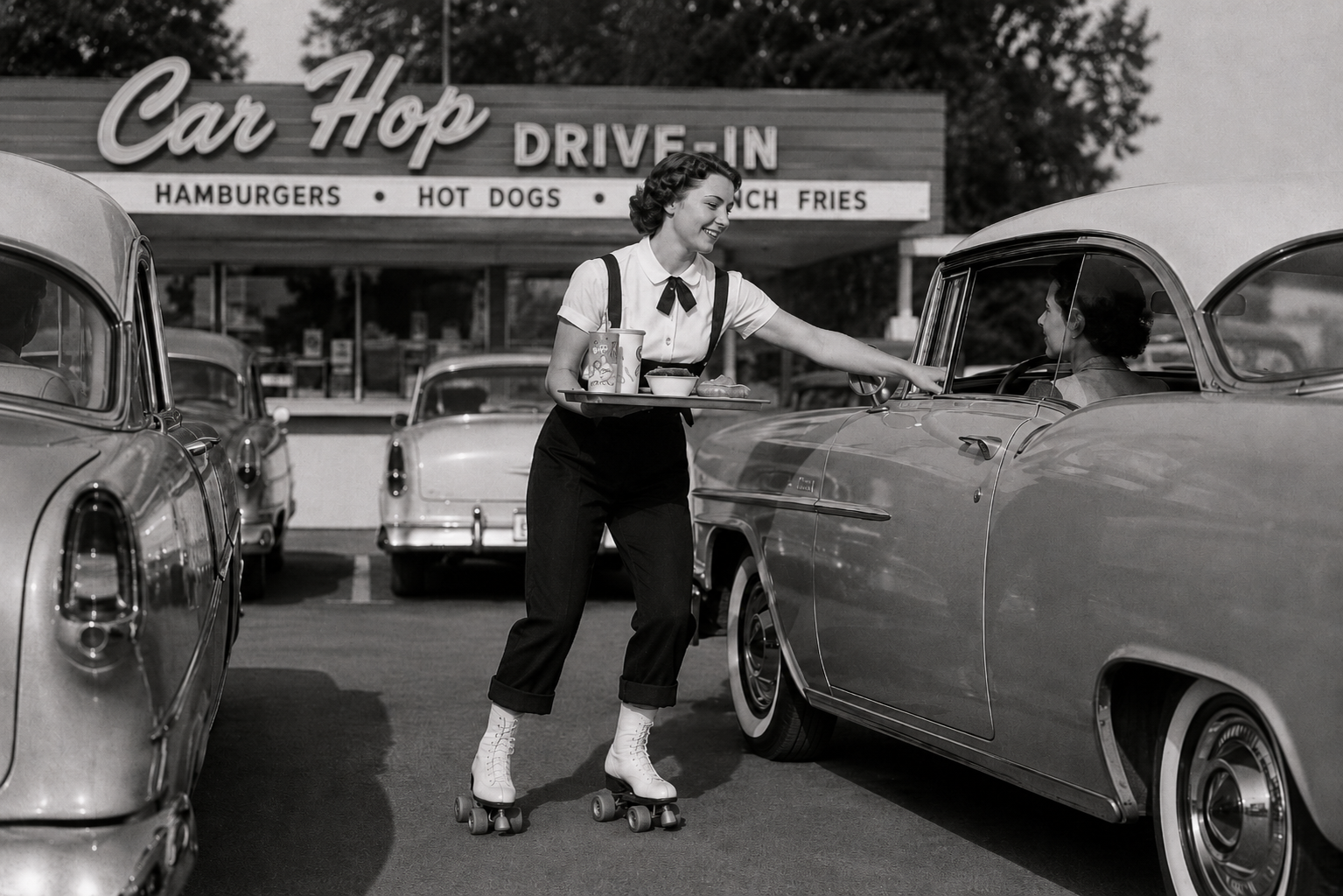
Picture a 1950s drive-in restaurant and chances are somebody is already rolling through the scene on roller skates.
Hamburgers on a tray.
Milkshakes balanced in one hand.
Ponytail bouncing.
Possibly a convertible full of teenagers nearby.
Movies, television, advertisements, and nostalgia have made the roller-skating carhop one of those images that seems inseparable from the American roadside restaurant.
But did carhops really serve food on roller skates? Yes.
Just not nearly as universally as fifty years of nostalgia may have convinced us.
And just to keep things straight: these were restaurant drive-ins, not drive-in movie theaters. Customers parked beside the restaurant and ate in their cars while carhops brought food directly to them.
First, What Was a Carhop?

A carhop was a server who brought food directly to customers sitting in their automobiles at a drive-in restaurant.
Instead of parking, walking inside, ordering, and carrying the meal back out, customers stayed in the car.
The server came to them.
Early drive-in restaurants appeared in the 1920s as automobiles were rapidly becoming part of everyday American life.
The job eventually picked up the name carhop, a play on hotel bellhops.
By the restaurant drive-in boom of the 1940s and 1950s, carhops could be a major part of the attraction.
They took orders, carried trays, collected money, cleared dishes, and sometimes did all of it while wearing remarkably elaborate uniforms.
And yes, some of them did it on wheels.
Roller-Skating Waiters Were Around Before Cars
Here is where the story gets strange.
Restaurants did not invent skating servers for the 1950s drive-in restaurant era.
They were experimenting with them when automobiles weren’t even part of the equation.
In 1884, newspapers around the country reported that waiters in the dining room of the Paxton Hotel in Omaha, Nebraska, had been put on roller skates.
The hotel’s owners had noticed how quickly people could move around on skates and apparently decided:
Why shouldn’t the waiters do that? The idea was supposed to save time.
It also created another problem. Noise.
Contemporary reports complained about the racket the skates made in the dining room.
So nearly seventy years before the stereotypical 1950s carhop rolled toward a Chevrolet with a tray of burgers, somebody had already decided restaurant service might be improved by putting the staff on wheels.
Apparently some ideas just need the right parking lot.
So Why Put Carhops on Roller Skates?
The obvious answer is speed.
A large drive-in restaurant could have dozens — sometimes far more — cars spread across a parking lot. Every order had to travel from the kitchen to the customer and eventually back again. A good skater could cover that distance faster than somebody walking. But speed wasn’t the only reason.
Roller-skating carhops were also entertainment. Drive-in restaurants were competing for attention.
Signs got bigger.
Buildings became more unusual.
Carhops wore themed uniforms.
Restaurants developed gimmicks designed to make drivers pull into one parking lot instead of another. A server gliding between automobiles while balancing a tray full of food was something people remembered.
The carhop wasn’t simply delivering dinner. She could be part of the show.
But Did Every Drive-In Restaurant Have Skating Carhops?
Absolutely not.
This is where the nostalgic version of the 1950s gets ahead of the actual history.Carhops commonly worked on foot.Roller skates were an added gimmick used by some restaurant drive-ins, not a standard requirement throughout the industry.One spectacular example was Sivils Drive-In in Dallas, which opened in 1940.
Sivils became famous for its enormous carhop operation and eye-catching uniforms. At its peak, scores of carhops served hundreds of automobiles.
They wore outfits inspired by marching-band uniforms.
They paraded in and out for their shifts.
They were absolutely part of the attraction.
And they didn’t wear roller skates.
So even a drive-in restaurant that turned its carhops into a major piece of entertainment didn’t necessarily put wheels under them.
The roller-skating carhop was real.
The idea that every drive-in restaurant had one wasn’t.
Movies Helped Turn Them Into a Symbol of the 1950s
This is probably why our mental picture is so strong.
Once old drive-in restaurants became nostalgic, the roller-skating carhop was irresistible.Regular walking carhops simply aren’t as visually interesting. Put one on skates, add a tray and a row of tailfins, and the decade identifies itself before anybody says a word.
Later movies, television shows, advertisements, and retro restaurants kept that image alive long after traditional carhop service had declined. Eventually the roller skates became shorthand for the entire 1950s roadside restaurant experience.
If somebody wants to tell you a scene takes place at a 1950s drive-in restaurant, apparently all they need is a hamburger tray and eight little wheels.
There Was One Slight Problem With the Whole Idea
Roller skating while carrying somebody else’s dinner requires a fairly specific collection of skills.
You have to skate.
You have to stop.
You have to dodge automobiles.
You have to carry a tray.
And preferably you have to accomplish all of this without introducing someone’s chocolate shake to the pavement.
A restaurant parking lot wasn’t a roller rink. There could be cracks, gravel, oil, curbs, moving cars, bad weather, spilled drinks, and customers opening doors. The skating carhop may have looked effortless. The job was not.
Even decades later, restaurant operators trying to revive skating-carhop service have run into the obvious problem of finding employees who are comfortable enough on skates to work safely while carrying food.
And grease or spilled soda getting into skate wheels probably didn’t improve anybody’s afternoon.
Suddenly walking doesn’t sound terribly inefficient.
What Happened to Drive-In Restaurant Carhops?
Roller skates weren’t the only thing disappearing. The entire drive-in restaurant service model was changing.
Restaurants were looking for faster and cheaper ways to move customers through. Some drive-in restaurants installed intercom systems so carhops no longer had to walk out just to take an order. Others eliminated car service and made customers walk to a counter or window. Then the developing fast-food industry pushed efficiency even further.
The McDonald brothers famously built their restaurant system around customers coming to the window rather than maintaining a fleet of servers carrying meals around a parking lot.
Eventually the drive-through accomplished something even more efficient: The customer brought the car to the food instead of the food being carried across the parking lot to the car.
Once that happened, the business case for dozens of carhops — skating or otherwise — became considerably harder to make.
But Roller-Skating Carhops Never Completely Disappeared
They’re rare.
They’re nostalgic.
But they’re not extinct.
SONIC Drive-In still employs skating carhops at some restaurant locations today.
And this isn’t simply an employee deciding to strap on skates for fun.
SONIC has specific expectations for skating carhops, including training and the ability to balance, carry trays, and work on different surfaces while skating.
So somewhere in America, more than a century after Omaha hotel owners decided waiters might move faster on wheels, somebody can still bring your hamburger to the car on roller skates.
The Real Roller-Skating Carhop Was Better Than the Myth
The funny thing is, we don’t have to exaggerate this one.
Roller-skating carhops really existed. They really did carry trays through restaurant parking lots. They really were used for speed, attention, and entertainment. And they became one of the defining images of American drive-in restaurant culture. But they were never standing outside every roadside restaurant in America.
Some places used them.
Plenty didn’t.
And eventually the economics of fast food found something faster than a good pair of roller skates.
They made the car come to the window.
Want Further Information??
1884 Paxton Hotel roller-skating waiters — Rockland County Journal
https://news.hrvh.org/veridian/cgi-bin/senylrc-larc?a=d&d=rocklandctyjournal18840426.1.1
Sivils Drive-In — Roadside America
https://www.roadsideamerica.com/story/73240
Carhops in Fact and Fiction — Restaurant-ing Through History
https://restaurant-ingthroughhistory.com/2017/07/23/carhops-in-fact-and-fiction/
SONIC — Skating Carhop careers
https://careers.sonicdrivein.com/skating-carhop/job/076D864AE616F387325BED43338E7F20