
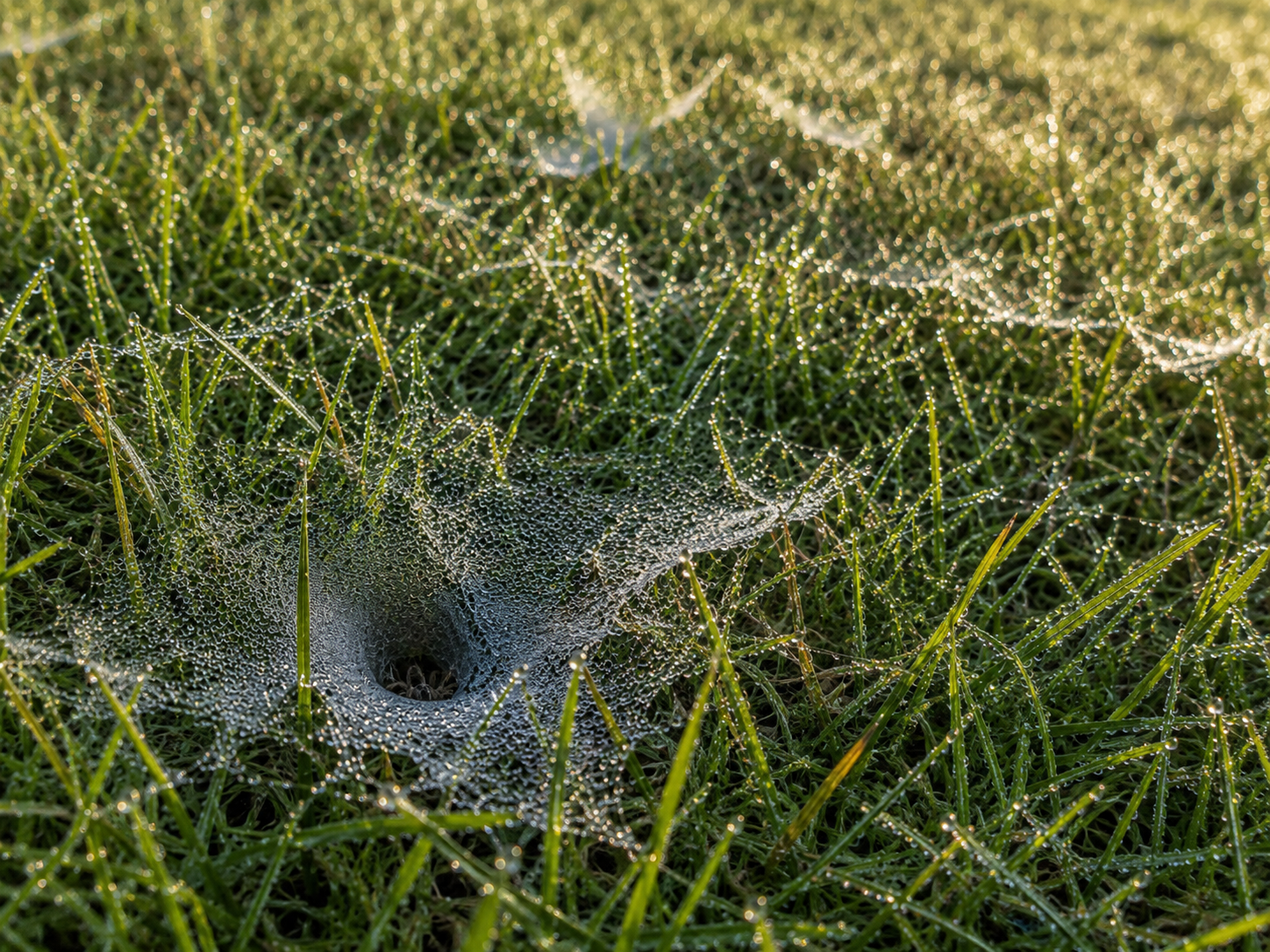
Walk across the yard early on a late-summer morning and suddenly they are everywhere.
Dozens of little sheets of silk stretch between blades of grass, each one sparkling with dew. By lunchtime, most of them seem to have disappeared. It can look as though an entire army of spiders moved into the lawn overnight. They probably didn’t. The spiders were likely there already.
The morning dew simply gave them away.
The Short Answer
Those webs scattered across the lawn are often made by grass spiders, funnel-weaving spiders that build flat, sheet-like webs to the ground.They become especially noticeable in late summer and early fall. By then the spiders are larger, their webs are more substantial, and cooler nights can leave enough dew to outline every strand of silk.
Once the dew dries, those same webs become surprisingly difficult to see. So the spiders didn’t necessarily arrive overnight.
The weather turned the invisible visible.
Meet the Spider You Probably Never Saw

Grass spiders are much easier to notice by their houses than by the spiders themselves.
Instead of making the familiar round web stretched between branches, they build something that looks more like a little silk sheet spread across the grass. At one edge, that sheet narrows into a funnel. That is where the spider waits.
Look closely at one of those dewy webs and you may see the silk disappearing down between the blades of grass into a small tunnel. The spider may be sitting right at the entrance. Or, having noticed the enormous creature crouching over its house and staring at it, it may have wisely gone farther downstairs.
The funnel isn’t just a hiding place. It is part of the hunting system. When an insect lands on or walks across the sheet, the movement sends vibrations through the silk. The grass spider comes racing out of the funnel.
And these spiders are fast.
Unlike the sticky webs made by many other spiders, the sheet itself does not have to glue an insect in place. The web alerts the spider that dinner has arrived, and speed does the rest. The spider grabs its prey and can retreat back toward the protection of the funnel.
So that pretty little dew-covered web in the morning isn’t merely a house. It is also a very effective dinner bell.
Why Am I Suddenly Seeing So Many Webs?
Late summer is prime time for noticing grass spiders.
Young grass spiders hatch earlier in the year and spend the growing season getting larger. By late summer and into fall, mature spiders and their larger webs are much easier to spot.
At almost exactly the same time, the nights begin cooling enough for heavier morning dew. That combination makes a big difference. There may genuinely be more large webs in the lawn than there were earlier in summer. But many of the spiders have been around for months.
They’ve simply reached the point where both their size and the weather make them much harder to overlook.
Why Does Dew Make Such a Difference?
Spider silk is incredibly fine. Against grass, soil and vegetation, a dry sheet of it can almost disappear. Dew changes that.
Water gathers along the threads in tiny droplets. Those droplets catch the morning light and outline a structure that was nearly invisible the day before. What looked like empty grass suddenly has sheets, tunnels and tiny pathways stretched through it.
Then the sun gets higher. The dew evaporates. The droplets disappear from the silk. And much of the spider neighborhood seems to vanish along with them. The webs are still there.
You just lost the lighting.
Are All Those Spiders Bad for the Yard?
No. Grass spiders aren’t eating your lawn. They’re eating other small creatures that wander across their webs. That makes them predators living in the lawn rather than pests feeding on it. And unless a web happens to be somewhere inconvenient, there generally isn’t much reason to do anything about it.
By midday you may barely notice it anyway.
This is one of those backyard situations where discovering what is happening can save you from trying to fix something that wasn’t actually a problem. The spiders were just doing what spiders do. We happened to catch them at home.
But Is It Definitely a Spider Web?
Usually, that little sheet with a funnel gives the spider away.
But there is one other possibility worth knowing about.
Some lawn fungi can produce fine white growth called mycelium, and when the grass is wet early in the morning it can look surprisingly web-like. You don’t need to become a turf specialist to tell the two apart. Look at the shape.
A grass spider has built something. You should be able to see some structure — a sheet stretched across the grass, often leading toward a funnel or tunnel. Fungal growth tends to look more like fuzz, cottony threads or fine material growing directly on and between the wet grass blades. Then look at the lawn underneath.
Healthy-looking grass beneath an organized sheet and funnel strongly suggests a spider.
Web-like fuzz accompanied by brown spots, yellowing, thinning grass or damaged patches gives you more reason to consider fungus.
An easy way to remember it is: A spider builds over the grass. A fungus grows on the grass.
It isn’t a perfect scientific test for every situation, but it’s a useful place to start.
What Happens to the Web When You Mow?
A mower, rake, heavy rain, people walking across the grass and other disturbances can damage or destroy parts of a web. That doesn’t necessarily mean the end of the spider.
Web-building spiders can repair and rebuild damaged silk, and a grass spider still has its protected funnel area to retreat into when trouble arrives.
So if you’ve ever mowed the lawn and then discovered fresh-looking webs a morning or two later, you may be looking at repairs rather than a brand-new group of spiders moving in.
They are persistent little contractors.
One of Late Summer’s Small Shows
There is something rather nice about discovering that the lawn hasn’t suddenly been invaded.
Most of those shimmering webs were probably there yesterday. You walked past them. Mowed around them. Maybe stepped right over them. The spiders went about their lives almost completely unnoticed.
Then one cool night covered thousands of nearly invisible strands with water, and by breakfast an entire little neighborhood appeared.
Those glittering webs can even be one of the first quiet signs that the season is beginning to change. Long before the leaves turn, the spiders seem to know. Or at least their webs start telling on them.
Look closely and you may even find the tiny tunnel where somebody is waiting for breakfast to walk across the front porch.
A few hours of sunshine will hide most of it again.
But on another cool, dewy morning, the whole neighborhood may be back on display.