
Every fall, they start marching.
Across driveways. Across sidewalks. Across roads where they seem remarkably confident that traffic will simply work around them.
And yes, I have absolutely looked at one and wondered what kind of winter it thought we were getting.
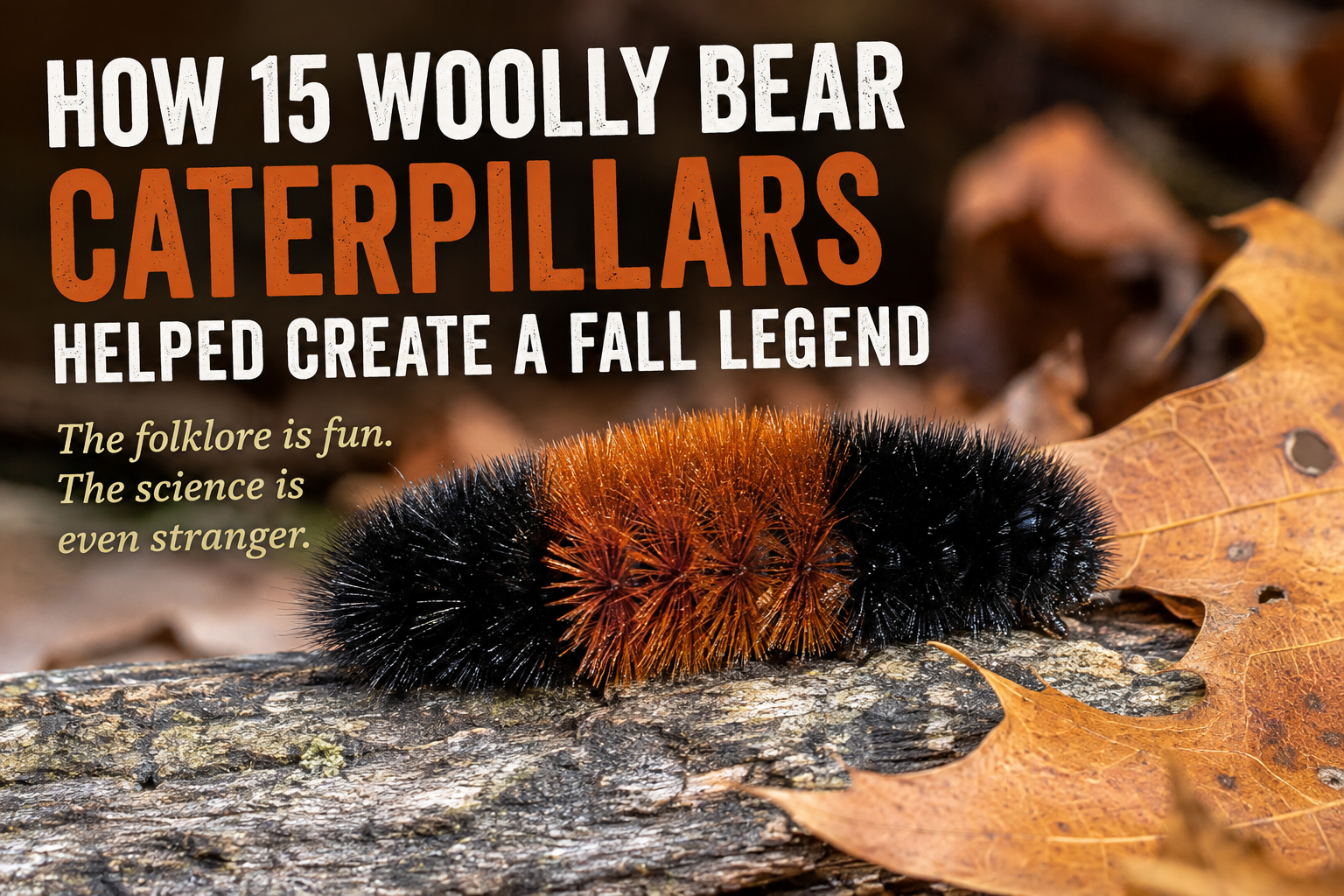
The little black-and-rust woolly bear caterpillar is so familiar that plenty of us learned the story before we knew what kind of caterpillar it actually was:
Look at the bands and you can tell what winter is going to be like.
More black means a hard winter. A wide rusty-brown middle means a mild one.
There are plenty of versions of the rule, naturally. Folklore rarely comes with an instruction manual.
But the woolly bear’s reputation as a tiny weather forecaster got an enormous boost from something rather wonderfully small: 15 caterpillars collected in New York in 1948.
And the real science of the woolly bear turns out to be considerably stranger than predicting snow.
Fifteen Caterpillars and a Winter Forecast
The belief that woolly bears could predict winter was already old by the time entomologist C. Howard Curran got involved.
Curran was curator of insects and spiders at the American Museum of Natural History. In the fall of 1948, he headed to the Bear Mountain area of New York with other entomologists and examined woolly bear caterpillars.
They collected 15 of them.
That is not exactly a giant scientific sample.
Curran measured the rusty middle bands and found that they averaged a little more than five segments wide. The previous year’s caterpillars had supposedly shown much narrower bands.
The conclusion?
Perhaps a milder winter was on the way.
TIME covered the woolly bear forecast in November 1948, and the story spread well beyond a handful of people wandering around Bear Mountain looking at caterpillars.
Suddenly an old piece of weather folklore had a scientist, measurements and newspaper coverage behind it.
That made it sound considerably more official.
It wasn’t.
Curran apparently understood that this wasn’t rigorous meteorology, and the outings became something of an annual fall tradition themselves.
I have to admit, I rather like the idea of a group of respectable scientists heading out every fall to inspect fuzzy caterpillars and make a winter prediction anyway.
But by then the woolly bear weather forecaster had escaped into the wild.
So What Do Those Bands Really Tell Us?
Not next February’s snowfall.
The familiar banded woolly bear is the caterpillar of the Isabella tiger moth, Pyrrharctia isabella.
Its body is covered with stiff bristles, with black at the front and rear and a rusty reddish-brown section through the middle.
Those colors really can vary from one woolly bear to another.
That part isn’t imaginary.
But scientists have found much more ordinary explanations for the differences.
Age is one of them.
As a woolly bear grows and molts, its coloration can change. Older caterpillars generally develop a wider rusty-colored middle section.
Conditions while the caterpillar is growing can matter too. Moisture has been associated with differences in the amount of black in the coat.
So if you find one woolly bear with an enormous brown band and another that looks mostly black, you haven’t necessarily found two caterpillars arguing about January.
You may simply be looking at animals of different ages that developed under different conditions.
That makes the woolly bear much better at telling you something about itself and the conditions it has already experienced than about weather that hasn’t happened yet.
Which seems fair.
Predicting the future is an unreasonable amount of responsibility to put on a caterpillar.
The Woolly Bear’s Real Winter Trick Is Better
Here is where things get genuinely strange.
The woolly bear doesn’t simply disappear before winter and emerge as a moth somewhere warm.
It spends the winter as a caterpillar.
When cold weather approaches, woolly bears crawl into protected places such as leaf litter, underneath bark, rocks and fallen logs.
Then their bodies begin preparing for cold.
Among the changes is an increase in substances that help protect their tissues during freezing. One of the important ones is glycerol, a small molecule that acts as a cryoprotectant.
Think of it as part of the caterpillar’s built-in cold-protection system.
It doesn’t necessarily prevent the animal from freezing.
That’s the really interesting part.
Woolly bears can actually freeze and survive it.
That stopped me.
All these years we’re looking at the stripes trying to decide whether we’re getting buried in snow, and the caterpillar itself is preparing to spend winter partly frozen under a pile of leaves.
Laboratory experiments have shown that properly cold-acclimated banded woolly bears can tolerate substantial freezing. In one study, caterpillars acclimated to cold survived a full week frozen at −20°C, or −4°F.
Their body fluids and tissues are not behaving as though nothing happened. Ice forms, water availability changes and freezing places enormous stress on cells.
The caterpillar survives because its physiology changes as winter approaches.
Researchers have found increases in glycerol as well as changes involving amino acids, proteins and the concentration of the caterpillar’s hemolymph—the insect equivalent, roughly speaking, of circulating blood.
Those changes help reduce freezing injury and protect cells and tissues.
So while we’ve been asking whether the width of its brown stripe means we’ll need an extra shovel, the woolly bear has been quietly preparing to become a partially frozen caterpillar and live through it.
I feel as though we buried the more impressive story.
Freezing Still Has a Price
Being able to survive freezing does not mean freezing is harmless.
Experiments involving repeated freeze-and-thaw cycles have found increased tissue damage and higher mortality in woolly bears subjected to repeated freezing.
In one study, five freeze-thaw cycles pushed mortality close to 30 percent.
That matters because winter isn’t always one long steady freeze.
Temperatures rise. Things thaw. Then temperatures plunge again.
Anyone who has lived through a winter that goes from snow to rain to ice and back to snow knows exactly how annoying that can be.
Apparently the woolly bear agrees.
It is extremely cold-hardy, but it isn’t indestructible.
It has simply evolved a remarkable set of tools for surviving conditions that would kill many other animals.
Why Are They Always Crossing the Road?
That brings us back to those determined little caterpillars hustling across the driveway every fall.
They aren’t migrating south.
They aren’t following a secret caterpillar route.
And they aren’t heading to a meeting to finalize the winter forecast.
The late-season woolly bears we notice wandering around are looking for a suitable place to spend the winter.
A protected spot beneath leaves, bark, rocks, logs or other debris can shelter them from some of the worst temperature swings.
That is also one good reason not to make every corner of a yard spotless in autumn.
A layer of leaves and a fallen branch may look like something we forgot to clean up.
To a woolly bear, it may look like winter housing.
Which gives me a perfectly good excuse for leaving at least part of the yard alone.
Eventually, the Woolly Bear Isn’t Woolly Anymore
After winter, the caterpillar becomes active again, feeds for a while and eventually forms a cocoon.
What emerges looks almost nothing like the famous fuzzy weather predictor.
The adult Isabella tiger moth is generally yellowish or orange-tan, with relatively subtle markings and small black spots.
It is a perfectly respectable moth.
It just has the misfortune of following one of the better-known caterpillar acts in the country.
Most people recognize the woolly bear immediately.
Far fewer ever realize what it grows up to become.
I didn’t.
The Forecast Was Never the Best Part
So no, I wouldn’t cancel the snowplow based on a woolly bear with an unusually wide brown stripe.
I might still look at the stripe, though.
Some traditions are too much fun to abandon simply because science wandered in and ruined the forecast.
The bands aren’t a reliable prediction for the coming winter.
But I don’t think that makes the old story any less fun.
If anything, the truth improved it.
An old piece of weather folklore was given a tremendous boost when a scientist measured 15 caterpillars in 1948 and the newspapers ran with it.
Nearly eighty years later, we’re still inspecting woolly bears every fall.
Meanwhile, the little creature we’re asking to predict winter is busy doing something far more remarkable.
It’s finding a pile of leaves, changing its body chemistry and getting ready to freeze solid enough to survive the season.
Forget predicting winter.
The woolly bear knows how to live through it.
Sources & More Information
National Weather Service https://www.weather.gov/arx/woollybear?utm_source
Iowa State Extension is a solid, reader-friendly source for the woolly bear’s coloration and life cycle.
Iowa State University Extension — Woollybear Caterpillar
PubMed. Cold-acclimated caterpillars survived a week frozen at −20°C.
PubMed — Cold-hardening in the woolly bear caterpillar
The separate study on repeated freeze-thaw cycles.
PubMed — Effects of repeated freezing in woolly bears