
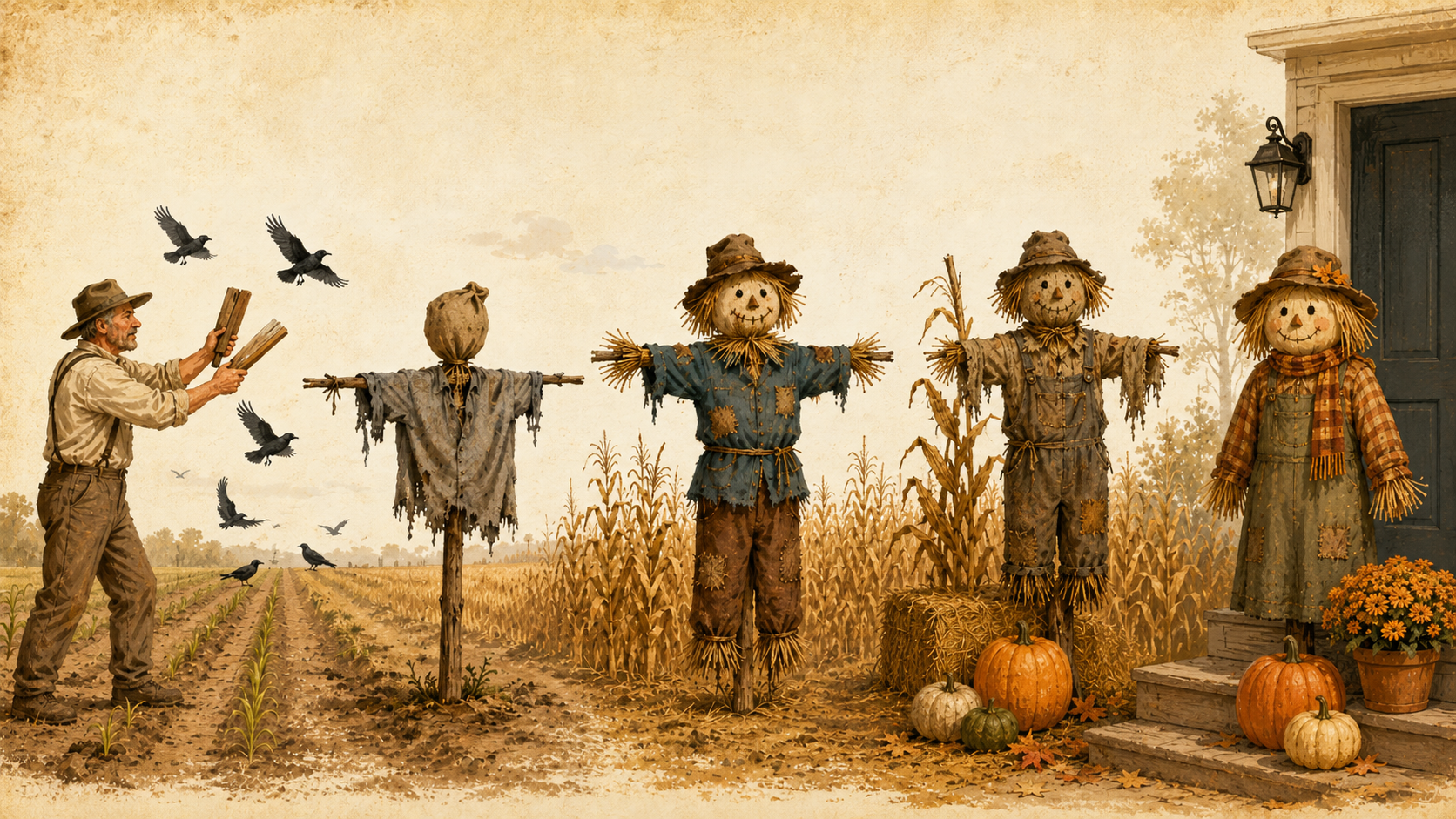
Put a scarecrow beside a pumpkin, a bundle of cornstalks and a few mums and nobody has to ask what season it is.
It is fall.
Which is a little strange when you think about it.
Scarecrows were not invented to decorate porches in October. They were working farm tools meant to keep hungry birds away from seeds and crops. Depending on what was growing, that job could begin long before autumn arrived.
So how did a practical bird-scarer become one of the most familiar symbols of fall?
The Short Answer
Scarecrows became associated with fall gradually.
They were already a familiar part of the farm landscape, particularly around fields and crops that eventually led to harvest. As the old-fashioned scarecrow became less important as an actual method of controlling birds, its image stayed behind.
Cornfields, straw, harvested crops, pumpkins and scarecrows became part of the same visual language of harvest. Eventually, the scarecrow could leave the field entirely and still mean the same thing.
Put one on a front porch in October and our brains fill in the rest.
A Real Scarecrow Had a Job
The basic idea behind a scarecrow is exactly what the name suggests: frighten birds away from something you wanted to eat yourself. But that didn’t make scarecrows strictly an autumn tool.
Birds can damage crops at different stages of the growing season. Some will dig up newly planted seed. Others become a problem when corn, berries, grapes or fruit begin to ripen.

Modern agricultural advice still reflects that problem. Bird deterrents are most useful when they are put in place when a particular crop becomes vulnerable, rather than simply standing in a field all year. Birds can also become accustomed to something that never actually threatens them.
So depending on the crop, a scarecrow might have had work to do in spring, summer or close to harvest. And we actually have photographic proof that the old-fashioned scarecrow wasn’t waiting around for October.
In May 1938, Farm Security Administration photographer John Vachon photographed a scarecrow standing in a field in Irwin County, Georgia. The photograph is preserved by the Library of Congress.
A real working scarecrow was part of the growing season. The fall scarecrow came later.
Before the Fake Person, There Was Sometimes a Real One
This may be the strangest part of the scarecrow story.
Originally, “scarecrow” did not necessarily mean a stuffed figure at all.
The word appears in English in the mid-1500s, and its earliest known use referred to a person employed to scare birds. By the late 1500s, the word was also being used for the human-shaped figure placed in a field.
And bird-scaring wasn’t always an occasional chore.
It could be a job.
In Victorian Britain, children were employed as bird scarers and sent into farm fields to keep birds from eating seed and crops. They might shout, chase birds, throw things or use a wooden clapper to make enough noise to send them elsewhere.
Some worked from dawn until dusk, outdoors in whatever weather happened to arrive, for only a few pence. Imagine spending an entire day standing watch over a field because every crow that landed represented a little bit of the crop disappearing.
Suddenly the stuffed figure makes much more sense.
If the purpose was to convince a bird that somebody was standing in the field, why not build somebody who never needed lunch, never went home and never complained about the rain? Old clothes created a human outline. Loose sleeves moved in the breeze. Whatever material was handy could fill out the body.
The scarecrow was, in a way, an extremely low-tech replacement worker.
Unfortunately, the birds eventually figured that out too.
Did Scarecrows Actually Work?
Sometimes. Just not forever.
Birds are capable of becoming accustomed to visual deterrents that remain in the same place and never pose an actual threat. Modern agricultural guidance still includes scarecrows and other visual devices among possible bird-control methods, but recommends movement, variety and changing tactics to delay that habituation.
Apparently a crow can eventually determine that the fellow in Grandpa’s shirt hasn’t moved in six days and probably isn’t much of a threat. That is why modern bird control looks considerably stranger than the traditional stick-and-straw version.
Farmers and growers may use reflective material, netting, noise devices, predator shapes, pyrotechnics, trained animals and even lasers. Researchers have even developed and tested laser “scarecrows” for protecting crops.
The job survived. The employee changed.
If Scarecrows Weren’t Just for Fall, Why Do They Mean Fall to Us?
This is where the story gets more interesting.
There does not seem to be one tidy historical moment when the working scarecrow became an official autumn decoration.
The evidence points instead to a gradual change.
The scarecrow had already become something people immediately recognized as belonging to the cultivated field and the farm. And toward the end of the growing season, many of the things surrounding it reached their most visually memorable stage at the same time.
Corn was tall and beginning to dry. Fields were mature. Harvest was underway. Straw, stalks and cut vegetation appeared. Pumpkins and other fall crops were coming in.
The scarecrow already belonged in that landscape.
So as the harvest itself became something Americans celebrated and decorated for, the scarecrow didn’t have very far to travel.
He was already standing there.
Somewhere Along the Way, We Learned What Fall Looks Like
This may be the biggest reason the scarecrow survived after farmers found better ways to frighten birds.
Seasonal symbols work through repetition.
You see the same things together often enough and eventually one can summon the others. A scarecrow doesn’t just look like a stuffed person in old clothes anymore. For many of us, it brings other things with it. Dry cornstalks. Pumpkins. Hay. Brown fields. Leaves underfoot. Cooler mornings. Farm stands. Harvest displays. Maybe even the smell of woodsmoke or the sound of dry leaves moving across the yard.
The scarecrow became a visual trigger for the season.
That helps explain something the practical history alone doesn’t: why we kept the scarecrow after we stopped needing him so much.
By the time better bird-control methods came along, the old-fashioned scarecrow had another job.
He reminded us of harvest.
Eventually, he was no longer out standing in his field.
From the Field to the Front Porch
Today’s fall scarecrow often doesn’t look particularly capable of frightening anything.
He smiles.
He sits on a hay bale.
He wears overalls and a floppy hat.
Sometimes he has rosy cheeks.
Modern fall festivals hold scarecrow-building contests in which families, schools, businesses and community groups create characters that are funny, elaborate, historical or downright adorable. Scarecrow festivals have become established autumn events in communities around the country.
That cheerful figure is a long way from a Victorian child standing in a cold field banging a wooden clapper.
But not every scarecrow got friendlier.
There has always been something a little unsettling about a human-shaped figure standing perfectly still in an empty field. In daylight, the old clothes and outstretched arms can say harvest. Put the same figure in a dark field, let a loose sleeve move in the wind, and suddenly the mind starts wondering whether it moved at all.
Books, movies and Halloween displays have made good use of that darker side. The scarecrow ended up with an unusual advantage as a fall symbol: he belongs just as comfortably to the harvest season as he does to the spooky one.
He can sit smiling beside the pumpkins all afternoon and look considerably less friendly after sunset.
That may be one more reason the scarecrow became so firmly rooted in autumn. Fall gave him two roles to play. We kept the old clothes, the outstretched arms and the vaguely human shape.
Sometimes we made him charming.
Sometimes we remembered that his original job was to be frightening.
Are Traditional Scarecrows Still Used?
They are, especially in gardens and small growing areas, but the traditional stuffed figure is only one option among many.
Modern wildlife-management guidance still includes human-shaped effigies and other visual frightening devices, while farmers and researchers continue experimenting with ways to make bird deterrents harder for birds to ignore.
So the scarecrow never completely lost his original occupation. He just has considerably more competition now.
And while lasers, reflective tape and predator kites may be better suited to keeping birds out of a crop, none of them has managed to replace the straw fellow beside the pumpkins.
Probably because by then it was no longer about the birds.
Why the Scarecrow Stayed
A working scarecrow belonged to many parts of the growing season, not just autumn. But the image of one became tangled up with the sights of harvest until separating them hardly mattered. That is why a scarecrow can sit on a suburban porch today, miles from the nearest cornfield, and still make perfect sense.
We aren’t really decorating with an old piece of bird-control equipment. We’re decorating with a memory of the harvest landscape.
The scarecrow may have started as a way to fool birds. But somewhere along the way, it picked up a second job entirely by accident.
It taught us what fall looks like.
Discover more from A Little Off the Ordinary
Subscribe to get the latest posts sent to your email.