
There are certain things that seem as though they have simply always belonged to fall.
Leaves turn. Apples ripen. Someone puts a pumpkin on a porch. And somewhere in New England, you walk into an orchard or farm stand and get hit with the smell of warm apple cider doughnuts covered in cinnamon sugar.
It feels old. Really old.
The sort of tradition you could easily imagine somebody’s great-great-grandmother making after the apple harvest while the kids hauled baskets into the barn.
The truth is a little more complicated.
Apple cider doughnuts do have some history behind them, but the fall tradition we recognize today owes quite a bit to doughnut machines, automobiles, roadside farm stands and some very deliberate marketing.
Cider Doughnuts Were Around Before the 1950s
One of the earliest known newspaper references turns up in 1901.
A Buffalo newspaper mentioned cider doughnuts as part of the refreshments for a Halloween gathering. That tells us people were eating them well before the mid-century orchard version became familiar.
What it does not tell us is exactly who invented the cider doughnut or when the first one was fried.
That part of the story is frustratingly fuzzy.
Both halves of the equation were already old. Apples and cider had been important in American life for generations, particularly in apple-growing areas such as New England. Fried cakes and doughnuts had long histories of their own.
Putting cider into doughnut batter was hardly an impossible leap.
But making a few at home and turning them into something thousands of people expect to buy every October are two different things.
And that second part of the story gets interesting.
Then Along Came the Doughnut Machine
In 1921, businessman Adolph Levitt developed an automatic doughnut-making machine.
Instead of somebody rolling dough, cutting individual doughnuts and tending them by hand in hot fat, the machine could drop batter into the oil, move the doughnuts along, flip them and send finished doughnuts out the other end.
Anyone who has stood at an orchard watching a line of little doughnuts float through hot oil already knows the appeal.
You watch one.
Then another.
Then suddenly you have apparently spent five minutes staring at doughnuts being born.
Levitt eventually built a much larger business around doughnuts, including commercial mixes and the Doughnut Corporation of America.
At roughly the same time, Americans were taking to the road in greater numbers.
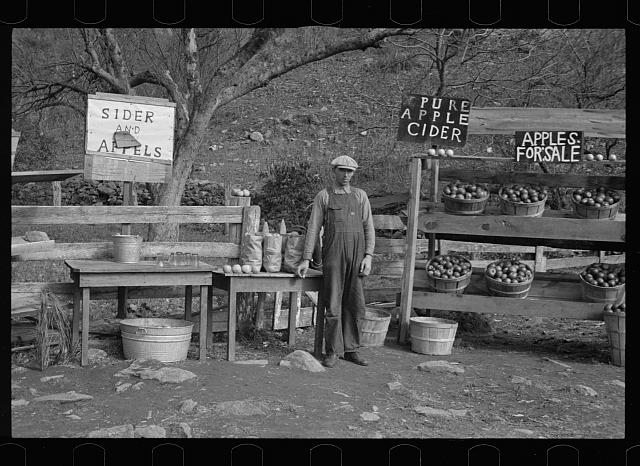
Sunday drives became entertainment. Families traveled outside cities. Roadside stands and farms had a new stream of potential customers arriving by automobile.
Food historian Michael Krondl has described the rise of cider and doughnuts at farm stands as a meeting of automobiles, automation and advertising.
That combination makes a surprising amount of sense.
Farm stands already had apples and cider.
The doughnut machine provided something hot, inexpensive and irresistible to sell alongside them.
And motorists provided the customers.
In 1951, Somebody Saw Fall Written All Over It
This is where the modern cider doughnut really begins to look familiar.
In August 1951, the Doughnut Corporation of America announced that it would introduce a new product during its annual fall sales campaign: the Sweet Cider Doughnut.
A New York Times report described it as a spicy cake doughnut expected to have a “natural fall appeal.”
They certainly got that part right.
The company had not necessarily invented the idea of putting cider in a doughnut—remember that 1901 reference—but it did deliberately promote the cider doughnut as something that belonged to autumn.
In other words, somebody looked at a doughnut flavored with apple cider and essentially said:
We can sell fall with this.
And we have been cooperating enthusiastically ever since.
The Orchard Made It More Than a Marketing Idea

Marketing alone probably would not have been enough.
The cider doughnut landed in exactly the right place.
At an orchard in September or October, you already have apples piled in baskets, jugs of cider, cool air, changing leaves and people who made a special trip specifically because it is fall.
Then somebody hands you a warm doughnut.
That is a pretty difficult experience for a packaged snack to compete with.
Across New England and other apple-growing regions, cider doughnuts became closely tied to orchards, cider mills and farm stands. Some farms have now been making them for generations, and families return to the same places year after year.
So although the widespread tradition may be newer than it feels, the memories attached to it are completely real.
For plenty of people, the smell of a fresh cider doughnut now means fall just as surely as wood smoke or fallen leaves.
And Yes, the Cider Actually Does Something
Apple cider in the batter is not there just so we can put the word apple on a sign.
Cider adds moisture and some acidity to a cake-style doughnut, helping give it that tender texture. Cinnamon, nutmeg and other warm spices usually do much of the heavy lifting when it comes to the familiar fall flavor.
Then comes the cinnamon sugar.
Preferably while the doughnut is still warm.
There are probably laws somewhere against eating a cold cider doughnut while a warm one is available.
If not, there should be.
A Tradition Can Be Real Without Being Ancient
That may be my favorite part of the cider doughnut story.
We tend to imagine traditions as things handed down unchanged for hundreds of years.
Sometimes they are.
Sometimes a tradition comes together because somebody invents a machine, more people buy automobiles, roadside farm stands become destinations, a doughnut company spots a seasonal marketing opportunity, and everybody collectively decides that the result is delicious.
The apple cider doughnut did not need to come over on the Mayflower to earn its place in fall.
It just needed apples, hot oil, cinnamon sugar and enough years for families to start saying, “Let’s go pick apples—they have the best doughnuts there.”
And that may be how a tradition really takes hold.
A little fresh air, a bag of apples in the back seat, and a warm cider doughnut to enjoy in the car on the way home.
That seems like fall to me.
For More Information
Smithsonian — “Sweet Cider Donuts”
Smithsonian — Sweet Cider Donuts
New Hampshire Public Radio/NPR — “Donuts and Apple Cider: An Autumn Marriage Made by Autos and Automation”
NHPR/NPR — Donuts and Apple Cider
Smithsonian National Museum of American History
Smithsonian — Sally Levitt Steinberg Collection
Discover more from A Little Off the Ordinary
Subscribe to get the latest posts sent to your email.