
Look at enough old Thanksgiving menus and something strange starts happening.
Turkey? Of course.
Mashed potatoes? Naturally.
Cranberry sauce? We expected that.
But then, over and over again:
Celery. Olives. Pickles.
Sometimes the celery gets its own line on the menu. The olives do too, as though a few stalks of celery and a little dish of olives deserved the same billing as the turkey.
And if you grew up with one of these Thanksgiving tables, none of this may seem strange at all.
When I started looking at the old menus, I had to laugh. I knew these dishes. This wasn’t some forgotten Victorian feast.
This was Thanksgiving.
So why were celery and olives such a big deal?
Yes, They Really Were on Thanksgiving Menus
This wasn’t just something one grandmother decided to do.
Historical Thanksgiving menus repeatedly list celery and olives among the foods served with the holiday meal.
A Thanksgiving dinner menu from around 1900–1901 for the Royal Limited train included celery, salted almonds, and Queen olives before moving on to the rest of the meal.
And old Thanksgiving menus from the late 1800s well into the 20th century keep showing the same combination.
So if you remember the little dish of olives or stalks of celery appearing every Thanksgiving whether anyone asked for them or not, there was a much bigger tradition behind it.
Believe It or Not, Celery Used to Be Fancy
Today celery is the vegetable we buy for stuffing, soup, or because we have convinced ourselves we’ll eat it with dip.
In the 1800s, it had considerably better public relations.
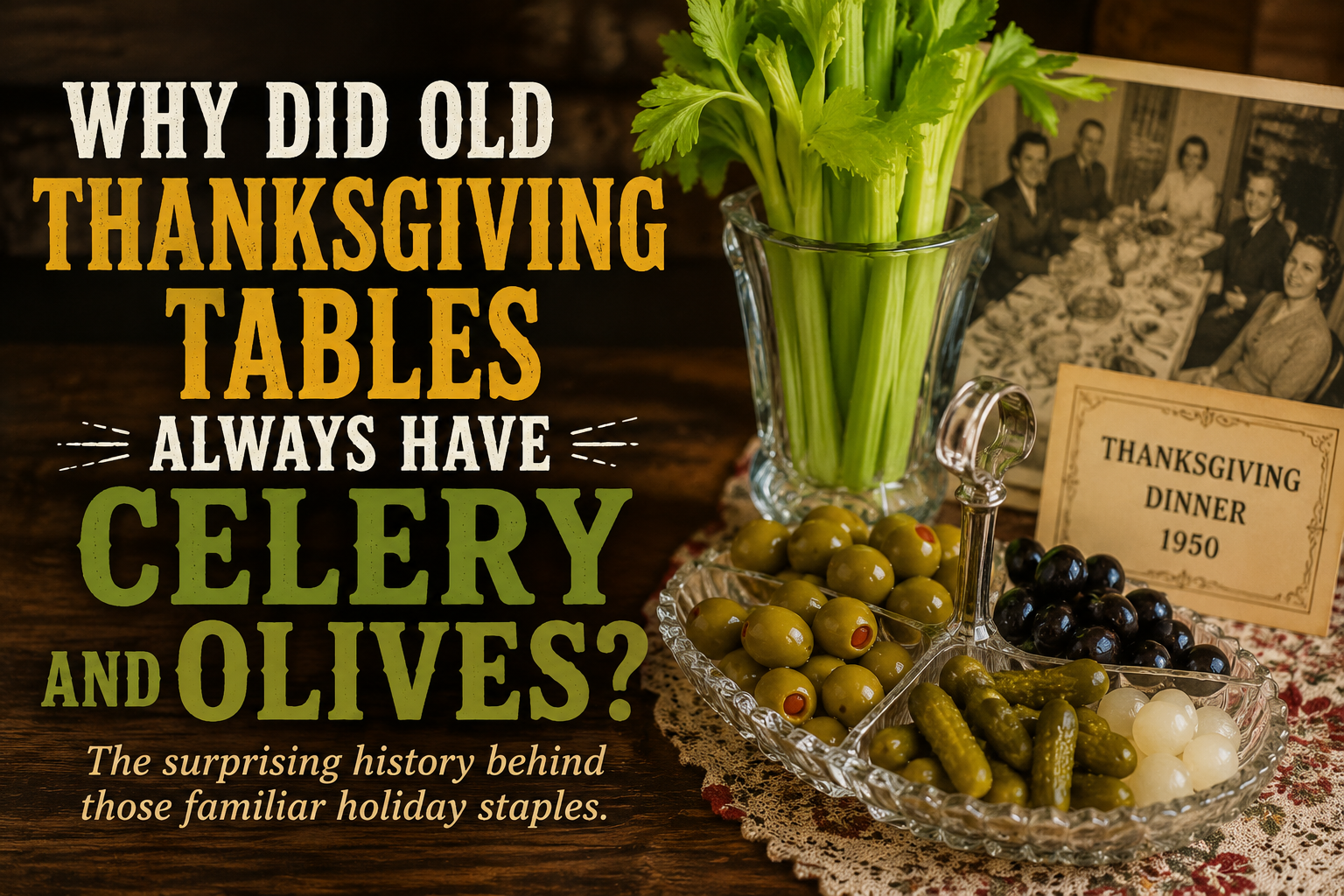
Celery was once considered an elegant vegetable. Special tall glass serving pieces called celery glasses or celery vases were made specifically to display it.
The celery was placed upright in the vase, often with cold water at the bottom, with the leafy tops sticking out like a bouquet.
Yes.
People once put celery in a vase and showed it off.
Celery vases could even serve as symbols of wealth and good taste. Some were elaborate pieces of decorated glass that looked far more important than anything currently holding celery in my refrigerator.
Celery Was Also Perfectly Timed for Thanksgiving
There was another reason celery fit so naturally onto the holiday table.
It was seasonal.
Fresh celery traditionally arrived in markets in the fall, with November and December falling right in its prime season.
That meant Thanksgiving happened when fresh, crisp celery was readily available.
Long before grocery stores carried virtually every vegetable twelve months a year, seasonality helped decide what appeared at a celebration.
Celery was available, fashionable, crisp, and considered suitable for a good dinner.
Thanksgiving practically handed it an invitation.
But Why the Olives?
Celery wasn’t usually sitting there alone.
Olives, pickles, radishes, and other sharp or crisp foods belonged to a category called relishes.
This did not mean the chopped green stuff we put on a hot dog.
A relish course could include small portions of pickled, salty, crisp, or tart foods intended to accompany a large meal.
By the late 1800s, celery and olives were commonly grouped among these little cold accompaniments.
So that little bowl of olives wasn’t random.
It was the surviving descendant of a much more formal style of dining.
And Then Came the Relish Tray
As celery became cheaper and available throughout the year, it lost some of its fancy reputation.
Nobody was going to impress the neighbors by producing a stalk of celery anymore.
But celery and olives didn’t disappear.
Instead, they migrated onto the relish tray.
By the mid-20th century, holiday and party tables often included a divided glass dish filled with some combination of:
- celery sticks
- green olives
- black olives
- pickles
- radishes
- carrot sticks
- pickled onions
- stuffed celery
And suddenly we’ve arrived at a Thanksgiving table a lot of us actually recognize.
The fancy Victorian celery vase was gone.
Grandma had the divided glass dish.
By the 1970s, It Was Also the Pre-Dinner Snack
By the 1960s and 1970s, the relish tray had become less formal in many homes.
It wasn’t necessarily something everyone politely waited to eat with dinner.
It was what came out while the turkey was still cooking and people were beginning to ask how much longer it was going to take.
There might be bowls of mixed nuts, green and black olives, little pickles, carrot sticks, and celery.
And sometimes the celery had been upgraded.
Stuffed celery had been around for decades, including early versions filled with Roquefort cheese. Later cooks used cream cheese, blue-cheese spreads, chopped olives, nuts, or whatever mixture had become traditional in their own family.
By the 1970s, jarred cheese spreads made the whole thing even easier.
A stalk of celery filled with Roquefort or blue-cheese spread, a handful of nuts, and a bowl of olives could keep everyone occupied while dinner finished cooking.
At least for a little while.
Did the Charcuterie Board Replace the Relish Tray?
Not exactly.
But it certainly feels like a close relative.
Today’s charcuterie board often does much the same job the old relish tray did.
It appears before the meal. People stand around it talking and picking at little bites while someone is still in the kitchen trying to get everything else onto the table at the same time.
Instead of celery, olives, and pickles lined up in a divided glass dish, today’s board may have cured meats, cheeses, crackers, nuts, fruit, preserves, fancy olives, and pickled vegetables arranged across a wooden board.
The ingredients changed.
The presentation got considerably more photogenic.
But the basic idea is very familiar:
Give everybody something to nibble on while dinner finishes cooking.
Grandma had the relish tray.
We have the charcuterie board.
Why Did the Old Tradition Fade?
Part of the answer may simply be that celery stopped being special.
Modern farming, refrigeration, and transportation made it available year-round. What had once been a seasonal delicacy gradually became an ordinary grocery-store vegetable.
Holiday menus changed too.
New appetizers appeared. Cheese trays, vegetable platters, dips, and eventually charcuterie boards took over some of the job once handled by the humble relish tray.
And somewhere along the way, the obligatory bowl of olives stopped appearing on quite so many Thanksgiving tables.
But it didn’t disappear everywhere.
There are still families where somebody puts out the olives and celery because Thanksgiving would look strangely incomplete without them.
Nobody necessarily knows why.
It’s just what you do.
Grandma Wasn’t Just Filling Space on the Table
That’s probably my favorite part of this whole story.
Something that can look almost comically simple today — a few stalks of celery and a dish of olives — actually carries more than a century of American holiday dining behind it.
The celery began as something seasonal and fashionable enough to display in special glassware.
The olives belonged to the relishes served alongside formal dinners.
Eventually both survived together on the divided relish trays many families remember from Thanksgiving, Christmas, and other big family meals.
Then the relish tray became part appetizer, part snack, and part way of keeping everybody out of the kitchen until dinner was ready.
Today we may accomplish the same thing with a charcuterie board.
Different tray.
Much fancier name.
Same basic problem.
So the next time you see an old Thanksgiving photograph and wonder why there’s celery sitting proudly beside a turkey that took half the day to cook, give it a little respect.
There was a time when the celery thought it was the fancy one.
Discover more from A Little Off the Ordinary
Subscribe to get the latest posts sent to your email.