
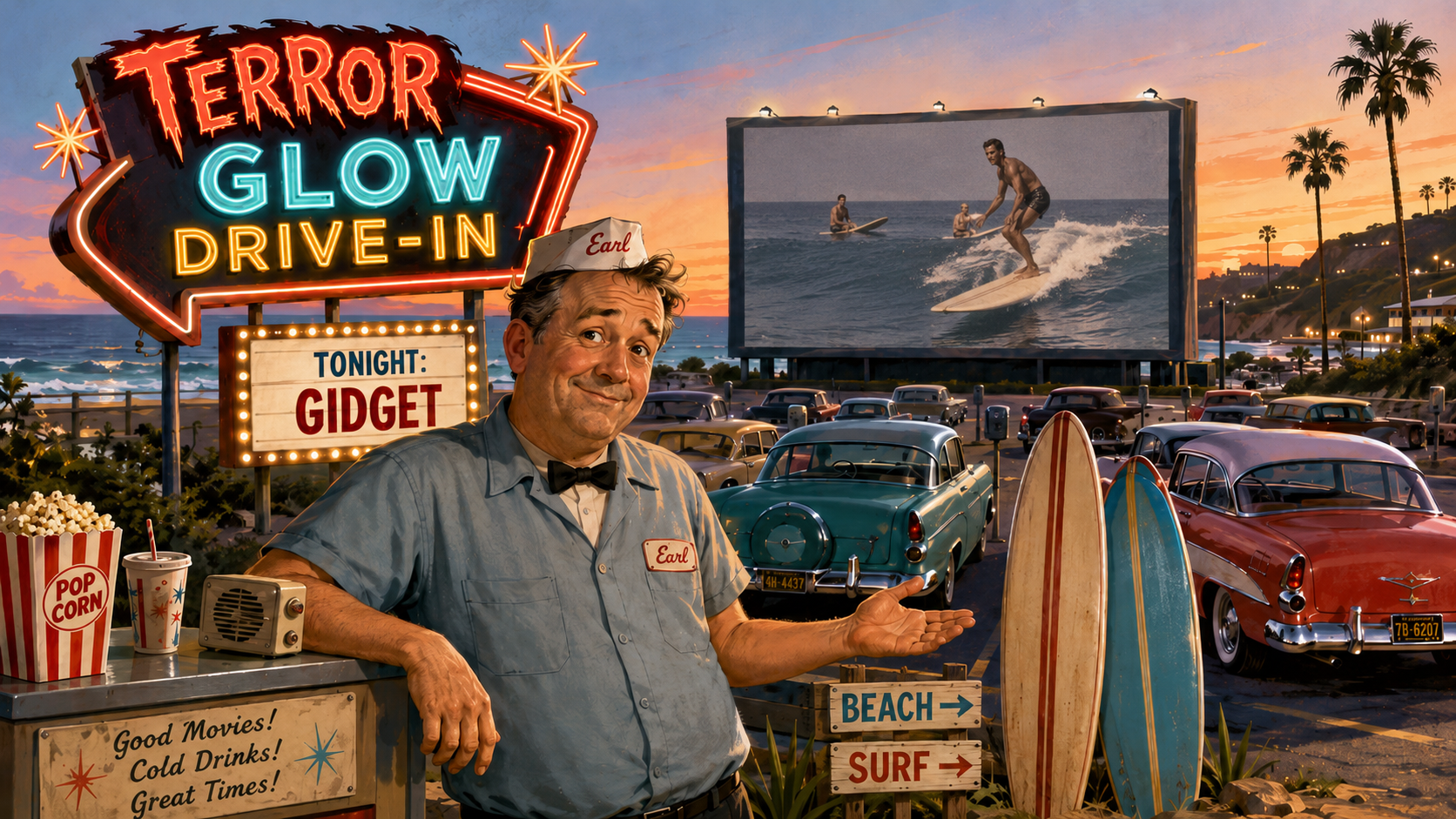
Earl has put away the bug spray.
The giant ants are gone. The mutant crabs have been returned to whatever radioactive tide pool they crawled out of. And for one Friday night at the Terror Glow Drive-In, absolutely nothing is planning to eat the customers.
It’s August. It’s hot.
Earl wants a beach picture.
So tonight the marquee belongs to Gidget, the 1959 sun-and-surf movie starring Sandra Dee, James Darren and Cliff Robertson.
Yes. Gidget.
Don’t question Earl. He runs the projector.
The Earl Rating
Feature: Gidget
Year: 1959
Best watched: On a hot August night with the windows down and something cold from the snack bar
Scare level: 0 out of 5
1950s cheese: 3½ out of 5
Surf-and-sun satisfaction: 4½ out of 5
So What Is Gidget About?
Francie Lawrence is nearly seventeen, more interested in swimming than chasing boys, and not particularly bothered by the fact that her girlfriends think this is a crisis requiring immediate attention.
Then she goes to the beach.
After surfer Moondoggie rescues her from some kelp and brings her back to shore on his surfboard, Francie discovers something far more interesting than the boyfriend hunt her friends had planned:
Surfing.
She wants a board. She wants to learn. And she intends to work her way into the group of surfers who initially see the tiny newcomer as something between a nuisance and a mascot.
They give her the nickname “Gidget” — a combination of “girl” and “midget” — and before long she is spending her summer trying to master the waves while also becoming increasingly interested in Moondoggie.
Naturally, this being 1959, things cannot remain as simple as a girl discovering a sport she loves.
There must be romance. There must be jealousy. There must be parental concern. And eventually there must be a beach party where several people make questionable decisions.
Earl considers this perfectly acceptable. Nobody has grown claws yet.
The Surprise Is That Gidget Is Actually Pretty Good
It would be easy to remember Gidget as ninety-five minutes of Sandra Dee being adorable on a beach. There is certainly plenty of that. But the movie has more going on than its reputation suggests.
Sandra Dee makes Francie likable because she doesn’t begin the movie desperately hunting for a boyfriend. In fact, she would rather get into the water. Her fascination with surfing feels genuine, and watching her stubbornly work her way into a group that initially doesn’t take her seriously gives the movie its best stretch.
The romance eventually takes over, but surfing gets there first.
And then there is Cliff Robertson as Kahoona.
Kahoona is the older surfer the younger guys admire — the man who has apparently escaped ordinary adulthood to chase waves instead. But the movie gradually makes it clear that his carefree existence isn’t quite as carefree as it looks.
The American Film Institute’s synopsis identifies Kahoona as a Korean War veteran who became disenchanted with ordinary rules and expectations after flying fighter planes during the war. That gives what could have been a stock “beach bum” character considerably more weight.
Suddenly Gidget isn’t entirely about who gets the girl.
There’s also a quiet argument going on about growing up, responsibility and whether dropping out of ordinary life really makes you free.
That was not what Earl expected when he ordered the print.
And This Beach Was About to Get Very Crowded
Gidget arrived in April 1959, before Frankie Avalon and Annette Funicello started throwing the beach parties most people now associate with 1960s beach movies.
The movie was based on Frederick Kohner’s 1957 novel Gidget. More interestingly, Kohner based the character on his own teenage daughter, Kathy, whose experiences around Malibu’s surfing crowd gave him the material for the story.
Kathy Kohner really did learn to surf as a teenager in the 1950s and really did earn the nickname Gidget from the Malibu surfers.
Her story — and the books and screen adaptations that followed — helped introduce surfing to a much larger audience, including girls and women who had rarely seen themselves represented in the sport.
That popularity wasn’t welcomed by everyone.
Some surfers later resented the attention Gidget brought to their world, believing the sudden popularity helped turn surfing from their comparatively small subculture into a mainstream craze.
Which means this cheerful little Sandra Dee movie caused approximately the worst possible thing to happen to people who had found a great uncrowded beach:
Everybody else found out about it.
Earl understands. He once advertised fifty-cent popcorn. He still regrets it.
A Little Music for the Parking Lot
Gidget didn’t just help sell surfing. It came with music aimed squarely at the same teenage audience.
James Darren, already playing Moondoggie, sang the movie’s title song, “Gidget.”Released as a single in 1959, it climbed to No. 42 on Billboard’s Hot 100 — not exactly Mack the Knife, but enough to give Darren a real foothold as a recording artist.
He also sings “The Next Best Thing to Love” in the movie, and The Four Preps turn up as themselves, adding still more late-1950s teen-pop credentials to the beach party.
Then Columbia brought in someone who knew a thing or two about what teenagers were listening to: Dick Clark.
The American Bandstand host endorsed Gidget, and Columbia even used Clark to introduce a promotional trailer for the film. Contemporary theater promotion regarded his endorsement as a major selling point. Which makes sense.
If you were trying to fill a drive-in with teenagers in 1959, having Dick Clark tell them your movie was worth seeing was considerably better than Earl standing under the marquee waving at passing cars.
Although Earl would have tried.
Does Gidget Hold Up?
Mostly — provided you arrive prepared for 1959.
Some of the attitudes toward girls, dating and what supposedly makes someone a “real woman” have aged about as gracefully as a carton of milk left in the snack-bar window.
There are also moments when Francie’s determination to prove she is grown-up leads the story into territory that feels considerably more uncomfortable now, particularly when an older man is involved.
But underneath those dated pieces is a surprisingly recognizable teenager.
Francie wants to belong without admitting how badly she wants to belong. She gets embarrassed. She makes dumb decisions. She develops a crush. She tries too hard to look sophisticated. She worries that everybody else has somehow received instructions for growing up that were never delivered to her house.
That part hasn’t aged much at all. And Sandra Dee carries it.
This was Dee’s first starring role, and Columbia borrowed her from Universal-International for the picture. She would quickly become one of the most recognizable teenage stars of the period.
James Darren has the necessary Moondoggie charm, but Robertson may be the one who sneaks up on you. Kahoona gives the movie a slightly melancholy edge that keeps all the surfboards, songs and teenage scheming from becoming pure fluff.
The 1950s Cheese Report
Oh, there is cheese.
His name is Moondoggie. We could probably stop there.
There are surfers with names including Stinky, Hot Shot, Lover Boy and Waikiki. Teenagers speak in carefully packaged surfer slang. Gidget even practices surfing by jumping around on her mattress while recovering from tonsillitis. It is impossible to watch some of this without smiling.
But Gidget never becomes the full-blown beach-party madness that would come later. This is still 1959. The genre hasn’t yet discovered how many bikinis, motorcycles, musical numbers and increasingly ridiculous plots can be squeezed onto one stretch of sand.
Gidget is standing near the beginning of all that. The beach is still relatively quiet.
Enjoy it while you can.
Earl’s Verdict
Earl booked Gidget because even the Terror Glow Drive – In needs one night when nothing is trying to destroy civilization.
Good call.
It’s light, summery and occasionally ridiculous, but there is enough underneath the suntan oil to make it interesting sixty-seven years later. Sandra Dee is charming, Cliff Robertson gives the movie more depth than expected, and the surfing footage makes the whole thing feel like exactly the movie you should be watching during the last stretch of August.
More importantly, Gidget captures the moment just before surfing and beach culture exploded across American popular culture.
So park the car. Clip the speaker onto the window. Get something cold from the snack bar.
And enjoy the ocean while it lasts. Next Friday, we’re heading inland.
Sources
American Film Institute Catalog — Gidget (1959)
https://catalog.afi.com/Catalog/moviedetails/52896
TIME — The Real-Life Gidget Reflects on Women in Surf History
https://time.com/4361986/international-surfing-day-2016-gidget/